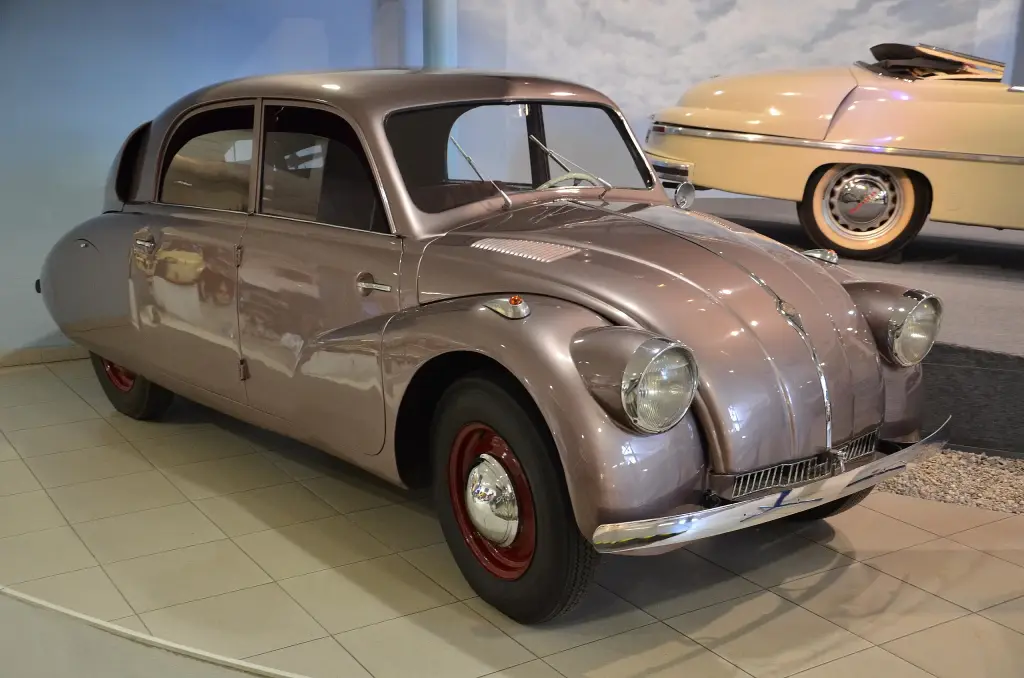
The Tatra 97 is a Czechoslovak mid-size car built by Tatra in Kopřivnice from 1936 to 1939. It complemented the full-size Tatra 77 and Tatra 87 as a smaller aerodynamic saloon with a rear air-cooled engine, and its resemblance to the Volkswagen KdF-Wagen led to a lawsuit that Volkswagen settled in 1965.
Tatra 97 at a glance
| Maker | Tatra, Kopřivnice, Czechoslovakia |
|---|---|
| Production | 1936–1939 |
| Engine | rear-mounted 1,759 cc air-cooled flat four |
| Power | 40 hp (30 kW) |
| Top speed | 130 km/h |
| Body | aerodynamic fastback four-door sedan |
| Headlamps | two, with a one-piece windscreen |
| Built | 508 |
| Production ended | 1939, after the annexation of the Sudetenland |
| Settlement | Volkswagen paid Tatra DM 1,000,000 in 1965 |
History of the Tatra 97
Place in the range
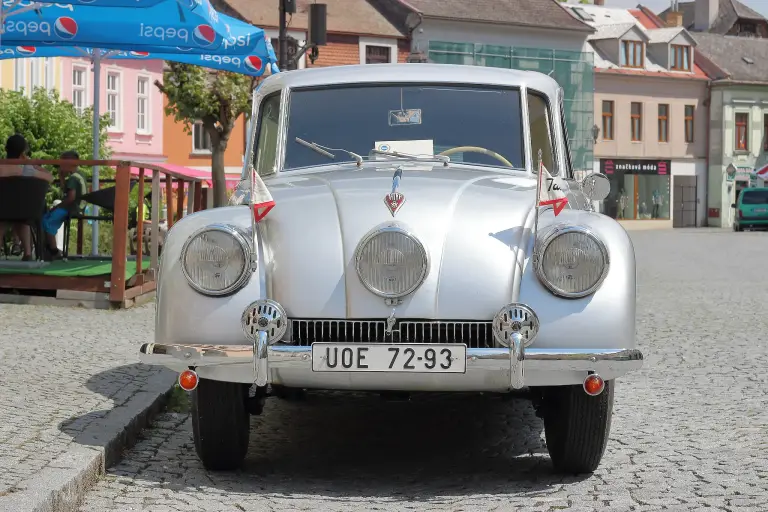
The Tatra 97 was designed to complement two full-size cars in the Tatra range: the Tatra 77 of 1934 and the Tatra 87 of 1936, which appeared together with the Type 97. All three had an air-cooled rear engine and similar aerodynamic fastback four-door bodies, but while the 77 and 87 had large V8 engines, the Type 97 used a flat four. It is distinguished by two headlights and a one-piece windscreen, where the 77 and 87 have three headlights and a three-piece windscreen.
Engine and production
The flat-four engine displaced 1,759 cc and produced 40 hp, giving a top speed of 130 km/h. Tatra already had a mid-size car in the same class, the more conventional 1,688 cc Tatra 75 of 1933, and continued to build the 75 alongside the futuristic 97; production of the 75 actually outlived that of the 97 and continued until 1942. Kopřivnice lies in northern Moravia, which Nazi Germany annexed after the Munich Agreement in September 1938, and production of the Type 97 ended in 1939, possibly to avoid comparison with the KdF-Wagen. In total 508 cars were built. In 1946 Tatra resumed car production and replaced the Type 97 with the larger, more modern Tatra 600 Tatraplan.
The Volkswagen resemblance
According to some authors the Type 97 strongly resembles the Volkswagen KdF-Wagen in its streamlined design and technical specification, especially the engine design and position. The Tatra 97 itself, however, does not appear entirely original, since it resembles sketches by the Hungarian engineer Béla Barényi conceived in the 1920s and published in 1934. Adolf Hitler is reported to have said of Tatra’s cars: “This is the car for my roads.” Ferdinand Porsche was accused of using Tatra designs to create the Volkswagen quickly and cheaply, and said: “Well, sometimes Ledwinka looked over my shoulder and sometimes I looked over his.” Tatra sued Porsche for damages and Porsche was willing to settle, but Hitler cancelled the settlement, saying he “would settle the matter”. Soon after Germany occupied the Sudetenland, Tatra stopped production of the Type 97 and the lawsuit was discontinued. After the Second World War Tatra resumed the case, and in 1965 Volkswagen settled it by paying Tatra DM 1,000,000.
Design and features
- Aerodynamic fastback: the same streamlined family as the Tatra 77 and 87.
- Rear flat four: 1,759 cc and 40 hp for a 130 km/h top speed.
- Two headlights: a one-piece windscreen, unlike the three-lamp V8 cars.
- Beetle connection: the resemblance behind Tatra’s lawsuit against Porsche.
Tatra 97 versions
- Tatra 97: the standard four-door fastback saloon.
The 97 was the small sister of the Tatra 87 and the Tatra 77, and its ideas were continued by the Tatra 600 and the prototype Tatra V570. More cars are in the Tatra collection.
Sources
- Tatra 97, English Wikipedia: design, production, Volkswagen case