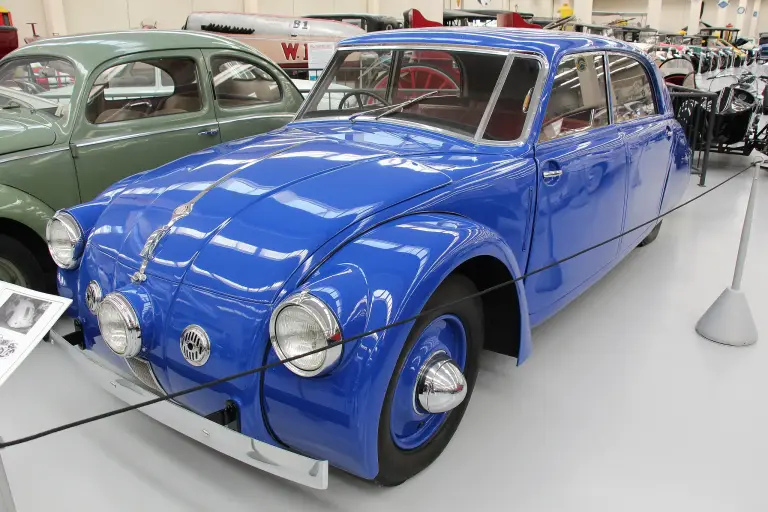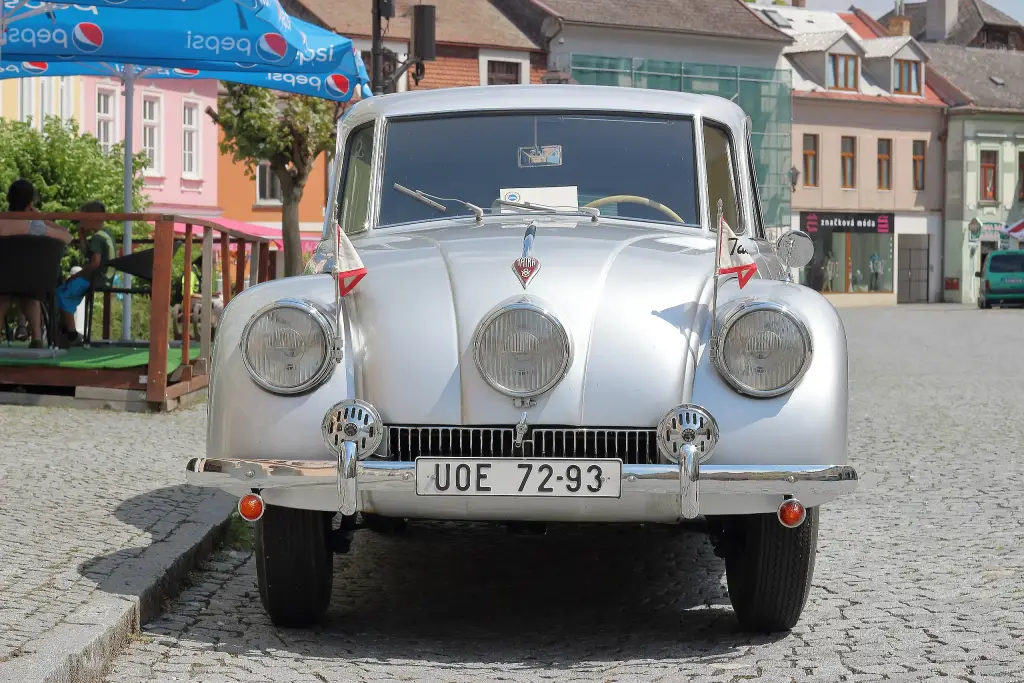
The Tatra 87 is a car built by the Czechoslovak manufacturer Tatra from 1936 to 1950. Powered by a rear-mounted 2.9-litre air-cooled 90-degree overhead-cam V8 producing 85 hp, it could reach nearly 160 km/h and ranks among the fastest production cars of its time, while using far less fuel than its rivals.
Tatra 87 at a glance
| Maker | Tatra, Kopřivnice, Czechoslovakia |
|---|---|
| Production | 1936–1950 |
| Designers | Hans Ledwinka, Erich Übelacker |
| Body inspiration | Paul Jaray, based on the Tatra 77 |
| Engine | rear-mounted 2.9-litre air-cooled V8 |
| Power | 85 hp |
| Top speed | nearly 160 km/h |
| Fuel consumption | 12.5 litres per 100 km |
| Drag coefficient | 0.36 (VW tunnel, 1979) |
| Doors | rear-hinged front doors, front-hinged rear doors |
| Postwar engines | 2.5-litre V8 T603 engine from 1950 to 1953 |
History of the Tatra 87
Aerodynamic bodywork
The Tatra 87 has unique bodywork. Its streamlined shape was designed by Hans Ledwinka and Erich Übelacker and was based on the Tatra 77, the first car designed with aerodynamics in mind, with body proposals from Paul Jaray, who had designed the famous German Graf Zeppelin airships. A fin in the sloping rear helps divide the air pressure on both sides of the car, a technique later used in aircraft. The T87 had a drag coefficient of 0.36 as tested in the VW tunnel in 1979, and a reading of 0.244 for a 1:5 model tested in 1941.
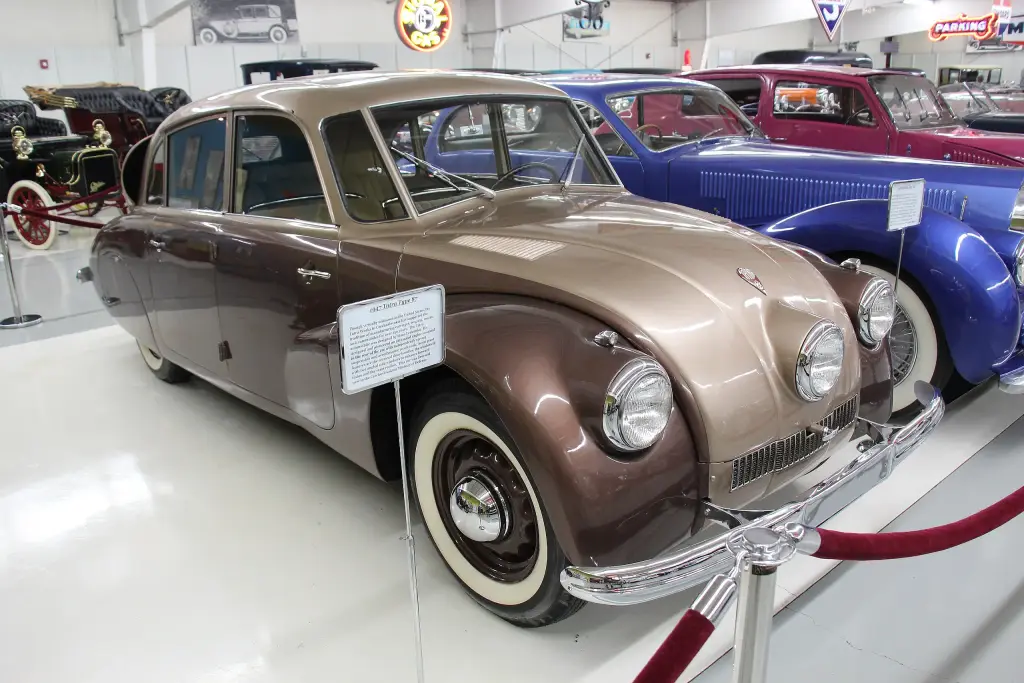
Small windows in the dividers between the passenger, luggage and engine compartments, plus louvres feeding the air-cooled engine, allowed only limited rear visibility. The entire rear segment could be opened to service the engine. The front doors are rear-hinged coach doors, sometimes called suicide doors, while the rear doors are front-hinged.
Performance and economy
The rear-mounted 2.9-litre air-cooled 90-degree overhead-cam V8 produced 85 hp and could drive the car at nearly 160 km/h, making it one of the fastest production cars of its time. Competing cars of the class used engines of almost twice the displacement and consumed about 20 litres per 100 km, while the aerodynamic T87 needed just 12.5 litres. Between 1950 and 1953, after the war, T87s were fitted with the more modern 2.5-litre V8 T603 engine.
Influence and owners
Many design elements of the Tatra 87, V570 and the later T97 were copied by other manufacturers. Ferdinand Porsche was heavily influenced by the T87 and T97 and by their flat-four engine when designing the Volkswagen Beetle, and was subsequently sued by Tatra. The car cost 25,000 Swiss francs new in the 1940s and is worth around $125,000 today; a 1941 Tatra 87 restored by Paul Greenstein and Dydia DeLyser of Los Angeles won a New York Times readers’ poll of collectors’ cars in 2010 against 651 competitors.
Owners included the designer Hans Ledwinka, the racing driver Eliška Junková, the aircraft designer Ernst Heinkel, the engine inventor Felix Wankel, the writers John Steinbeck and Vítězslav Nezval, the Egyptian king Farouk I, the Czechoslovak presidents Edvard Beneš, Klement Gottwald and Antonín Zápotocký, the architect Norman Foster and the comedian Jay Leno. German officers praised the car’s speed and handling on the Autobahn, and the armaments minister Fritz Todt called it “the Autobahn car”. The story that the German army banned officers from driving the T87 after fatal accidents is considered apocryphal; the order followed several non-fatal accidents. Hanzelka and Zikmund used a T87 for their journey through Africa and Latin America from 1947 to 1950.
Design and features
- Streamlined body: a drag coefficient of 0.36, with a rear fin.
- Air-cooled V8: 2.9 litres and 85 hp behind the rear axle.
- Speed with economy: nearly 160 km/h on 12.5 litres per 100 km.
- Beetle connection: an influence on Ferdinand Porsche’s design.
Tatra 87 versions
- T87 (1936–1950): the original 2.9-litre car.
- Postwar T87: fitted with the 2.5-litre T603 V8 from 1950 to 1953.
- Hanzelka and Zikmund car: the expedition example used in Africa and Latin America.
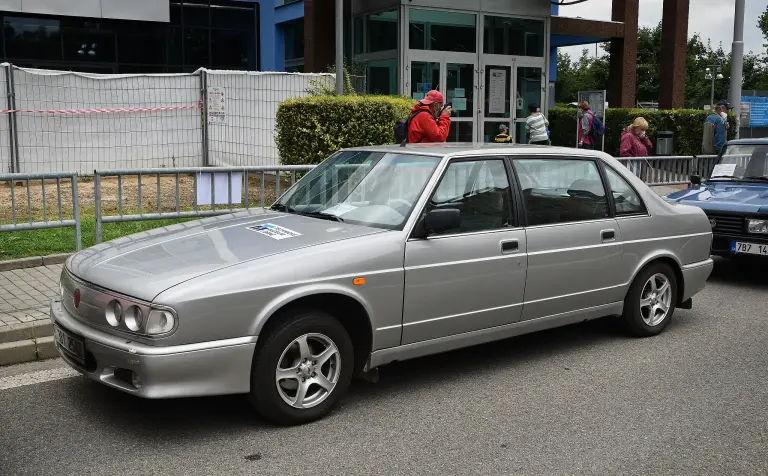
The 87 followed the Tatra 77 and was related to the small Tatra 97; its postwar successor was the Tatra 600. More cars are in the Tatra collection.
Video: Tatra T87 – Things of the Past
Video by Petrolicious on YouTube.
Sources
- Tatra 87, English Wikipedia: design, performance, influence, owners