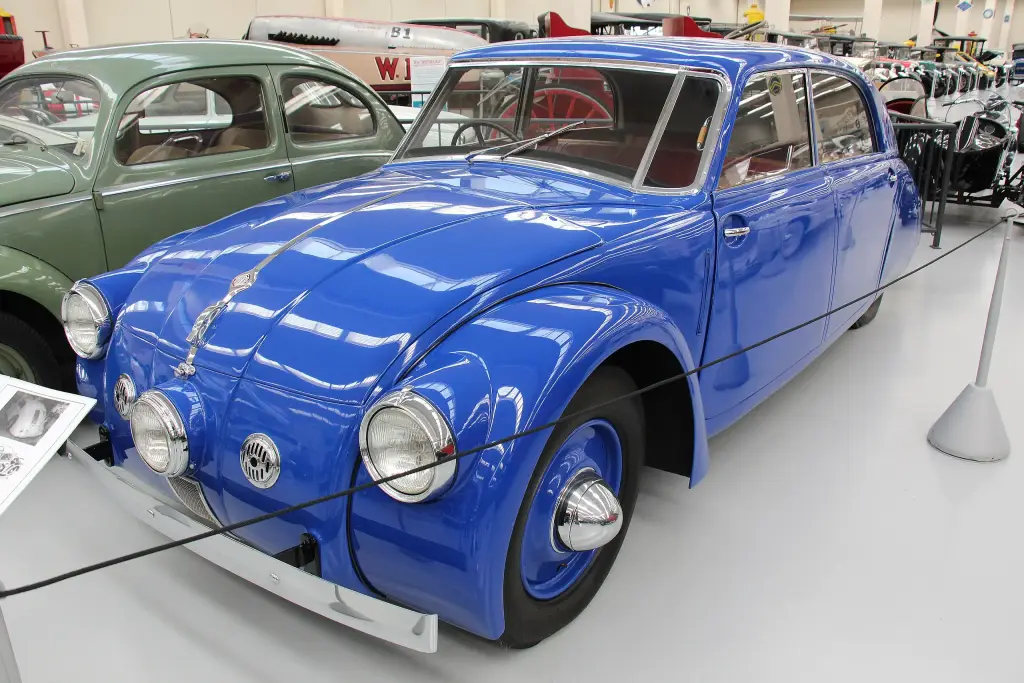
The Tatra 77 is one of the first serially produced automobiles with a truly aerodynamic design, built by the Czechoslovak company Tatra from 1934 to 1938. It was developed by Hans Ledwinka and the Zeppelin aerodynamic engineer Paul Jaray, and its rear-mounted air-cooled V8, streamlined body and advanced chassis made it a sensation at its launch.
Tatra 77 at a glance
| Maker | Tatra, Kopřivnice, Czechoslovakia |
|---|---|
| Production | 1934–1938 |
| Designers | Hans Ledwinka, Paul Jaray, Erich Übelacker |
| Body | streamlined coach-built saloon |
| Engine | rear-mounted 2.97-litre air-cooled V8 |
| Power | 60 hp, later 3.4 litres and 75 hp |
| Valvetrain | single high camshaft, hemispherical heads |
| Drag coefficient | 0.2455 on a 1:5 model |
| T77a top speed | over 150 km/h |
| Chassis | pressed box-section steel backbone |
| Price | 98,000 koruns in 1934 |
History of the Tatra 77
Jaray and the streamlining idea
Paul Jaray worked at Luftschiffbau Zeppelin, where he learned aerodynamic design from airships and used the company’s wind tunnels to establish streamlining principles for cars. In 1927 he founded a company that developed streamlined bodies and sold licences to manufacturers. Tatra was the only maker to incorporate Jaray’s principles into series production, starting with the Tatra 77. Before the large luxury T77, Jaray designed an aerodynamic body for the Tatra 57, but that prototype was not developed further. He then built two prototypes of the Tatra V570 with a beetle-shaped body, closer to his principles.
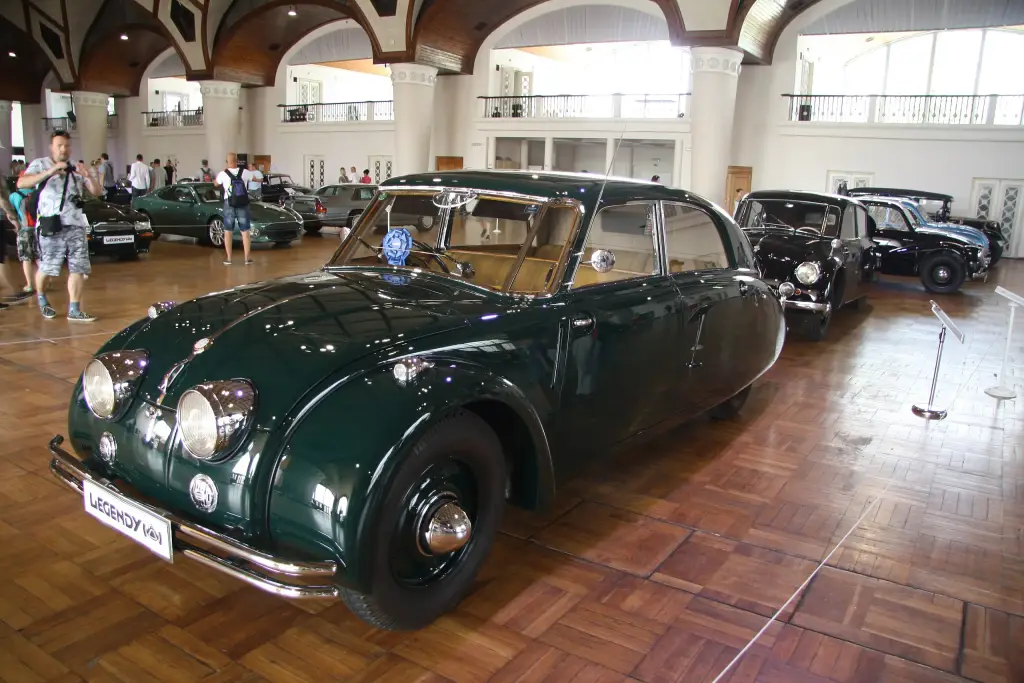
Tatra already had a cheap, strong-selling car in its range, so management believed a new aerodynamic model made sense only as a limited-production flagship at the top of the market. Ledwinka’s team stopped work on the V570 and concentrated on large luxury cars that would be fast, stable, nearly silent, economical and built to the most rigorous standards.
Engineering
The T77 was a coach-built car on a platform chassis with a pressed box-section steel backbone rather than Tatra’s usual tubular chassis. Its 2.97-litre rear-mounted air-cooled V8 produced 60 hp, later raised to 75 hp with a 3.4-litre engine. The car had overhead valves in hemispherical combustion chambers, a dry sump, fully independent suspension with rear swing axles and extensive use of lightweight magnesium alloy in the engine, transmission, suspension and body.
The engine is probably the last production use of the walking-beam valvetrain: the valves are opened by large drilled rockers driven by a single high camshaft between the two cylinder-bank heads, with no pushrods. Belt-driven squirrel fans in cast alloy ducting draw air forward, up and around the four shrouded pairs of finned iron cylinders, and a hinged alloy cover keeps the carburettor warm in winter. The average drag coefficient of a 1:5 model was 0.2455.
Public response
Development was secret until the presentation on 5 March 1934 at Tatra’s offices in Prague. The car was demonstrated on the road from Prague to Karlovy Vary, where it easily reached 145 km/h, and journalists were impressed by its handling and comfort at about 100 km/h. On 8 March it appeared at the Berlin motor show and became the centre of attention; that year it was also shown in Paris. Doubts that 60 hp could reach 140 km/h were answered with demonstration rides, and director Maurice Elvey used the car in his science-fiction film The Transatlantic Tunnel. The T77 was an expensive luxury car at 98,000 koruns, equal to some US$4,000 in 1935. The later T77a of 1935 had a top speed of over 150 km/h and an exceptionally low drag coefficient of 0.212.
Design and features
- True aerodynamics: a drag coefficient of 0.2455 on a 1:5 model.
- Rear air-cooled V8: hemispherical heads and a dry sump.
- Walking-beam valvetrain: one high camshaft, no pushrods.
- Lightweight materials: magnesium alloy in engine, transmission, suspension and body.
Tatra 77 versions
- Tatra 77 (1934): 2.97-litre V8 with 60 hp.
- Tatra 77A (1935): 3.4-litre V8 with 75 hp and over 150 km/h.
- Coachbuilt bodies: saloons and other styles on the T77 chassis.
The 77’s ideas led to the Tatra 87, and its experimental ancestor was the Tatra V570. More cars are in the Tatra collection.
Sources
- Tatra 77, English Wikipedia: design, engine, reception