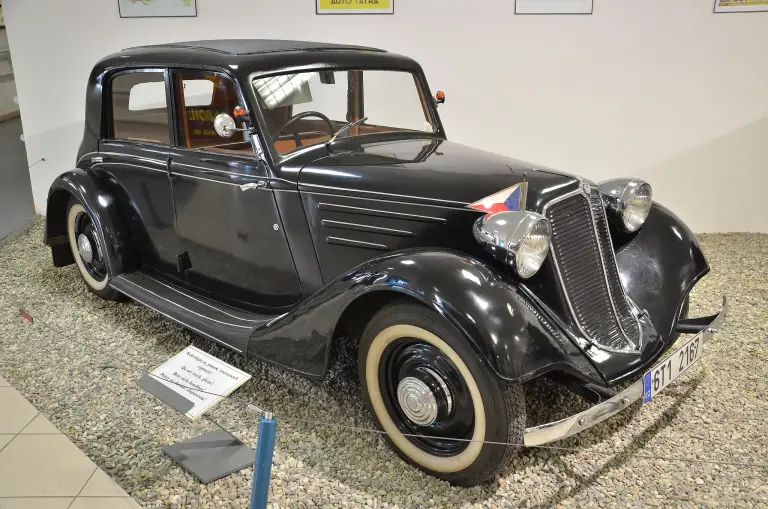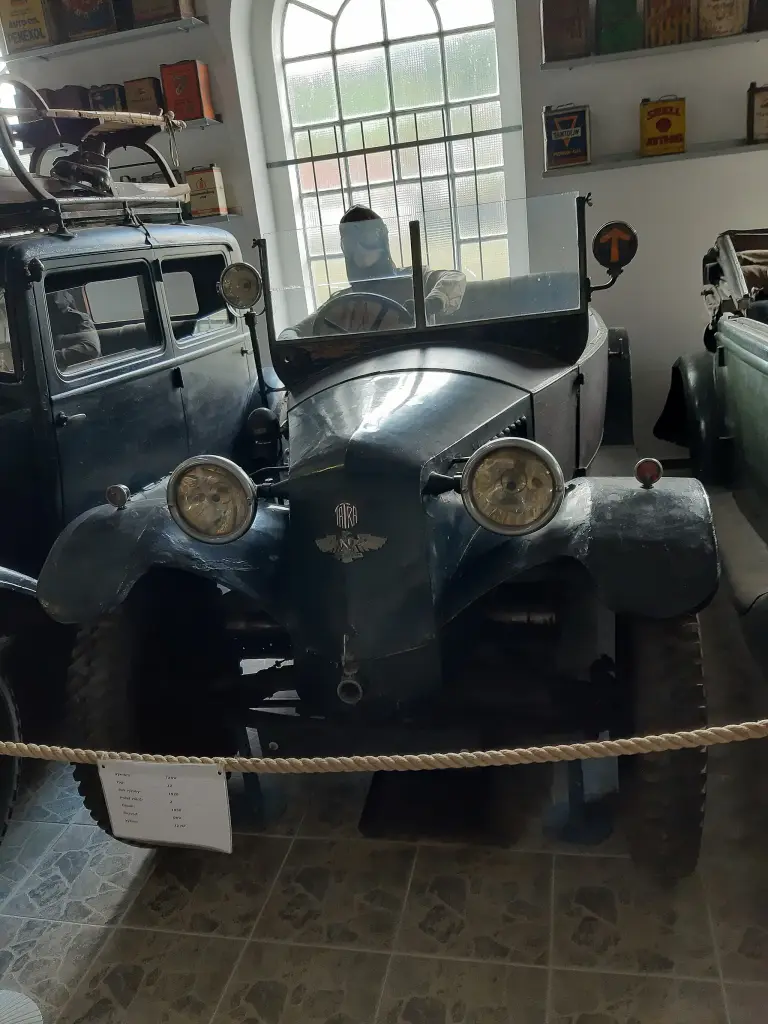
The Tatra 12 was an automobile produced by Tatra in Kopřivnice between 1926 and 1933, replaced by the Tatra 57 in 1932. It continued the ideas of the Tatra 11: a backbone tube chassis, rear swing half-axles and an air-cooled flat twin, in a car aimed at buyers who could not afford the large, expensive designs of the early 1920s.
Tatra 12 at a glance
| Maker | Tatra, Kopřivnice, Czechoslovakia |
|---|---|
| Production | 1926–1933 |
| Predecessor | Tatra 11 |
| Successor | Tatra 57 |
| Engine | air-cooled petrol flat twin |
| Gearbox | 4 forward, 1 reverse |
| Suspension | transverse leaf spring at the front |
| Brakes | drum brakes on all four wheels |
| Chassis weight | about 500 kg |
| Body styles | saloon, Weymann, Normandie, Targa Florio |
History of the Tatra 12
Ledwinka’s idea
At the beginning of the 1920s Czech manufacturers concentrated on large, expensive cars for the rich, and some began to offer cheaper designs for the middle class. Tatra entered this market with the Tatra 11, and the Tatra 12 was its successor. Designer Hans Ledwinka used a backbone tube chassis in which the differential and final drive with swing half-axles were mounted at the rear of the tube. The engine sat on top of the gearbox, and both were mounted at the front of the tube.
The engine was a petrol flat twin, notably air-cooled, which avoided the expensive and heavy radiators of the period and the problems of antifreeze. The front axle used a transverse leaf spring. Where the Tatra 11 had drum brakes only at the rear, the Tatra 12 had them on all four wheels. The two-door four-seat saloon had nickel-plated, later chrome-plated, cantilever tubular steel front seats with folding backrests, an idea that inspired Mart Stam’s cantilever chair.
Bodies and versions
The chassis weighed about 500 kg and was sold to other manufacturers who built their own bodies on it. A Weymann body used wooden pieces loosely joined by steel strips and covered in artificial leather, allowing the wood to move as it dried or got wet. Normandie bodies were modelled after popular French cars and the cheaper version was often used as a utility car.
Targa Florio
The racing version differed considerably from the production car. Its cylinders were made from a special alloy able to work under extreme heat, and the engine produced about 30 PS at 5,000 rpm, roughly twice the standard output. The front axle resembled the Tatra 17’s with swinging half-axles, and the plywood body weighed only about 25 kg, with the whole car at 560 kg. Top speed was about 120 km/h, helped by a 60-litre tank behind the rear seats and by the absence of coolant stops. Debuting Tatra 12s took first and second place in the under-1100 cc class at the 1925 Targa Florio in Sicily; Fritz Huckel beat the track record by 26 minutes and Karel Sponer by 21.
Design and features
- Backbone tube chassis: Ledwinka’s layout with the drivetrain inside the central tube.
- Air-cooled flat twin: no radiator, no antifreeze problems.
- Four-wheel drum brakes: an improvement over the Tatra 11.
- Cantilever seats: tubular steel front seats that inspired a famous chair design.
Tatra 12 versions
- Standard saloon: two-door, four-seat body.
- Weymann: light body with a flexible wooden frame and artificial leather skin.
- Normandie: French-inspired body, often used as a utility car.
- Targa Florio: lightweight racing car with a tuned engine and plywood body.
The 12 was replaced by the Tatra 57, and the larger Tatra 30 was its contemporary. Other pre-war cars are in the Tatra collection.
Video: Tatra 12 startování
Video by veterantatra on YouTube.
Sources
- Tatra 12, English Wikipedia: design, versions, Targa Florio