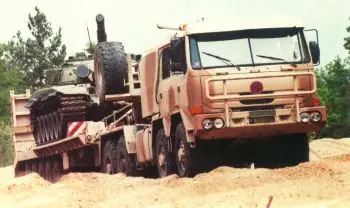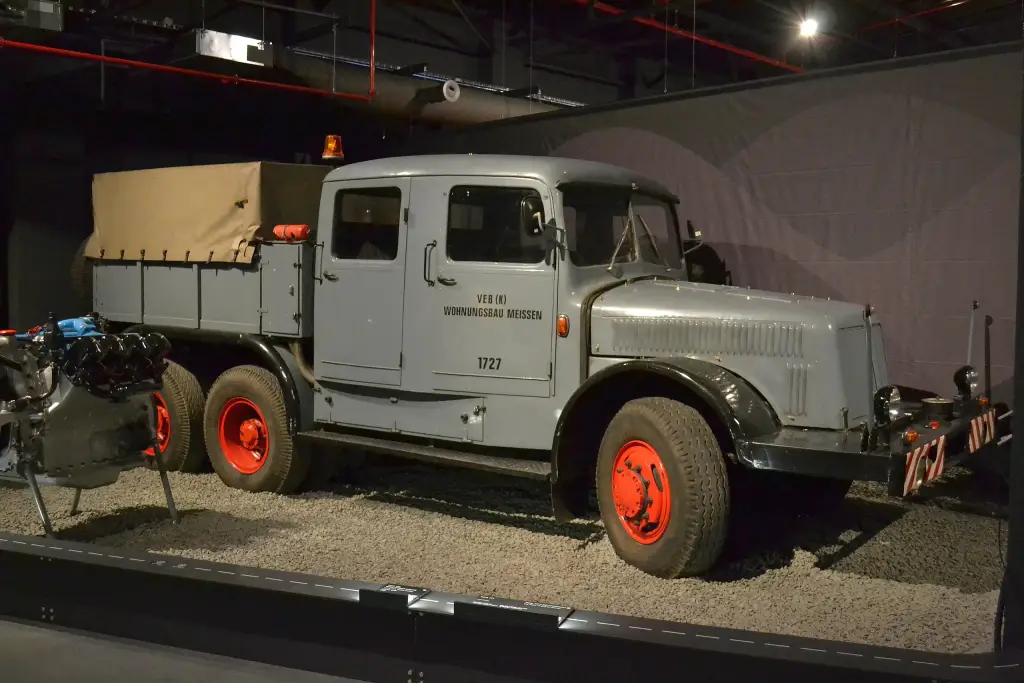
The Tatra 141 was a heavy three-axle lorry built by the Czechoslovak manufacturer Tatra. Developed from the Tatra 111 specifically as a heavy tractor unit, it was intended above all to pull very heavy loads for the railways, the construction industry and the army, and it was replaced by the Tatra 813 from 1967.
Tatra 141 at a glance
| Maker | Tatra, Bánovce nad Bebravou, Czechoslovakia |
|---|---|
| Production | from 1957 |
| Based on | Tatra 111 |
| Replaced by | Tatra 813 (from 1967) |
| Layout | 6×6, central backbone tube |
| Engine | air-cooled V12, three camshafts |
| Power | 180 hp (T 111 A-8), 185 hp (T 111 A-5) |
| Trailer load | up to 100 tonnes (T 141) |
| Cab | all-steel double cab for 8 people |
| Winch | up to 100 m, 8,000 kp |
| Top speed | 45 km/h (T 141B 60 km/h) |
| Built | 640 (1957–1960) and 4,341 (from 1961) |
There is no English Wikipedia article on the Tatra 141; the page is based on the German and Czech articles.
History of the Tatra 141
A tractor for the heaviest loads
The Tatra 141 was developed from the Tatra 111 as a heavy tractor for pulling the heaviest loads in railway transport, construction and the army. Its main purpose was towing Culemeyer road rollers, which explains the roomy all-steel double cab for eight people and the short platform intended to carry an extra 5,500 kg of ballast. The bonnet was like the Tatra 111’s, and the spare wheels were carried at the rear.
The vehicles were not built in Kopřivnice but in Tatra’s branch factory at Bánovce nad Bebravou, in what is now Slovakia. The type was produced from 1959, at first assembled from kits supplied from Kopřivnice. There were two main versions: the T 141, able to tow a 100-tonne trailer, and the T 141B for 50-tonne loads. The German Democratic Republic imported the vehicles between 1960 and 1970, and eight Tatra 141 tractors survive in Germany, with about fifteen said to remain in the Czech Republic and Slovakia.
Technology
The technology followed the Tatra 111 and the Tatra principle: central tube frame, all-wheel drive and an unsynchronised spur-gear differential gearbox. The vehicles built from 1957 to 1960, 640 in all, had the T 111 A-8 engine with 180 hp; from 1961 the T 111 A-5 with 185 hp was used, and 4,341 of this variant were made. All versions had the air-cooled four-stroke V12 diesel with three camshafts and pressure lubrication. Unlike the Tatra 111, the exhaust was led upwards behind the cab roof.
The tractor ran on 11.00-20 tyres, single at the front and twin at the rear, and carried a winch that could be extended to 100 m with a pull of 8,000 kp. Because of the central-tube layout the wheels gained positive camber as they rebounded. The windscreen was inclined positively, unlike the Tatra 111, which shows that the vehicles were mainly intended for civilian use. There was a 12 V, 200 W alternator and a 24 V, 4.4 kW starter. The Czech figures give a 14,825 cm³ engine with 136.2 kW (185 hp) at 2,000 rpm, a top speed of 45 km/h, consumption of 70 litres per 100 km and a weight of 12,140 kg, or 18,280 kg with the additional ballast.
Design and features
- Heavy-duty tractor: designed for Culemeyer trailers and loads up to 100 tonnes.
- Eight-seat double cab: room for the crew needed for heavy transport.
- Powerful winch: 100 m of cable and 8,000 kp of pull.
- Ballast platform: space for 5,500 kg of extra weight to improve traction.
Tatra 141 versions
- T 141: version able to tow a 100-tonne trailer.
- T 141B: version for 50-tonne loads, top speed 60 km/h.
- 1957–1960 cars: T 111 A-8 engine with 180 hp, 640 built.
- From 1961: T 111 A-5 engine with 185 hp, 4,341 built.
The 141 was developed from the Tatra 111 and replaced by the Tatra 813. Other heavy trucks are in the Tatra collection.
Sources
- Tatra 141, German Wikipedia: purpose, production, technology
- Tatra 141, Czech Wikipedia: versions, technical data