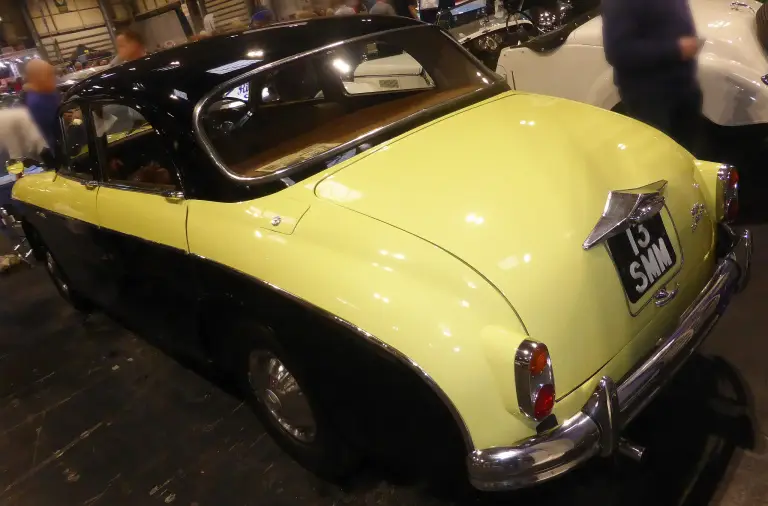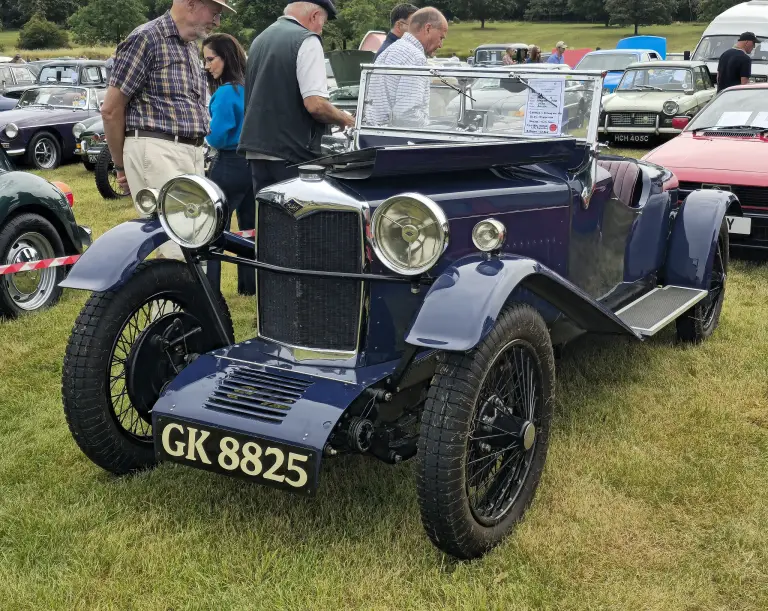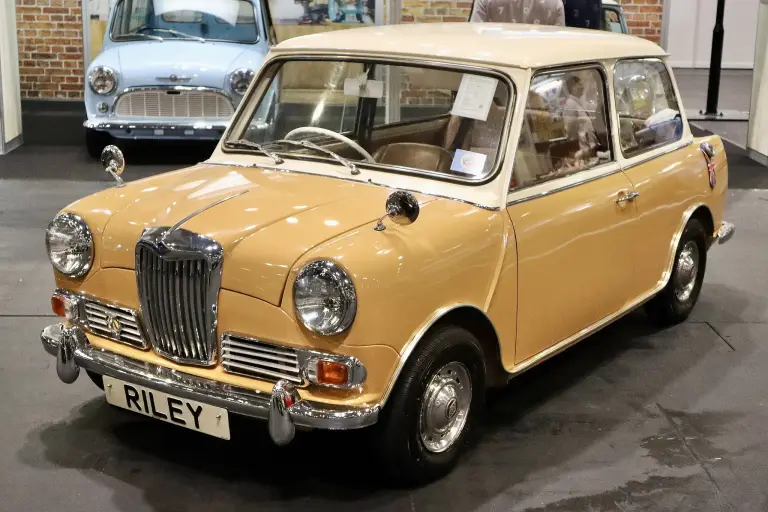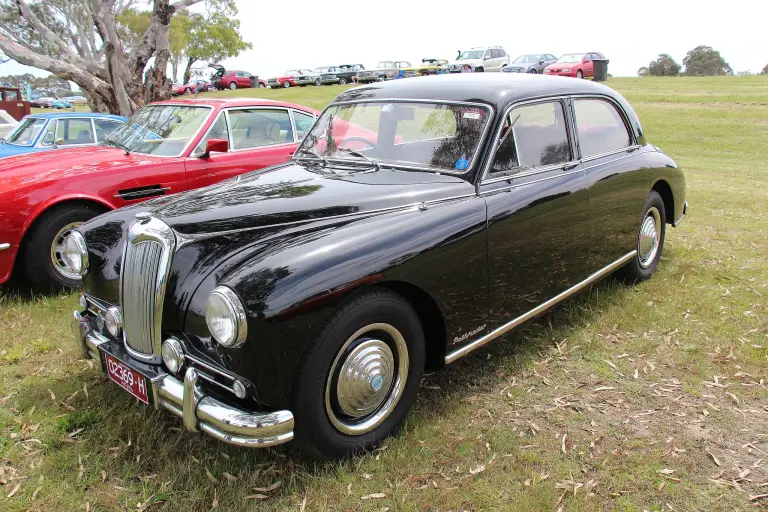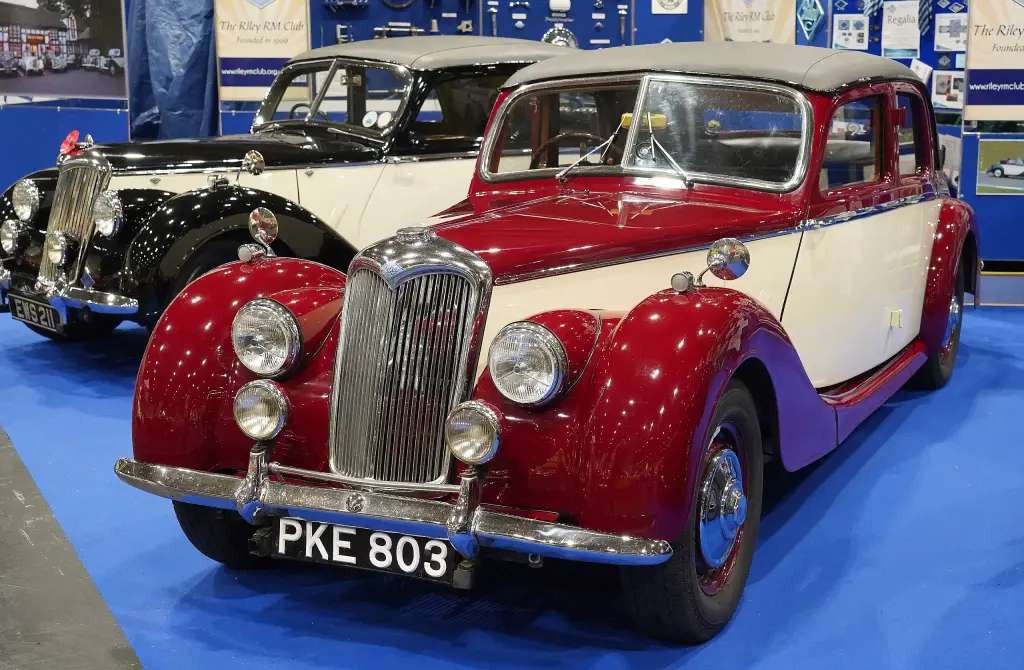
The Riley RM is a series of saloons, roadsters and dropheads built by Riley Motors from 1945 until 1955. They were the last models developed independently by Riley before its parent Nuffield merged with Austin to form BMC, and the name RM is used retrospectively for everything built before 1952, when the cars were still sold as the Riley 1½ Litre and 2½ Litre.
Riley RM at a glance
| Maker | Riley Motors, Coventry, then the MG works at Abingdon |
|---|---|
| Production | 1945–1955 |
| Models | RMA, RMB, RMC, RMD, RME, RMF |
| Engines | 1,496 cc and 2,443 cc four-cylinders, twin camshafts high in the block |
| 1½ litre output | 12 hp RAC rating, 75 mph |
| 2½ litre output | 90 hp, raised to 100 hp for 1948 |
| Suspension | independent front with torsion bars |
| Brakes | hydro-mechanical on the RMA, fully hydraulic on the RME |
| Body frame | wood, in the English coachbuilding tradition |
| RMC roadster | just over 500 built, 1948–1951 |
| RMD drophead | just over 500 built, 1949–1951 |
| Successor | Riley One-Point-Five of 1957, a BMC design |
History of the Riley RM
A new design after the war
The RM was inspired by Riley’s stylish pre-war 1.5 and 2.5 Litre Kestrel saloons, but it sat on a new chassis whose Riley “torsionic” independent front suspension incorporated the experience of the wartime years. A fresh design was necessary because air raids on Coventry had destroyed the patterns and dies of the pre-war models. All RM cars used Riley four-cylinders with hemispherical combustion chambers and twin camshafts mounted high at the sides of the cylinder block. Production stayed in Coventry until 1949, when it moved to the MG works at Abingdon.
RMA and RMB
The RMA was the first post-war Riley, announced in August 1945 and on sale that autumn. It used the 1.5-litre engine, hydro-mechanical brakes and independent torsion-bar front suspension, with a body frame of wood in the English tradition and traditional styling; it could reach 75 mph and was replaced by the RME in 1952. The RMB was a lengthened RMA launched a year later in 1946, with the 2.5-litre “Big Four” engine and twin SU carburettors. Power started at 90 hp and rose to 100 hp for 1948, taking the top speed to 95 mph. The wheelbase was 6.5 in longer and the car 7 in longer overall. RMB 2½ Litre models carried light blue bonnet and bootlid badges, while the RMA 1½ Litre had dark blue ones. The Motor tested an RMB in 1949: 90 mph, 0–60 mph in 16.8 seconds, 19.6 mpg and a price of £1,224 including taxes.
RMC and RMD
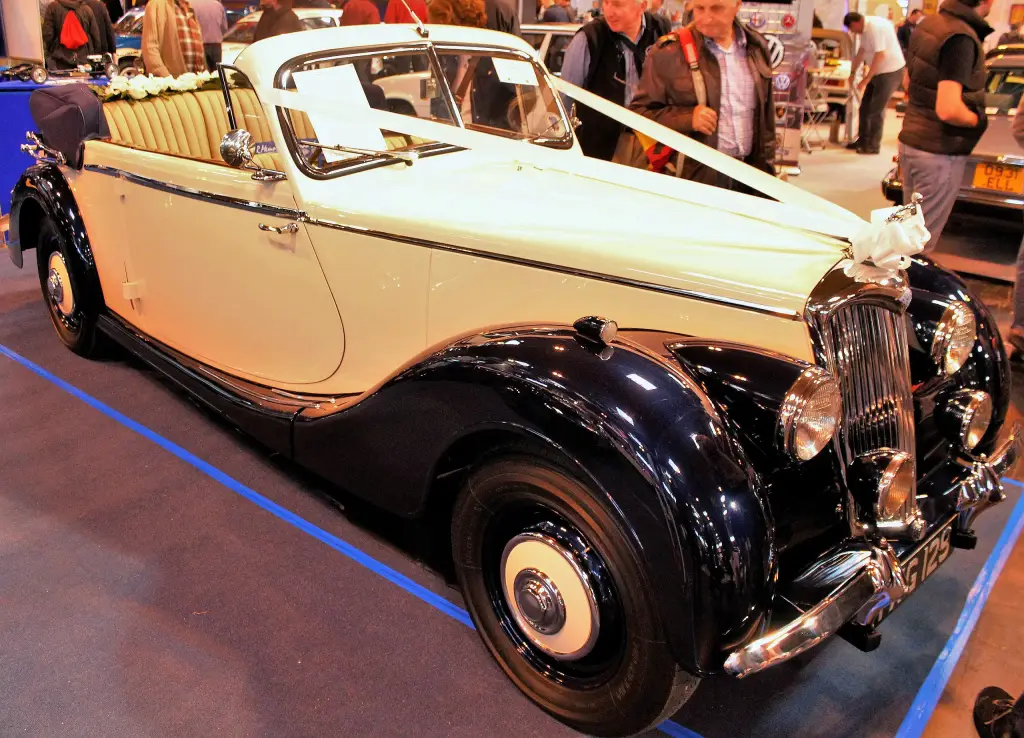
The RMC was an open two-door, single-bench-seat 2/3-seater version of the RMB with a large rear deck and a fold-flat windscreen. Announced in March 1948, it was aimed mainly at North America and was normally built left-hand drive with the gear lever on the steering column. The bonnet and radiator were lowered, the bonnet catches worked from inside, extra over-riders were fitted and the fuel tank grew to 20 imperial gallons. Instead of side windows it had celluloid-glazed side curtains with a hole for hand signals and a light synthetic roof. From September 1949 a small quota of right-hand-drive cars was added. The RMC shared the 100 hp 2.5-litre engine and could reach 100 mph; just over 500 were built from 1948 to 1951. The RMD was a traditional two-door drophead, the last Riley cabriolet, first shown at Earls Court in October 1948 and built in similar numbers between 1949 and 1951.
RME and RMF
The RME of 1952 was an improved RMA with the same 1.5-litre engine, now with fully hydraulic brakes, a larger rear window in curved glass and a lower final drive ratio of 5.125:1 instead of 4.89:1. When the 2.5-litre RMF finished in October 1953 the RME lost its running boards and gained reshaped front wings. The Motor tested an RME in 1952: 75 mph, 0–60 mph in 29.5 seconds, 24.2 mpg, £1,339. The RMF had replaced the RMB in 1952 with the same Big Four engine and the mechanical updates of the RME, and was itself replaced in 1953 by the Pathfinder. The RME went out of production in 1955 and was followed in 1957 by the Riley One-Point-Five, a much shorter BMC design unrelated to the RM.
Design and features
- Twin-cam fours: hemispherical combustion chambers and camshafts high in the block, a Riley signature since the Nine.
- Torsion-bar front suspension: the “torsionic” layout developed from wartime experience.
- Wood-framed bodies: traditional coachbuilding under the steel panels of the saloons.
- Four body styles: two saloon lengths, an open roadster and a drophead coupé.
- Badge colours: light blue for the 2½ Litre, dark blue for the 1½ Litre.
Riley RM versions
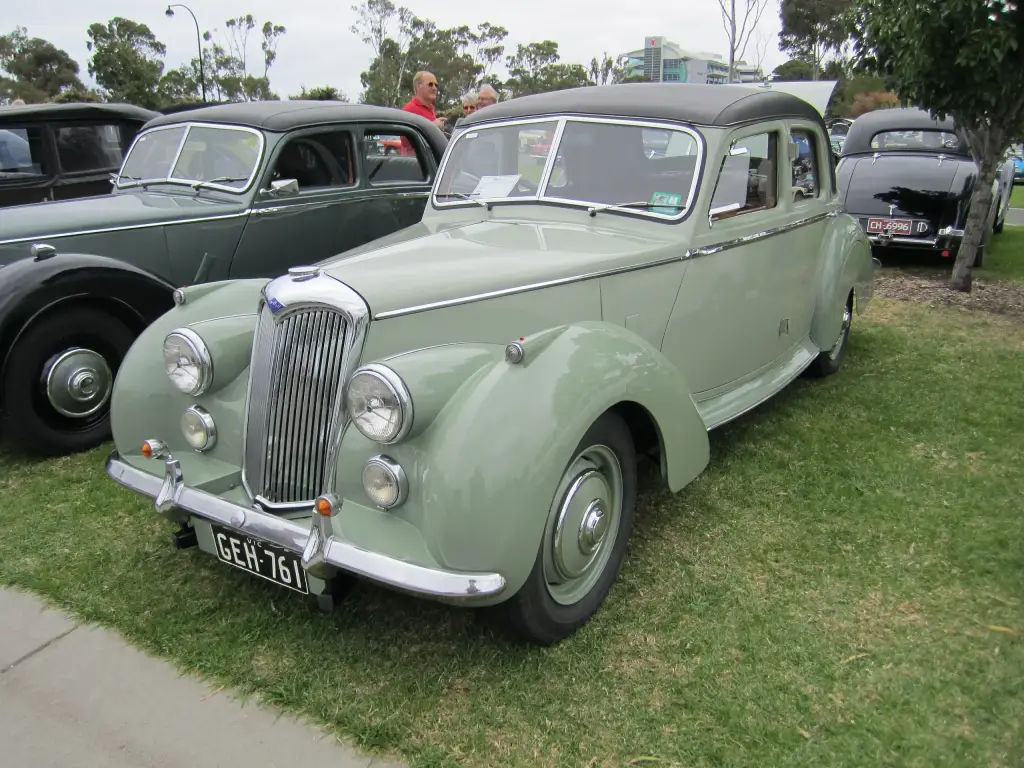
- RMA (1945–1952): the first post-war Riley, 1.5-litre saloon, 75 mph.
- RMB (1946–1952): longer 2.5-litre saloon with the Big Four engine, 100 hp from 1948.
- RMC (1948–1951): open 2/3-seater roadster for export, just over 500 built.
- RMD (1949–1951): the last Riley drophead, just over 500 built.
- RME (1952–1955): improved 1.5-litre saloon with hydraulic brakes.
- RMF (1952–1953): the last 2.5-litre RM saloon, replaced by the Pathfinder.
The RM was replaced at the top of the range by the Riley Pathfinder, and the 1½ Litre line by the Riley One-Point-Five. Its engines came from the pre-war Riley Nine; more cars are in the Riley collection.
Sources
- Riley RM, English Wikipedia: models, engines, production, road tests
- Riley RM, German Wikipedia: RME cabriolet conversions, engine supply to Healey