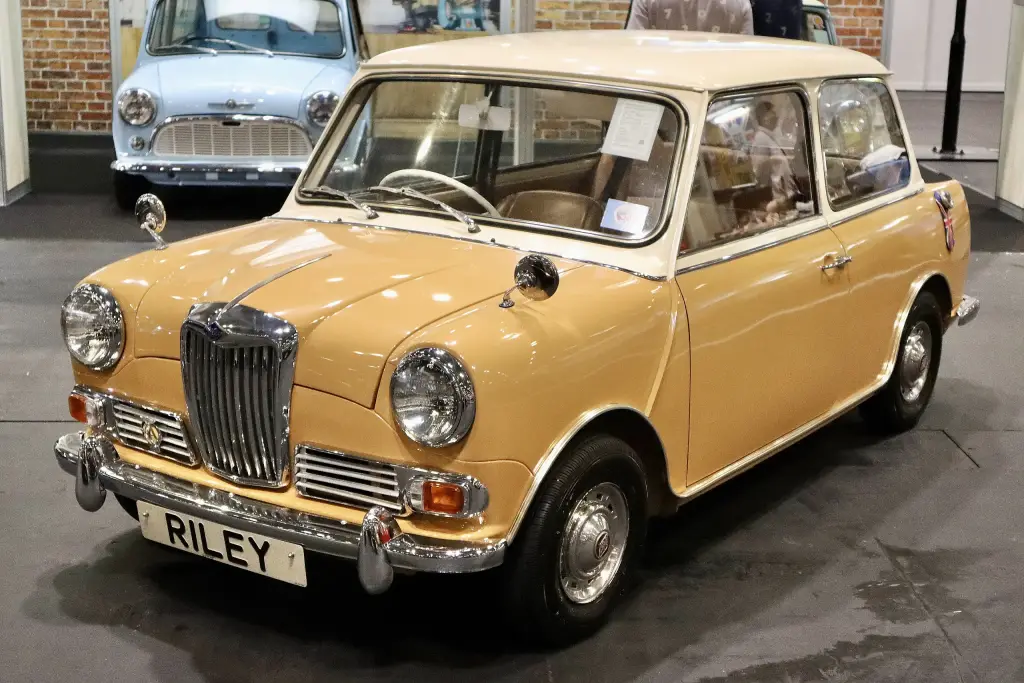
The Riley Elf was a small car based on the Mini, launched by BMC in 1961 together with the Wolseley Hornet. It corresponded to the Austin and Morris Minis but had an added boot, a larger grille and different tail lights, and it was built in three Marks until 1969.
Riley Elf at a glance
| Maker | BMC, British Motor Corporation |
|---|---|
| Production | 1961–1969 |
| Twin model | Wolseley Hornet |
| Basis | the Mini, front-wheel drive with a transverse engine |
| Mark I engine | 848 cc four-cylinder, 34 bhp |
| Mark I speed | 112–115 km/h |
| Mark I body | added boot, larger grille, different tail lights |
| Mark II (1963) | 998 cc, 38 bhp, 121 km/h, inside door hinges |
| Mark III (1966) | Hydrolastic suspension with hydraulic pitch compensation |
| End | 1969, the year the Riley marque disappeared |
Only the German Wikipedia has an article on the Riley Elf; this page uses it together with the English article on the Mini for the background of the car it was based on.
History of the Riley Elf
The Mini with a boot
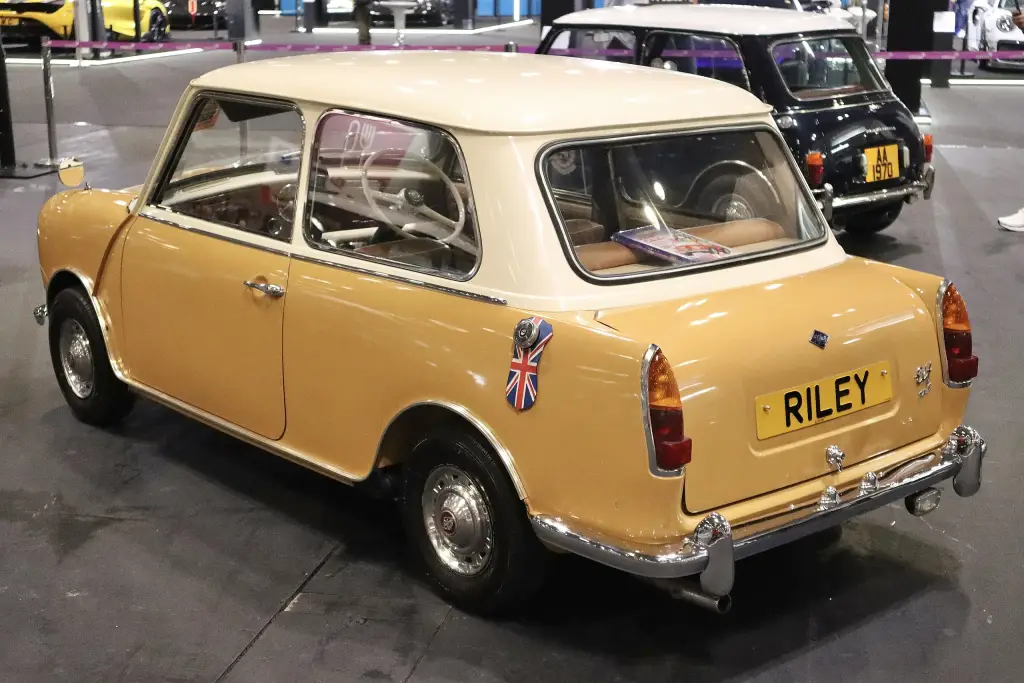
The Riley Elf and the Wolseley Hornet were small cars based on the Mini, brought to market by BMC in 1961. The Elf corresponded to the Mini sold as the Austin or Morris, but it had a boot grafted onto the Mini’s short tail, a larger radiator grille and different rear lights, which gave it a more conventional look than the original. Its front-wheel-drive layout, with a transversely mounted four-cylinder engine, was the same as the Mini’s — the arrangement that made the Mini’s name and influenced a generation of small cars.
Mark I, II and III
The first Elf used an 848 cc four-cylinder engine with 34 bhp, giving a top speed of 112–115 km/h. In 1963 came the Mark II: the Riley gained inside door hinges, while the Wolseley kept outside ones, and both cars moved to a larger 998 cc engine with 38 bhp and a top speed of 121 km/h. The Mark III appeared in 1966 with the same mechanical layout but Hydrolastic suspension, which used rubber springs with hydraulic pitch compensation.
The end of Riley
The Riley Elf was discontinued in 1969, the year the Riley name disappeared from the list of car makers; the Wolseley Hornet was built for another year, until 1970. The Elf was therefore one of the last Rileys, a small, expensive version of a mass-produced car — a long way from the twin-cam sporting models that had made the marque’s name.
Design and features
- Mini underpinnings: front-wheel drive with a transverse engine, the layout of the original Mini.
- Added boot: a proper luggage compartment where the Mini had none.
- Riley face: a larger grille and different tail lights from the Austin and Morris Minis.
- Three Marks: 848 cc Mark I, 998 cc Mark II and Hydrolastic Mark III.
- End of the marque: the last Elf was built in 1969, when Riley disappeared.
Riley Elf versions
- Mark I (1961–1963): 848 cc, 34 bhp, 112–115 km/h.
- Mark II (1963–1966): 998 cc, 38 bhp, 121 km/h, inside door hinges.
- Mark III (1966–1969): Hydrolastic suspension and the same 998 cc engine.
- Wolseley Hornet: the twin model, built until 1970.
The Elf was the small Riley of its day, sold alongside the larger Riley 4/72 and the ADO16-based Riley Kestrel. Its Mini basis links it to the last of the Riley collection.
Video: Spitfire 1500 meets friend Riley Elf
Video by george irving on YouTube.
Sources
- Riley Elf, German Wikipedia: Marks, engines, suspension, end of production
- Mini, English Wikipedia: the Mini layout the Elf was based on