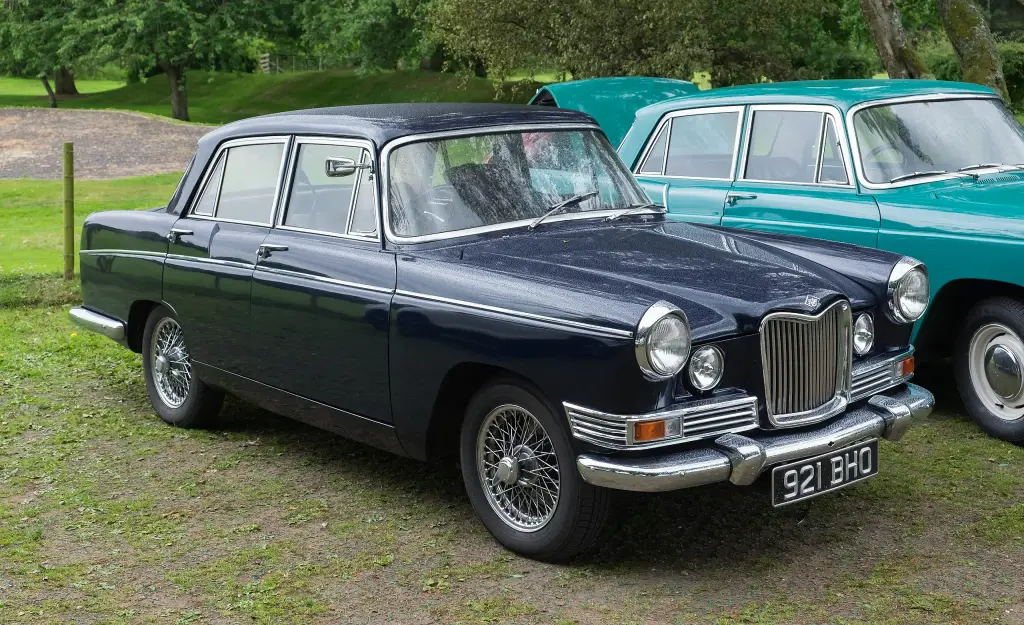
The Riley 4/68 and Riley 4/72 were built by BMC from 1959 to 1969. They were closely related to the Pinin Farina-designed MG Magnette Mark III and Wolseley 15/60, sharing the MG’s rear styling and engine with a milder camshaft, and the Riley was the most expensive car in that family.
Riley 4/68 at a glance
| Maker | BMC, British Motor Corporation |
|---|---|
| Production | 1959–1969 |
| Models | Riley 4/68 (1959–1961), Riley 4/72 (1961–1969) |
| Family | BMC’s five Pininfarina B-Series saloons |
| 4/68 engine | 1,489 cc B-Series four, twin SU carburettors, 64 bhp |
| 4/72 engine | 1,622 cc B-Series four, twin SU, 68 hp |
| 4/68 equipment | rev counter as standard, the only one of the five so fitted |
| 4/72 chassis | anti-roll bars, wheelbase 1 in longer, front track 2 in wider |
| 4/72 gearbox | four-speed manual, Borg-Warner automatic optional from 1961 |
| 4/68 road test | 88.2 mph, 0–60 mph in 18.8 seconds, 27.3 mpg |
| 4/72 road test | automatic: 81.3 mph, 0–60 mph in 20.6 seconds, 26.5 mpg |
| Also sold as | Riley 1500 in Argentina, Riley Comet in Austria |
History of the Riley 4/68
The fifth Farina car
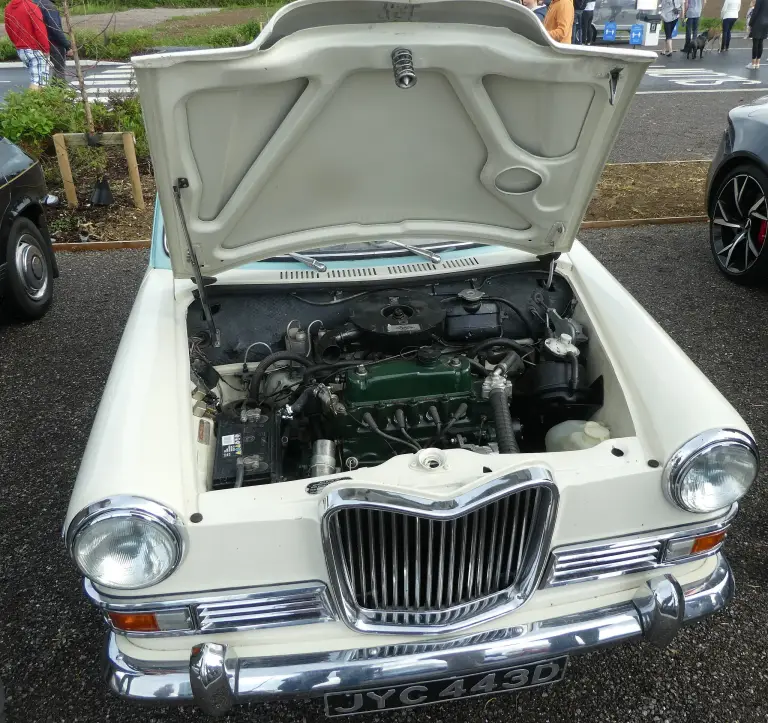
Launched in April 1959, the 4/68 was the last of the five B-Series BMC Pininfarina cars to be released. It used the twin-carburettor B-Series engine in the form already familiar from the MG Magnette III, producing 64 bhp, which was 6 hp more than the similar Wolseley 15/60. Outside, a Riley grille and, apart from the MG with which it shared its tail treatment, slightly less acute tail fins told it apart; inside, the fascia was well equipped and this was the only one of the five cars to come with a rev counter as standard. The introduction of the 4/68 did not affect production of the smaller-bodied 1½-litre One-Point-Five, which continued until 1965.
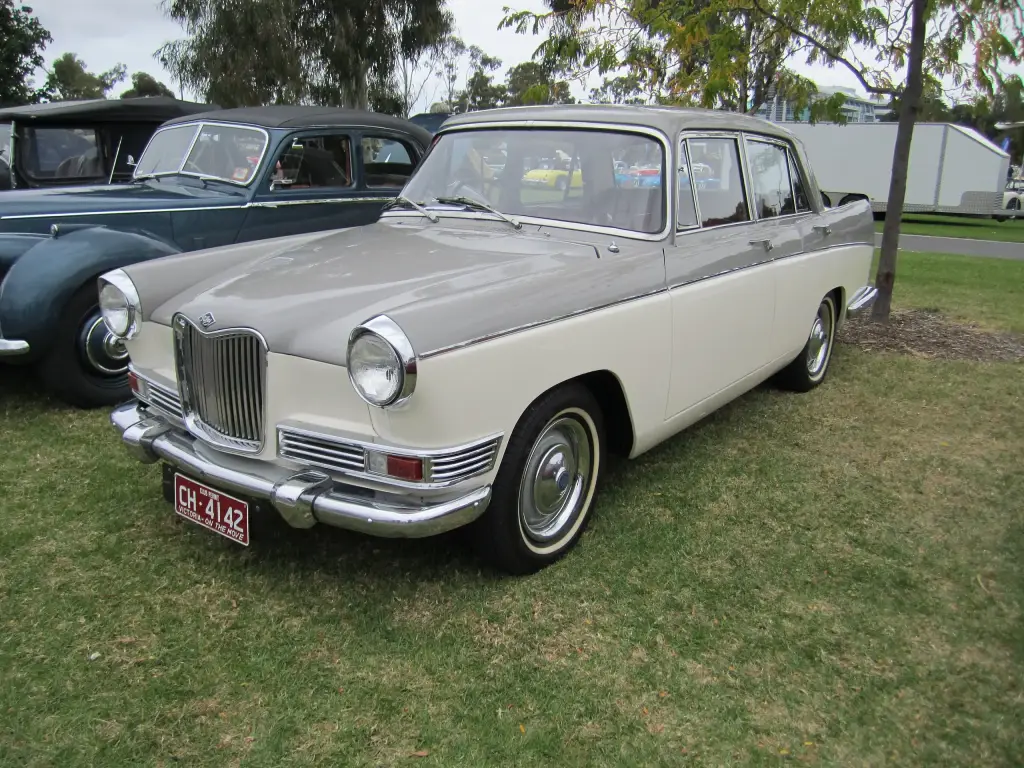
Comfort before appearance
The 4/68 was intended to be the most luxurious of the Farina B-series cars and was priced accordingly. The Motor tested one in 1959: 88.2 mph, 0–60 mph in 18.8 seconds, 27.3 mpg and a price of £1,028 including taxes. The Times’s motoring correspondent noted that the more expensive Riley shared its specification with the MG Magnette Mark III but had different styling and a very full equipment list including a tachometer, with a well-furnished interior combining leather, walnut veneer and pile carpet, and easy gear changing through a well-placed central lever.
The 4/72
Just before the 1961 Motor Show, in October, the car became the 4/72. The engine grew to 1,622 cc, again with twin carburettors, for 68 hp, and the suspension gained anti-roll bars. The wheelbase was 1 in longer through moving the back axle rearwards and the front track was increased by 2 in, changes made at the same time to all the BMC Farina saloons as an answer to criticism of the earlier cars’ road holding. A Borg-Warner automatic became optional at the same time, making the Riley the first mass-produced car in Europe to adopt the Borg-Warner 35 system after the company opened a plant at Letchworth. Further suspension work a year later included recambering the rear springs, but outside there was little to distinguish the later cars, and the model continued almost unchanged until it was withdrawn in 1969. Its main competitor, the 1963 Humber Sceptre, thoroughly trounced it in period road tests.
Road tests and the Argentine cousin
The Motor tested an automatic 4/72 in 1962: 81.3 mph, 0–60 mph in 20.6 seconds and 26.5 mpg, at £1,186 including taxes, against £1,087 for the manual. In October 1962 the Consumers’ Association compared the Riley with the Fiat 1500, Peugeot 403B, Ford Taunus 17M, VW 1500 and Sunbeam Rapier; its most severe criticism was of the Riley’s handling, which changed from understeer to oversteer with speed, and of its brakes. In Argentina the closely related Siam Di Tella of 1960–1966 used the Riley body shape with the Austin Cambridge rear and the 1,489 cc engine, as the Di Tella 1500 saloon, Traveller estate and Argenta pick-up; the 4/72 itself was sold there as the Riley 1500 and in Austria as the Riley Comet.
Design and features
- Twin-carb B-Series: 64 bhp in the 4/68 and 68 hp in the 1,622 cc 4/72.
- Riley identity: its own grille and less acute tail fins than the other Farina cars.
- Full instruments: the only one of the five BMC Farina saloons with a standard rev counter.
- Luxury trim: leather, walnut veneer and pile carpet, at the top of the family’s price range.
- Borg-Warner automatic: optional from 1961, a European first for the BW35.
Riley 4/68 versions
- 4/68 (1959–1961): 1,489 cc, 64 bhp, rev counter as standard.
- 4/72 (1961–1969): 1,622 cc, 68 hp, anti-roll bars and a longer wheelbase.
- 4/72 automatic: the optional Borg-Warner 35 transmission.
- Riley 1500 and Riley Comet: the Argentine and Austrian names for the 4/72.
- Siam Di Tella (1960–1966): the Argentine relative with the Austin Cambridge rear.
The 4/68 replaced the Two-Point-Six as Riley’s largest car and was sold alongside the smaller One-Point-Five. Its Farina body was shared with the Kestrel’s BMC relatives; more cars are in the Riley collection.
Sources
- Riley 4, English Wikipedia: models, engines, equipment, road tests, Argentina