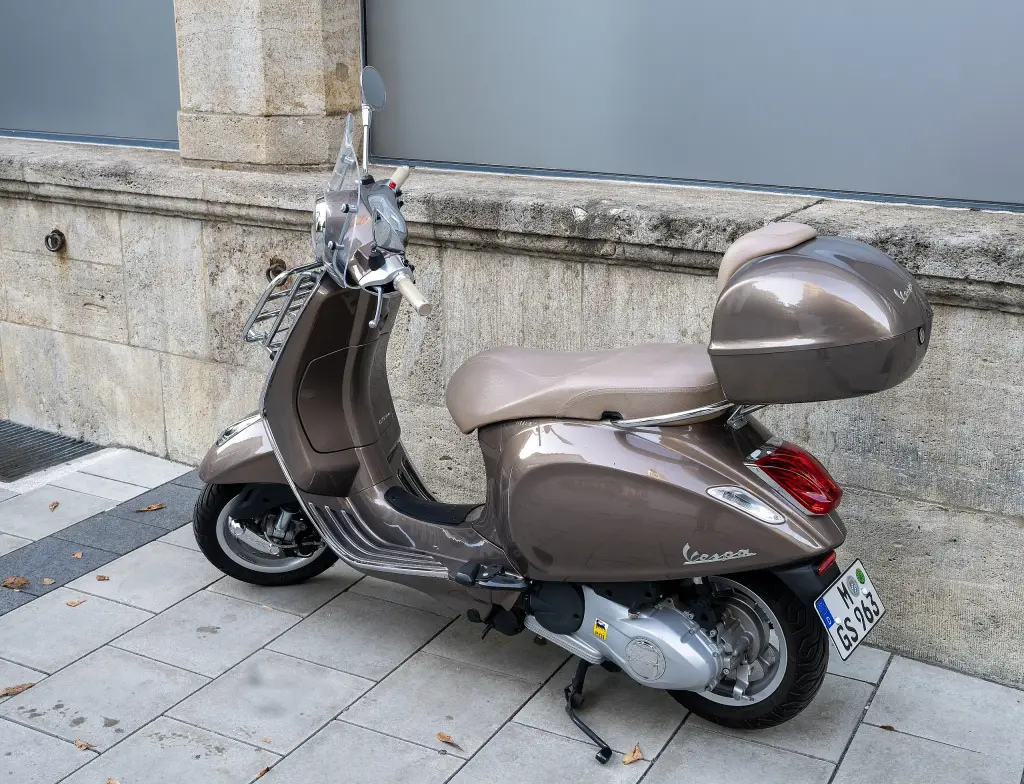
Vespa — Italian for “wasp” — is an Italian brand of scooters and mopeds manufactured by Piaggio. It has evolved from a single model motor scooter built in 1946 in Pontedera into a full line of scooters and one of the companies owned by the Piaggio group.
Vespa at a glance
| Brand | scooters and mopeds made by Piaggio |
|---|---|
| Origin | a single model of 1946, Pontedera |
| Patent | 23 April 1946, Florence |
| Designer | Corradino D’Ascanio, after the MP5 Paperino |
| Body | painted pressed steel, painted, with a full cowling around the engine |
| Original engine | 98 cc two-stroke, horizontal, driving the rear wheel directly |
| Original wheels | 8-inch |
| Transmission | three-speed with a twistgrip-controlled gearchange |
| Rear suspension | rigid on the first cars |
| Cooling | fan blades on the magneto flywheel, still used today |
The article is based on a single source, the English Wikipedia page on the Vespa brand; the Italian page of that name is a disambiguation page.
History of the Vespa
After the Second World War, in light of its agreement to cease war activities with the Allies, Italy had its aircraft industry severely restricted. Piaggio emerged from the conflict with its Pontedera bomber plant demolished by bombing, and Italy’s crippled economy and ruined roads did not favour the growth of the car market. Enrico Piaggio, son of the founder Rinaldo Piaggio, decided to leave the aeronautical field and address Italy’s urgent need for a modern and affordable means of transport for the masses.
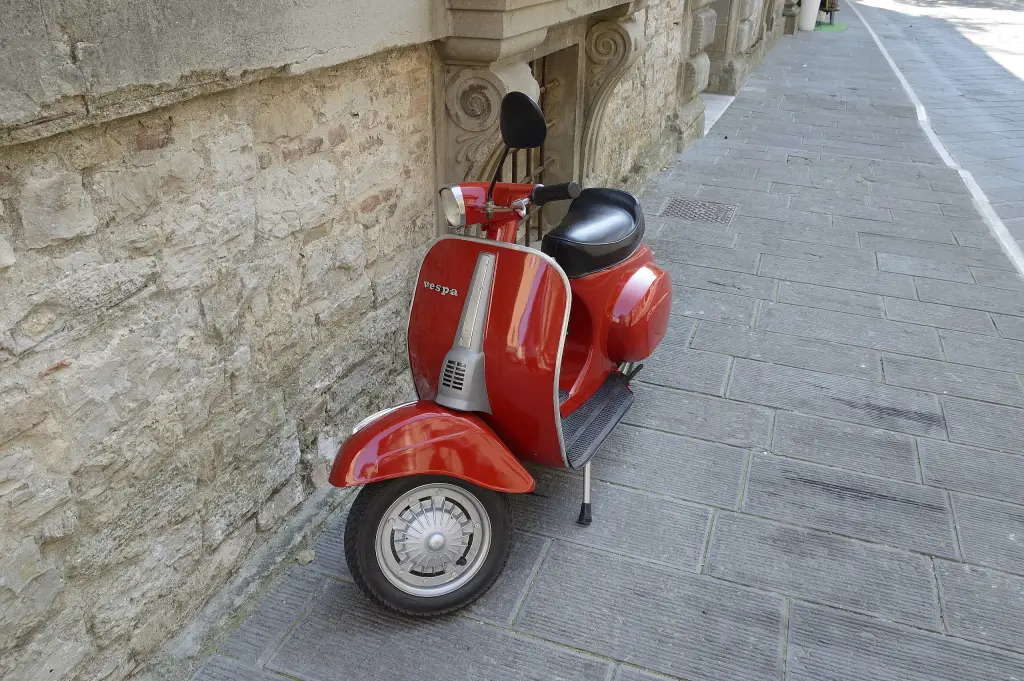
From the Paperino to the MP6
In 1944 Piaggio engineers Renzo Spolti and Vittorio Casini designed a motorcycle with bodywork fully enclosing the drivetrain and forming a tall splash guard at the front. Besides the bodywork, the design had handlebar-mounted controls, forced air cooling, small-diameter wheels and a tall central section that had to be straddled. Officially the MP5 (“Moto Piaggio no. 5”), the prototype was nicknamed Paperino, meaning Donald Duck. Piaggio was displeased with it, especially with the tall central section, and contracted the aeronautical engineer Corradino D’Ascanio to redesign the scooter. D’Ascanio, who had earlier been consulted by Ferdinando Innocenti about scooter design, made it immediately known that he hated motorcycles, believing them bulky, dirty and unreliable.
The MP6 and the name
D’Ascanio’s MP6 prototype had its engine mounted beside the rear wheel, driving the wheel directly from the transmission and eliminating the drive chain with its oil and dirt. It had a unit spar frame with stress-bearing steel outer panels, which allowed a step-through design instead of the tall centre of the Paperino. The MP6 also had a single-sided front suspension, interchangeable front and rear wheels on stub axles and a spare wheel. Seeing the MP6 for the first time, Enrico Piaggio exclaimed “Sembra una vespa!” — it looks like a wasp — and named the scooter on the spot: the thicker rear part is joined to the front by a narrow waist, and the steering rod resembles antennae.
The patent and the first cars
On 23 April 1946 Piaggio e C. S.p.A. took out a patent in Florence for a “motorcycle of a rational complexity of organs and elements combined with a frame with mudguards and a casing covering the whole mechanical part”. The basic design allowed a series of features to be deployed on the spar frame and made later models quick to develop. The original Vespa had a rear pillion seat for a passenger or, optionally, a storage compartment; the flat front shield of aero metal later became a twin skin with storage behind it, like a car glovebox, and the fuel cap sat under the hinged seat. The scooter had rigid rear suspension and small 8-inch wheels, which kept the design compact and left room for the rider’s legs. Its enclosed, horizontally mounted 98 cc two-stroke engine acted directly on the rear wheel through a three-speed transmission, with a gearchange worked by rods from the twistgrip. The early engine had no forced-air cooling, but fan blades were soon attached to the magneto flywheel to push air over the cylinder fins; the modern Vespa engine is still cooled this way. The first 13 examples appeared in the spring of 1946 and revealed their aeronautical background.
Design and features
- Pressed-steel body: one painted structure with a full cowling around the engine, a flat floor and a front fairing against wind and rain.
- Step-through frame: no tall tank to straddle, so the scooter could be ridden in ordinary clothes.
- Direct rear drive: no chain, no oil and no dirt on the rider.
- Fan cooling: blades on the magneto flywheel, still the system used today.
- A name from nature: the narrow waist and antenna-like steering rod suggested a wasp.
Vespa versions
- MP5 Paperino (1944): the first prototype, with a tall central section.
- MP6 (1945–1946): D’Ascanio’s step-through design with the engine beside the rear wheel.
- Vespa 98 (1946): the first production model, with a 98 cc two-stroke and 8-inch wheels.
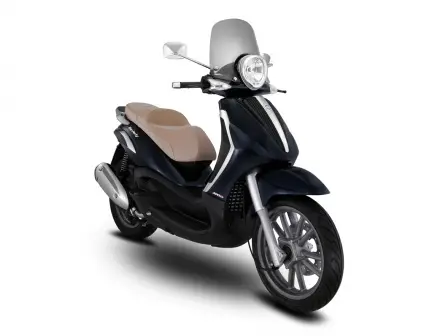
- Modern Vespa range: a full line of scooters built on the same steel-body idea.
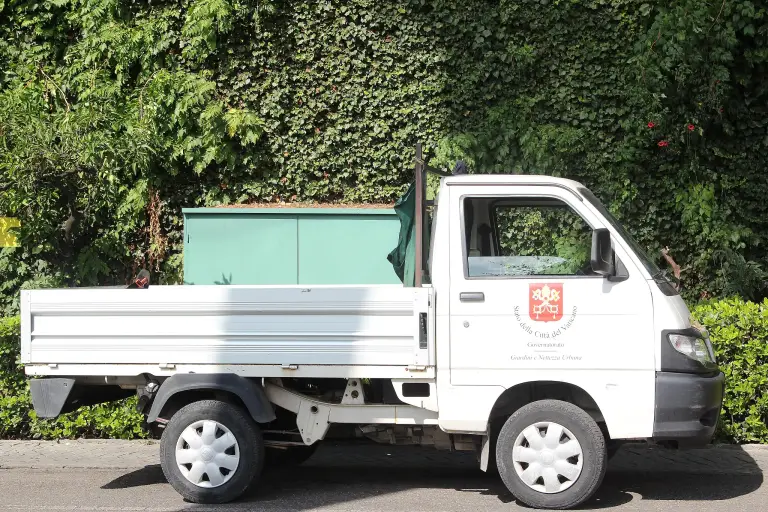
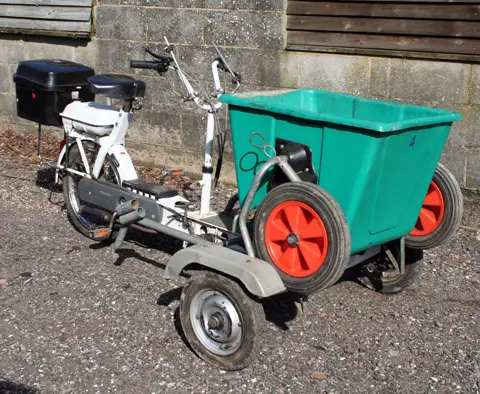
The Vespa gave birth to the three-wheeled Ape, and the Piaggio range also includes the Vespa LX and the Vespa Cosa. More models are in the Piaggio collection.
Video: Piaggio Vespa GTS 300 Super – parte 1/4.avi
Video by Roberto Scotto on YouTube.
Sources
- Vespa, English Wikipedia: origin, prototypes, patent, original specification