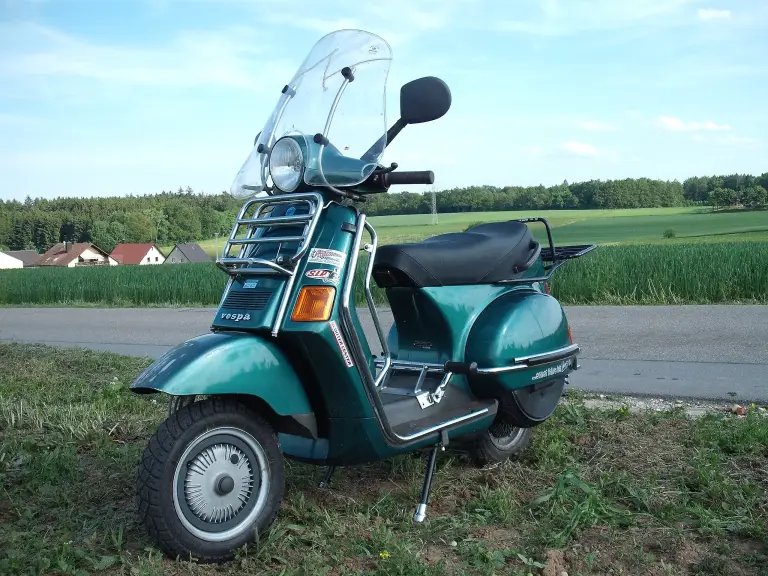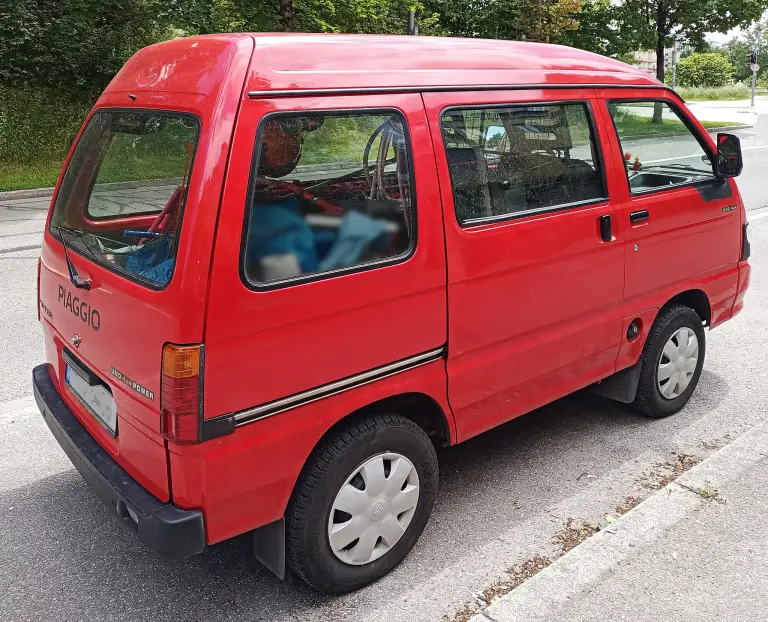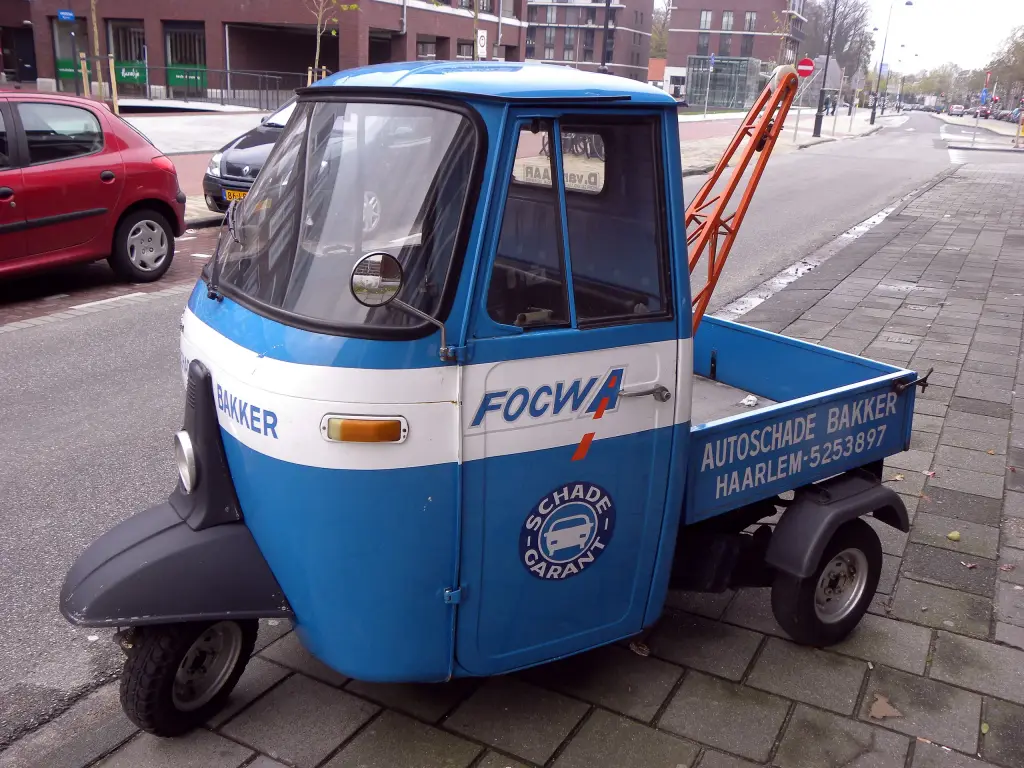
The Piaggio Ape is a three-wheeled light commercial vehicle manufactured and marketed by Piaggio as an adaptation of the Vespa scooter. It has been in continuous production since its introduction in 1948 and is offered in numerous body configurations, from pickups and vans to autorickshaws.
Piaggio Ape at a glance
| Maker | Piaggio, Pontedera |
|---|---|
| Designed by | Corradino D’Ascanio, 1947 |
| First model | 1948 Ape A, 125 cc |
| Early engines | 50, 125 and 150 cc; later a 1000 cc engine |
| Layout | two rear wheels and a flat utility bed behind the driver |
| Steering | handlebar at first, steering wheel on later models |
| Production | continuous since 1948; Italian production ended on 16 October 2013 |
| Current ranges | Ape 50 with a 49.8 cc petrol engine; Ape TM with 218 cc petrol or 422 cc diesel |
| Payload | 175–205 kg for the Ape 50, 700–805 kg for the TM and Classic |
| Fuel consumption | about 30 km/L for the current Ape 50 |
| Calessino | retro limited edition: 999 blue cars in 2007–2009, then 600 white from 2009 |
History of the Piaggio Ape
After the Second World War many Italians could not afford personal transport, and Piaggio was looking for a simple vehicle that could earn its keep. In 1947 the aircraft designer Corradino D’Ascanio, the man behind the Vespa, conceived a light three-wheeled commercial vehicle and the idea found favour with the company. The first model was a cabless adaptation of the Vespa scooter: two rear wheels were added and a flat utility bed was mounted over the rear axle. Initial models used 50, 125 or 150 cc engines, and a 1000 cc engine came later. With handlebar steering the original Ape was a single-seater that could provisionally carry two passengers of modest size, with a door on each side; performance was modest but the torque was adequate for hills.
From Ape A to Ape E
The model history runs through a long list of small steps. The Ape A of 1948–1952 had a 125 cc engine, a wooden pickup bed, a front fork mounted to the left of the wheel hub and a column-mounted gear lever. The Ape B of 1952–1956 kept the layout but moved to 150 cc, a pressed steel cargo bed, a fork on the right of the hub and a cable-operated gear change. The Ape C of 1956–1967 was a major redesign and the first Ape with an enclosed cab, with the engine under the driver’s seat running on a 5% oil mix; electric starting was optional. The Ape D of 1964–1967 brought a 175 cc engine, a trapezoidal headlight on the bulkhead instead of the mudguard, an intake valve that allowed a 2% oil mix and the first cab heater. The Ape E of 1965–1973 was identical to the D but with a 150 cc engine.
Rear engine and the modern range
In 1968 the Ape MP — Motore Posteriore — moved the engine from the cab to the rear to improve comfort, and it stayed there until 1978. The Ape E/400R followed in 1970–1978 with a 175 cc engine, the Ape P in 1979–1981, and the Ape 500 in 1981–1993 with a new front carrying two headlights on each side. The Ape TM has been built since 1982 with 218 cc petrol and 422 cc diesel engines, handlebar or steering wheel, and a top speed of 60 km/h for the petrol version and 63 km/h for the diesel. The Ape 50 arrived in 1996 with a 49.8 cc engine and redesigned headlights incorporating side lights, followed by the Furgone 50 van, the Cross Country 50 in 2000 and the Ape Classic in 2006, also built in India with a Lombardini 422 cc diesel.
Work, racing and India
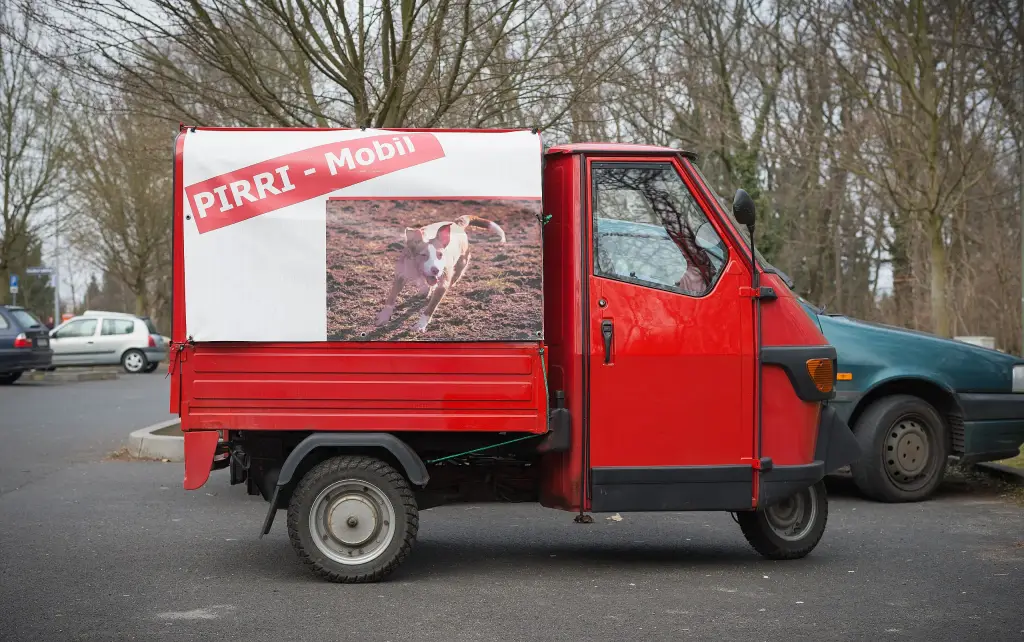
The Ape has been sold as a van, a pickup, a postal vehicle and an autorickshaw, and it is common in Italy, where its compact size lets it negotiate narrow streets, park easily and serve as an impromptu market stall. Advertising signboards are often mounted in the load bay. The Calessino of 2007–2009 revived the look of the 1950s and 1960s cars in an autorickshaw body, and a hand-built Ape Proto has been raced and drifted in events such as the Ape RR Show in San Marino. Most Apes are now produced in India by Piaggio India; on 16 October 2013 Piaggio announced that Italian production of the Ape would end and construction would move entirely to India.
Design and features
- Vespa bones: the front end, engine layout and handlebar steering come straight from the scooter.
- Three wheels, many bodies: pickup, van, autorickshaw, market stall and advertising vehicle from one chassis.
- Small but strong: low top speed, but enough torque for hills and narrow streets.
- Constant development: a cab from 1956, a heater from 1964, a rear engine from 1968, diesel power from 1982.
Piaggio Ape versions
- Ape A and B (1948–1956): cabless pickups with 125 and 150 cc engines.
- Ape C and D (1956–1967): the first enclosed cab and the first heater.
- Ape MP (1968–1978): the engine moved behind the cab.
- Ape TM (since 1982): the long-running 218 cc petrol and 422 cc diesel range.
- Ape 50 (since 1996): the small 49.8 cc model, later with Cross Country and Classic versions.
- Ape Calessino (2007–2009): a retro limited edition with a 422 cc diesel or an electric motor.
- Ape Poker (1993–2005): a four-wheel version of the Ape TM with the same engine.
The Ape was joined in the range by four-wheeled commercial vehicles such as the Porter and the Quargo. Its two-wheeled ancestor is described in the article on the Vespa, and more Piaggio vehicles are in the Piaggio collection.
Video: TV Bericht über die Piaggio Ape 50
Video by ratrace92 on YouTube.
Sources
- Piaggio Ape, English Wikipedia: model history, current ranges, production move to India
- Piaggio, Italian Wikipedia: company background