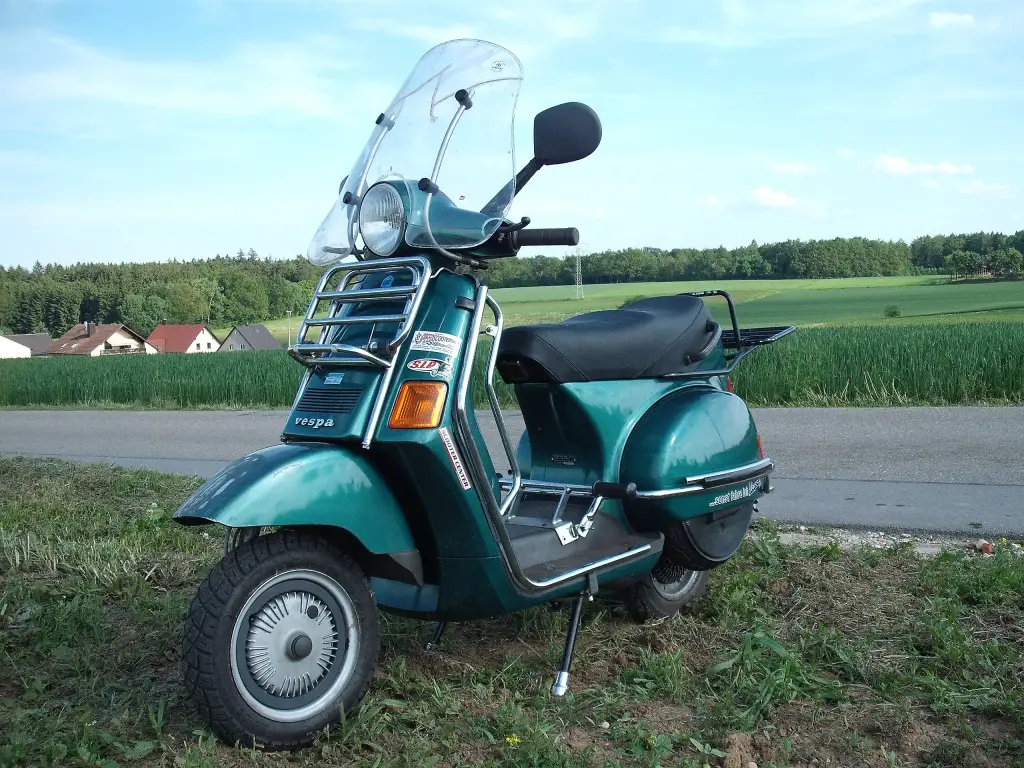
The Vespa Cosa is a model of scooter produced by Piaggio under the Vespa brand from 1988 to 1993. A direct successor to the PX series, it brought a new gearbox, storage under the seat and anti-lock brakes on the front wheel, but the PX stayed in production long after the Cosa had gone.
Vespa Cosa at a glance
| Production | 1988–1993 |
|---|---|
| Presentation | Milan motorcycle show, 1987 |
| Original name | Vespa R, for Rinnovata |
| Predecessor | Vespa PX |
| First generation | 1988–1991, type VNR1T |
| Second generation | Cosa 2 or Cosa FL, from 1992, type VNR2T |
| Price at launch | about 3,147,000 lire |
| Cosa 2 price | 4,571,000 lire |
| Brakes | integral braking on both wheels with a hydraulic circuit |
| Cosa 2 addition | EBC device preventing the front wheel from locking |
| Body | monocoque pressed steel with a significant amount of plastic parts |
The article is based on a single source, the English Wikipedia page on the Cosa.
History of the Vespa Cosa
The Vespa Cosa was initially to be called the Vespa R, standing for Rinnovata, renewed, and it was unveiled at the Milan motorcycle show in 1987. It is a direct successor to the Vespa PX series: the internal workings are largely similar, but it came with a newly developed gearbox that was a significant improvement on the one used in the PX. The PX, however, was still in production at the time, and it continued to be built even after the Cosa was discontinued. Other improvements over the PX included storage space beneath the seat and anti-lock brakes on the front wheel. More controversially, the Cosa was also the first Vespa to use a significant amount of plastic parts in addition to the traditional monocoque pressed-steel frame.
The Cosa 1
At the end of the 1980s Piaggio decided to make the PX line more modern with decidedly more angular shapes, and put into production the Cosa. The instrumentation was particularly complete, the engine more powerful, the rear swinging arm strengthened, and the scooter was even given a rev counter. On the chassis side, there was more space for the legs and the helmet could be put in the compartment under the saddle. The Cosa kept the monocoque body but brought several innovations compared with the PX: the side hoods were slightly inclined forward for better aerodynamics, the indicators were recessed in the front shield, and the rear light was recessed under the plate. The braking was integral, distributed to both wheels through a hydraulic circuit and a pressure regulator, and the scooter went on the market at about 3,147,000 Italian lire in white, red, green and blue.
The Cosa 2
The Cosa 2 was presented at the Milan show in 1991, at a much higher price of 4,571,000 lire. The stylistic changes were visible mostly at the back: the light moved up behind the saddle, which had two levels offset from each other, more padding and two large handles at the sides. The Cosa 2 was also safer under braking, because the integral braking system was completed by the EBC device, which uses a magnetic sensor to prevent the front wheel from locking.
What changed under the skin
The engine is virtually identical to that of the contemporary Vespa PX, with three main differences in the design: the swingarm pivot on the Cosa is wider than on the PX, the rear spring strut on the engine housing is shaped differently because the rear suspension is longer, and the mounting for the rear brake is different because the brake is hydraulic. The carburettor came as standard with an electronic fuel valve and an automatic choke, and the instrument panel included a digital tachometer similar to the one used on later versions of the Vespa T5. In Germany the Cosa 200 was sold with a 10 bhp engine, which made it cheaper to insure.
Design and features
- New gearbox: a significant improvement on the PX unit.
- Integrated braking: a hydraulic circuit working on both wheels, with the EBC anti-lock device on the Cosa 2.
- Practical storage: a compartment under the seat big enough for a helmet.
- Modern details: recessed indicators, a rev counter and an automatic choke.
Vespa Cosa versions
- Cosa 1, VNR1T (1988–1991): the first generation with integral braking.
- Cosa 2, VNR2T (from 1992): new tail light, wider saddle and the EBC anti-lock device.
- Cosa FL: the name often used for the second generation.
- Cosa 200 for Germany: sold with a 10 bhp engine for cheaper insurance.
The Cosa was meant to replace the Vespa PX, and it sat alongside modern scooters such as the Sfera. More models are in the Piaggio collection.
Video: Rebuilding Piaggio COSA II – Zagreb Croatia
Video by TheSpeedyGonsales on YouTube.
Sources
- Vespa Cosa, English Wikipedia: generations, gearbox, brakes, prices, technical differences