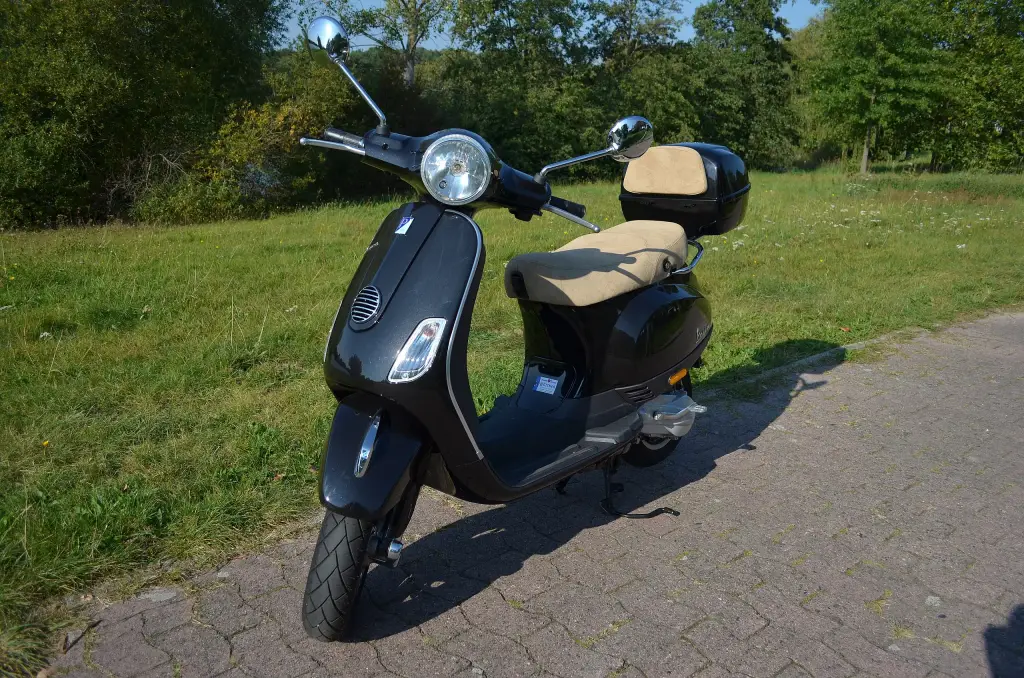
The Vespa LX is a scooter made by Piaggio from 2006 until 2014. It uses the steel supporting body of all Vespa scooters and was sold with 50, 125 and 150 cc engines; its name is the Roman numeral for 60, marking sixty years since the first Vespa of 1946.
Vespa LX at a glance
| Production | 2006–2014 |
|---|---|
| Presentation | February 2005 |
| Name | Roman numeral for 60, the anniversary of the 1946 Vespa |
| Replaced | the ET2 and ET4 series |
| Engines | 50 cc two-stroke or four-stroke, 125 and 150 cc LEADER |
| Frame | squared steel supporting body with a 9.8-litre tank inside |
| Front suspension | single-arm, as on other Vespa scooters |
| Rear suspension | single double-acting hydraulic shock absorber |
| Wheels | five-spoke light alloy, 11-inch front and 10-inch rear |
| Brakes | 200 mm stainless steel front disc with two opposed pistons, rear drum |
| 2009 restyle | crest on the front fender, chrome details, injection engines |
| Successor in Italy | Vespa Primavera, from 2013 |
The article is based on a single source, the English Wikipedia page on the Vespa LX.
History of the Vespa LX
The Vespa LX was released in 2005 and produced from 2006 to 2014. The LX is the Roman numeral for 60, marking the sixtieth anniversary of the first Vespa scooter of 1946, and it was presented in February 2005 as far as the exterior was concerned. Its frame is more squared than that of the ET2 and ET4 series it was intended to replace. In 2009 it was restyled, with a crest added on the front fender and some chrome on the edges of the knobs and on the horn grille; on the occasion of that restyling the engines became injection units.
The frame and the cycle parts
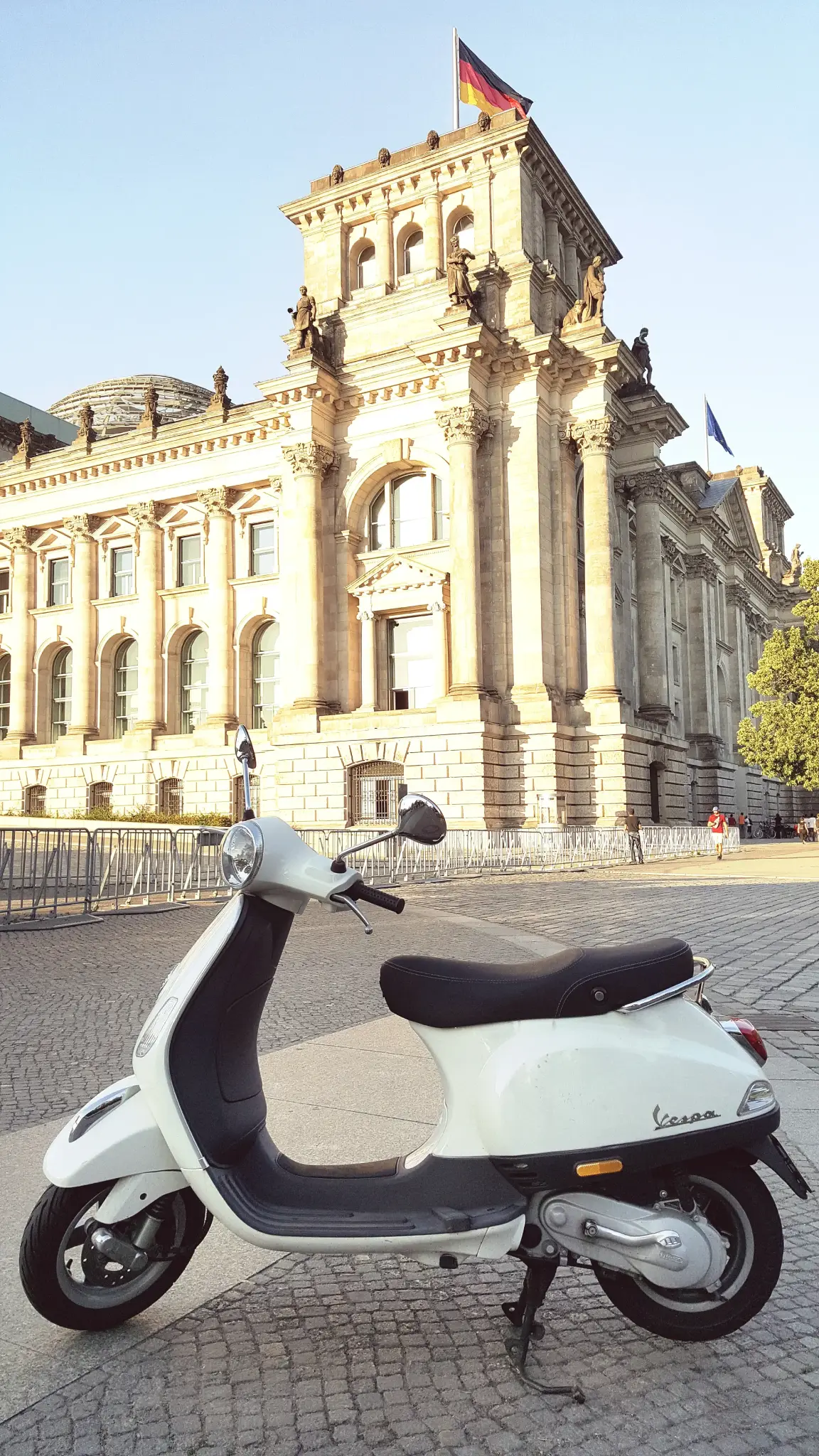
Like all other Vespa scooters, the LX has a steel supporting body that also contains a 9.8-litre tank inside, combined with the typical single-arm suspension on the front wheel. At the rear it has a suspension with a single double-acting hydraulic shock absorber. The wheels are five-spoke light alloy, 11 inches at the front and 10 inches at the rear. The front wheel has a stainless steel disc brake of about 200 mm with a caliper of two opposed hydraulically operated pistons, while the rear keeps the classic drum. To improve braking performance the front disc was made of stainless steel. The gearbox, like all Vespa scooters from 1996 to today except the PX, is of the CVT type.
The engines
The LX was available in 50, 125 and 150 cm3, all with forced air cooling. The 50 was built with both a two-stroke and a four-stroke engine, the latter later enhanced with two more valves in the cylinder; starting was electric or by a crank arm, the engines followed the Euro 2 directive, and the maximum speed was limited to 45 km/h as required for mopeds, with two-seater homologation as standard. To meet the emission rules the catalyst system was modified with the SAS secondary air recovery system; the four-stroke 50 weighed 102 kg and the two-stroke 96 kg. The 125 used the Piaggio Leader four-stroke with electronic injection, 7.9 kW or 10.7 hp, reaching 91 km/h, while the 150 was the Leader four-stroke of 151 cm3 with electronic injection, 8.9 kW or 12.1 hp, reaching 95 km/h. In June 2012 the LX 125 and 150 made their debut with three-valve timing and electronic injection, and in June 2009 production also started in Vietnam at the Binh Xuyen plant of Piaggio Vietnam; in January 2012 production of the LX began in India, where the scooter has a 125 single-cylinder three-valve engine and many changes to suit local customers, built at the Baramati plant of Piaggio Vehicles.
The LXV and the LX family
The LXV, with the V standing for vintage style, was released in the same year as the LX and is mechanically identical to it. The LX also gave rise to the Vespa S, introduced in 2007 after its presentation at the Milan show the previous year, with a rectangular headlight, a minimalist mudguard with a chromed crest, squared mirrors and a rear shield with a pouch instead of the glove box, details recalling the Vespa 50 Special of the early 1970s. Production of the LX in Italy ended in 2013, replaced by the new generation called Vespa Primavera.
Design and features
- Sixtieth-anniversary name: LX is the Roman numeral for 60.
- Vespa construction: a steel supporting body with the tank inside and a single-arm front suspension.
- Three engines: 50 cc two- and four-stroke, 125 and 150 cc Leader units.
- Built on three continents: Italy, Vietnam from 2009 and India from 2012.
Vespa LX versions
- LX 50 two-stroke: 96 kg with a 45 km/h limit for mopeds.
- LX 50 four-stroke: with two more valves added later, 102 kg.
- LX 125: Leader engine with injection, 10.7 hp and 91 km/h.
- LX 150: Leader engine of 151 cm3, 12.1 hp and 95 km/h.
- LXV: the vintage-styled version, mechanically identical.
- Vespa S: the derivative with a rectangular headlight and squared details.
The LX was the successor of the ET series and was replaced by the Primavera, and it shares its brand with the Vespa and the Cosa of the 1980s. More models are in the Piaggio collection.
Video: Piaggio Vespa LX 125 Acceleration Beschleunigung
Video by Dudikovsky on YouTube.
Sources
- Vespa LX, English Wikipedia: presentation, engines, cycle parts, factories, derivatives