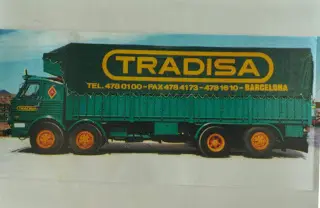
The Pegaso Barajas is the Z-207 lorry whose production began in 1955 at ENASA’s new factory in the Barajas district of Madrid. It brought solutions unusual for a European commercial vehicle of the mid-1950s, including a V6 diesel built partly in aluminium and independent front suspension, and it opened a generation of lorries designed specifically by ENASA.
Pegaso Barajas at a glance
| Maker | ENASA, Barajas, Madrid |
|---|---|
| Model | Pegaso Z-207 |
| Nickname | Barajas, after the Madrid plant |
| Production | 1955–1959 |
| Engine | V6 diesel, partly built in aluminium |
| Front suspension | independent |
| Cab | corrugated steel sheet |
| Derivatives | Z-702 semi-trailer tractor; Z-407 rear-engined coach (prototype only) |
| Significance | first generation designed entirely by ENASA |
The Barajas is described in the Spanish and English Wikipedia articles on Pegaso; there is no separate article on the model.
History of the Pegaso Barajas
ENASA began building vehicles in the old Hispano-Suiza works in La Sagrera, Barcelona, while a large new factory went up in the Barajas area of Madrid, its first phase working from the 1950s. The Z-207, which took the plant’s name as its popular nickname, was the model that started production there in 1955.
The lorry was technically adventurous for its class. Its V6 diesel was built partly in aluminium, and the front suspension was independent, both rare in European industrial vehicles of the mid-1950s. The corrugated-sheet cab became a familiar sight on Spanish roads and was reused on other Pegaso models in the 1960s and 1970s.
The Z-207 was built from 1955 to 1959. A semi-trailer tractor version was sold as the Z-702, and a rear-engined coach, the Z-407, was designed with the same V6 but never got past the prototype stage. Its arrival marked the start of a new generation of lorries designed specifically by ENASA rather than derived from Hispano-Suiza.
Design and features
- V6 diesel in aluminium: a light-alloy construction unusual in 1950s lorries.
- Independent front suspension: another rarity among commercial vehicles of the period.
- Corrugated cab: the ribbed steel cab that became a Pegaso signature for two decades.
- Built in Madrid: the first model produced at the new Barajas factory.
Pegaso Barajas versions
- Z-207 lorry: the standard goods vehicle, 1955–1959.
- Z-702: the semi-trailer tractor version.
- Z-407: a rear-engined coach with the same V6, built only as a prototype.
Later Pegaso lorry ranges are in Pegaso 1060 and Pegaso 2000; the coach line in Pegaso Z-403 Monocasco; more under Pegaso.
Video: Pegaso Barajas en marcha
Video by Dani Astures on YouTube.
Sources
- Pegaso, Spanish Wikipedia: Z-207, Barajas plant, V6, new generation
- Pegaso, English Wikipedia: V6, corrugated cab, Z-702, Z-407, production years