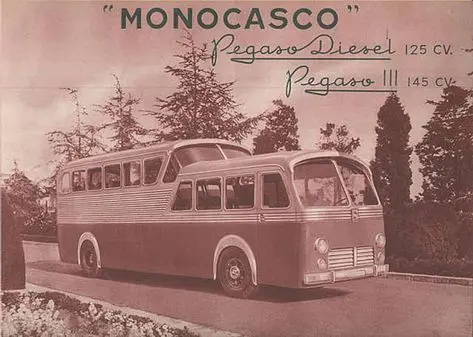
The Pegaso Z-403 Monocasco was a two-level, chassisless coach designed in 1949 and built by ENASA between 1951 and 1957. Its 125 hp diesel sat amidships, its single monocoque structure freed the space normally taken by a frame, and in standard form it came with a radio, a bar and a small bookcase.
Pegaso Z-403 Monocasco at a glance
| Maker | ENASA, Barcelona |
|---|---|
| Design | 1949 |
| Production | 1951–1957 |
| Structure | single monocoque, two levels |
| Engine | Pegaso diesel, 125 hp, mounted amidships |
| Petrol prototype | 145 hp, never produced |
| Length | 10 metres |
| Seats | 30 to 45, depending on comfort |
| Weight | about 4.8 t with all mechanical units |
| Equipment | radio, bar and small bookcase |
| Customers | Iberia, Aviaco and the Atesa tour operator |
The two Wikipedia articles disagree on how many were built: the English one estimates around 50 sold, the Spanish one gives 1,186. Both figures are reported here without choosing between them.
History of the Pegaso Z-403 Monocasco
The first Z-403 design dates from 1949. It was conceived as an “auto-pullman”, a coach whose comfort and equipment were meant to match a railway Pullman: in standard form it carried a radio, a bar and a small bookcase, and the upper deck of its split-level body gave passengers a better view and left room for generous luggage space.
The coach was built as a single chassisless structure, with all mechanical units underneath and isolated from the passenger compartment. That allowed a vehicle 10 metres long carrying between 30 and 45 seated passengers depending on the comfort specified. Front suspension was independent, with transverse arms and torsion bars, and the upper passenger cabin was built entirely of light alloy.
The 125 hp Pegaso diesel was mounted in the middle of the vehicle, in the space under the half upper deck, which gave good weight distribution and stability. A 145 hp petrol version was developed but never got past the prototype stage because of its fuel consumption. Resistance to bending and twisting came from the monocoque itself, with body panels, ceiling and the ornamental band under the windows all acting as structural elements, in a body of steel profiles and one-millimetre sheet.
The Z-403 was developed and built at Pegaso’s Barcelona plant. Its main customers were the Spanish airlines Iberia and Aviaco and the Atesa tour operator, and it was entered for the coach competitions at San Remo in 1952 and 1953, winning both; the trophies are kept in the Museo de Historia de la Automoción in Salamanca. Two of the coaches appear in the final scene of Orson Welles’s 1955 film Mr. Arkadin, at Madrid’s Barajas airport.
Design and features
- Monocoque body: no separate chassis, so the whole structure carried the loads and freed space for passengers.
- Amidships diesel: the 125 hp engine sat under the half upper deck for balance and stability.
- Two levels: the split deck improved the view and created luggage space.
- Pullman equipment: radio, bar and bookcase as standard.
- Light construction: about 4.8 tonnes complete, with an alloy upper cabin and independent front suspension.
Pegaso Z-403 Monocasco versions
- Pullman: the 37-seat comfort version.
- Lujo: the 45-seat luxury version.
- Petrol prototype: a 145 hp version that was never produced.
The sports car of the same years is in Pegaso Z-102; the integral buses that followed the monocoque idea are in Pegaso 6035 and Pegaso Monotral; more under Pegaso.
Video: PEGASO MONOCASCO 1950
Video by juanrapegaso on YouTube.
Sources
- Pegaso Z-403, English Wikipedia: design, structure, engine, customers, film appearance
- Pegaso Z-403 Monocasco, Spanish Wikipedia: dimensions, weight, versions, San Remo awards, production figure