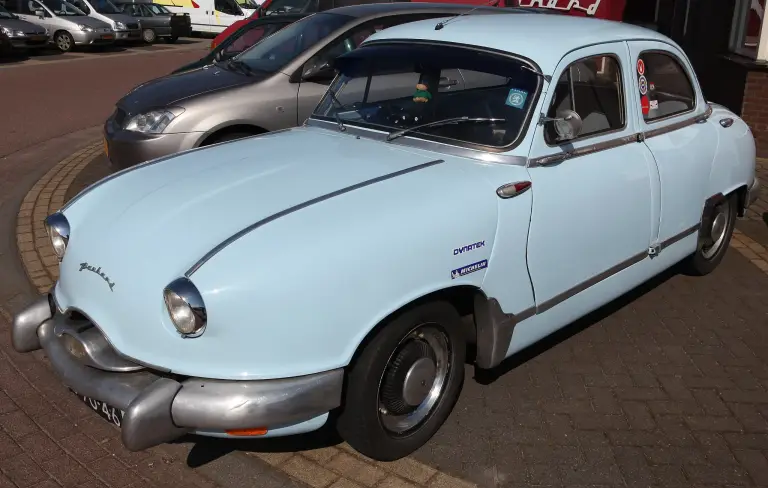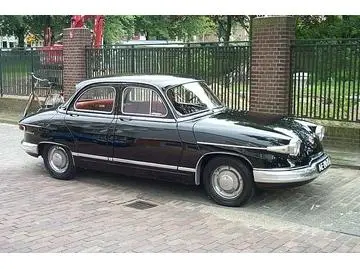
The Panhard PL 17 is an automobile made by the French manufacturer Panhard from 1959 until 1965. Presented on 29 June 1959 as successor to the Dyna Z, it was essentially a facelifted version of its predecessor, with a more angular front and rear in place of the rounded 1950s shapes. The initial four-door saloon, pickup and van were joined by a cabriolet in 1961 and by a five-door estate, the Break, in April 1963.
Panhard PL 17 at a glance
| Maker | Panhard, France |
|---|---|
| Production | 1959–1965 |
| Presented | 29 June 1959 |
| Predecessor | Panhard Dyna Z |
| Bodies | four-door saloon, cabriolet, Break estate, van and pickup |
| Engine | 851 cc at first, 848 cc from July 1960, air-cooled flat-twin |
| Power | 42 hp standard, 50 hp Tigre |
| Drive | front-wheel drive, four-speed column shift |
| Weight | about 805 kg, 830 kg for the Tigre |
| Drag coefficient | about 0.26 |
| Top speed | 130 km/h standard, 145 km/h Tigre |
History of the Panhard PL 17
The name of the PL 17 came from “PL” for Panhard et Levassor, the company’s original full name, with the 17 from the sum 5 + 6 + 6: five fiscal horsepower, six seats and an economy of 6 litres per 100 km. As the car was developed under close supervision by Citroën, it was no coincidence either that 17 was a lower number than the DS 19.
The two-door Cabriolet was first introduced in March 1960 and was available only to customers in the United States. It was not a success and only 47 of this export-only model were built. A version for European customers was shown at the 1960 Paris Salon and became available in 1961, with trim equivalent to the top Grand Standing saloon. For 1963 the cabriolet received the new engine and 125 were built of that version; never a strong seller, it was discontinued later in 1963 and its line used for the new Break.
In 1961 the whole range had a minor facelift: the front doors were now hinged at the front instead of being “suicide doors”, and the turn signals moved from near the base of the A-pillar to positions flanking the headlamps. From the 1964 model year the letters PL were dropped, roughly when Citroën completed its takeover of the company. Names changed too, with a “B” for Berline and “BT” for the Tigre, and the Grand Standing was replaced by the Relmax. The car also lost its chrome brow at the front.
The utility versions were equally long-lived. The Dyna Z Commerciale D65 of October 1958 had a 650 kg payload; 1,735 were built in its ten-month career before the model was updated with the PL 17 front. The range was joined in November 1959 by the F50 with a 500 kg payload, created to avoid parking restrictions in the new Blue Zones around several French cities and differing mainly in smaller tyres.
The PL 17 used the engines of the Dyna Z, initially both of 851 cc: the standard unit gave 42 hp and the Tigre 50 hp. From July 1960 capacity fell to 848 cc to suit tax limits of 850 cc in many markets, with power unchanged. Front wheels were driven through a four-speed gearbox with column shift and synchromesh on the upper three gears; the front suspension used two transverse leaf springs and the rear three torsion bars each side. The low weight and a drag coefficient of about 0.26 gave 130 km/h for standard saloons and 145 km/h for the Tigre. Sales were never aggressive in pricing: in 1962 five versions were listed between 6,990 and 8,240 francs, more than a larger-engined Simca Aronde, though Panhard owners, many of them taxi drivers, valued the roadholding, economy and space. Production of the Panhard 17, the marque’s last saloon, ended in May 1965.
Design and features
- Facelifted body: the Dyna Z structure with a more angular front and rear, in tune with the end of the 1950s.
- Air-cooled flat-twin: 851 cc at first and 848 cc from 1960, with 42 hp or 50 hp in the Tigre.
- Low drag: a coefficient of about 0.26 helped a light car reach 130 or 145 km/h.
- Space and economy: six seats, a large boot and a six-litre consumption that gave the model half its name.
- Wide range: saloon, cabriolet, Break estate, van and pickup all shared the same mechanicals.
Panhard PL 17 versions
- Saloon: the standard four-door, in Luxe, Grand Luxe, Grand Standing and Tigre trim.
- Cabriolet: American-only from 1960, European from 1961, discontinued in 1963.
- Break: five-door estate developed by Pan Auto, on a longer wheelbase from April 1963.
- Utilitaires: F65 van and pickup with a 650 kg payload, and the F50 with 500 kg for the Blue Zones.
- 17 B and 17 BT: the 1964 renaming of the saloon and Tigre, later joined by the Relmax and Confort versions.
The PL 17 replaced the Panhard Dyna Z and was itself replaced by the Panhard 24; the Panhard CD used its transaxle. More cars are in the Panhard collection.
Video: 1960 Panhard PL-17 Tigre Motor Running
Video on YouTube.
Sources
- Panhard PL 17, English Wikipedia: model history, bodies, specifications
- Panhard PL 17, French Wikipedia: trim levels, model years, end of production