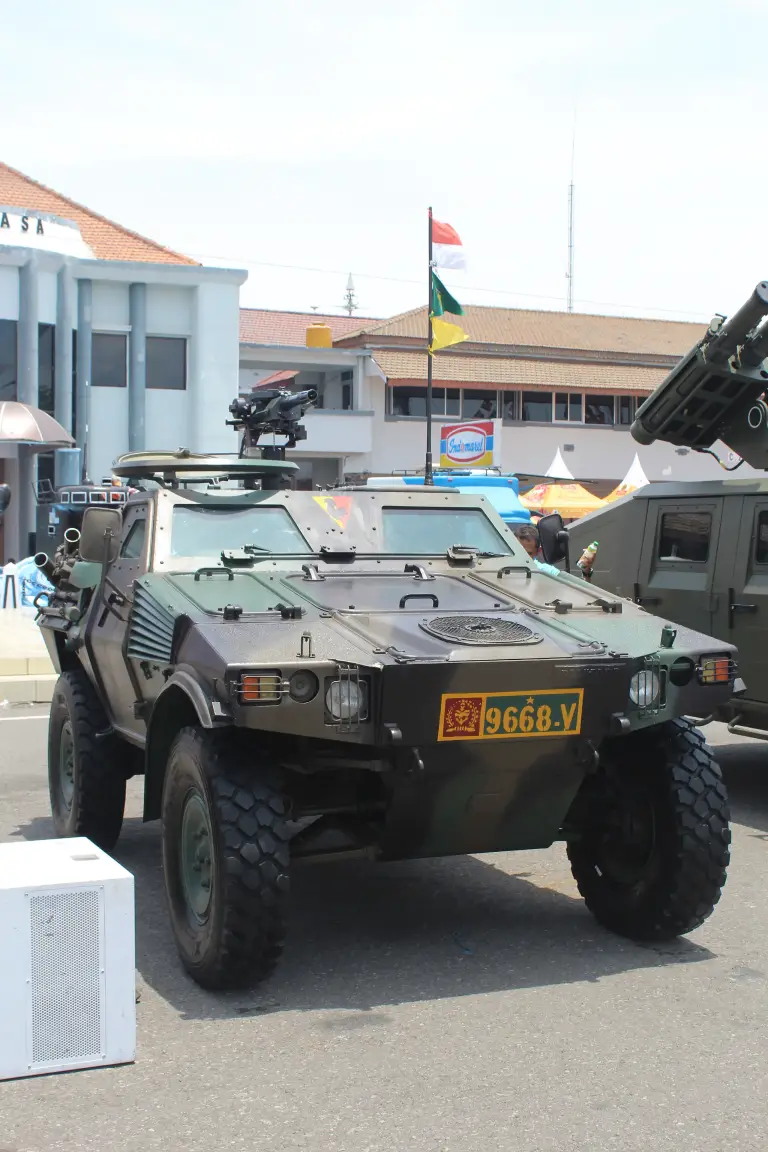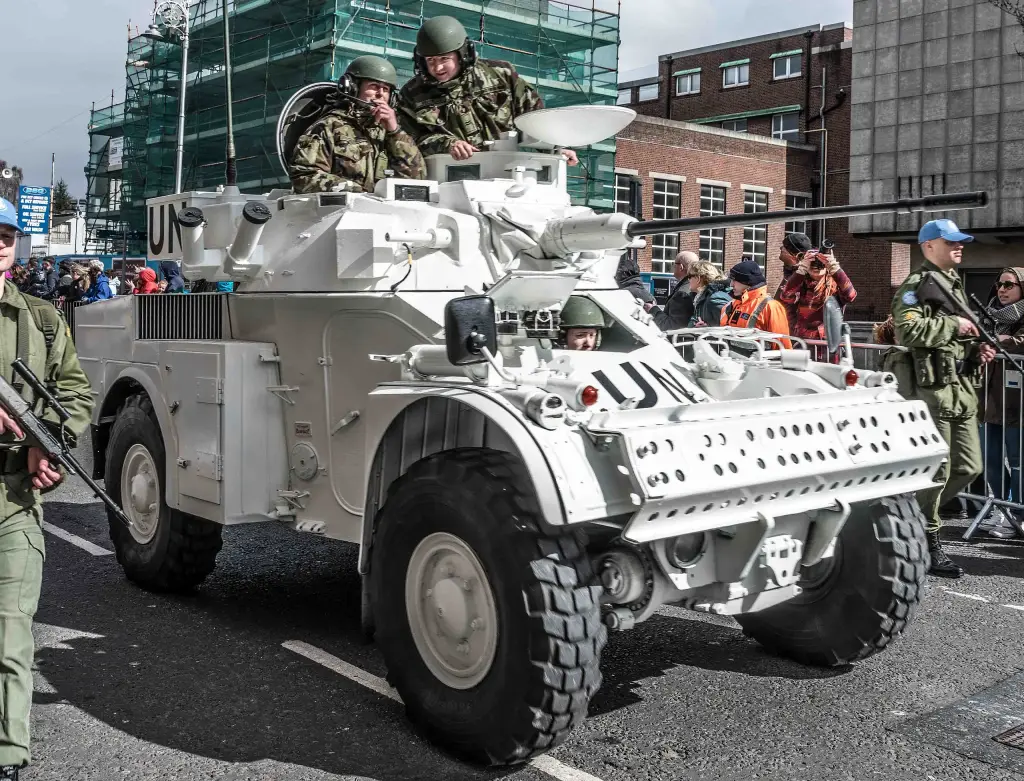
The Panhard AML, short for automitrailleuse légère, is a lightly armoured 4×4 car with reconnaissance capability. Designed by Panhard on a lightly armoured chassis, it weighs about 5.5 tonnes and can therefore be carried by air. Since 1959 it was sold on up to five continents, several variants stayed in production for half a century, and the type was operated by fifty-four national governments.
Panhard AML at a glance
| Type | light armoured car, Panhard model 245 |
|---|---|
| First prototype | 1959 |
| Production | from 1960, more than 4,000 built |
| Weight | about 5.5 tonnes |
| Armament | 60 mm breech-loading mortar and two 7.5 mm machine guns, later a 90 mm gun |
| Main gun (AML 90) | DEFA D921, low-velocity 90 mm rifled cannon |
| Ammunition | 53 mortar rounds, or 20 rounds of 90 mm |
| Effective range | 1,500 m with the 90 mm gun |
| Operators | fifty-four governments and other entities |
based on one source
History of the Panhard AML
During the Second World War the French army used a wide variety of vehicles for reconnaissance, from the compact Laffly S15 to the Panhard 178 and multi-wheeled designs such as the Type 201. After the war, keeping such a mixture of armoured cars became less attractive. In July 1945 Paris issued a requirement for a design combining the best features of the earlier vehicles, which led to the 8×8 Panhard EBR, in service from 1950. In 1956 the ministry of defence was persuaded to order a replacement for the Daimler Ferret scout car, and Panhard’s answer, the AML, entered service in 1961.
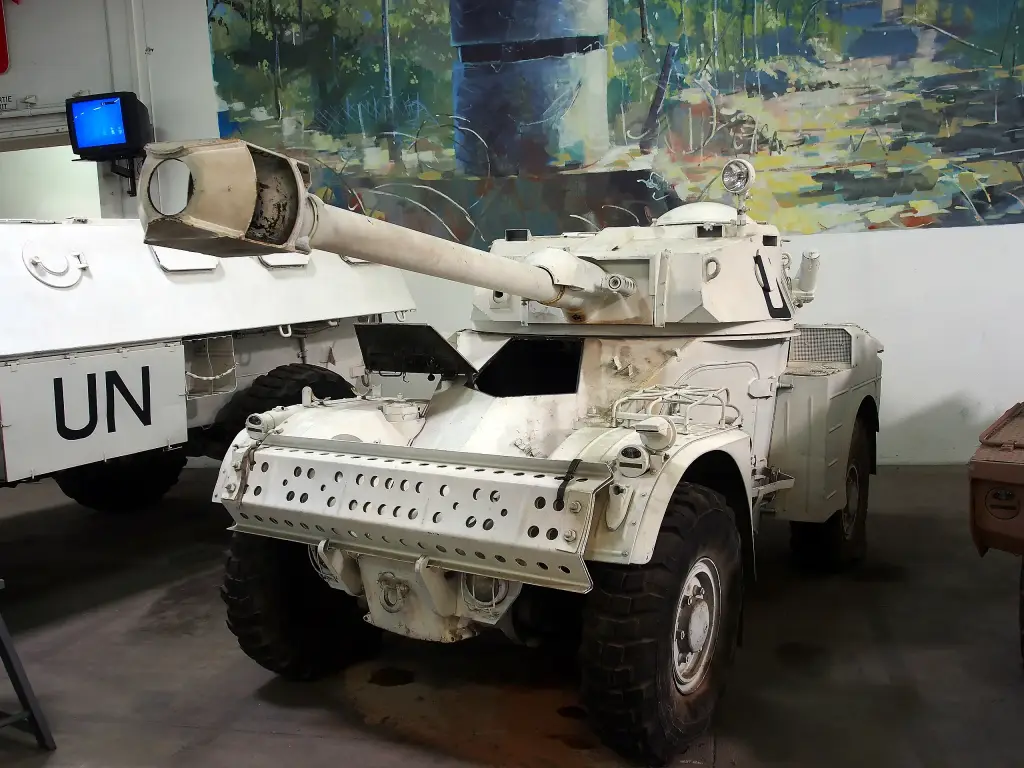
The AML was a private venture by Société de Constructions Panhard et Levassor, derived in part from the Ferret and similar to it in outward layout. France had bought two hundred Ferrets, which were light enough but carried only a single machine gun, inadequate for offensive work. Saviem, Berliet and Panhard asked to bid for a home-grown vehicle, and in 1956 the ministry issued specifications for an indigenous wheeled armoured car of similar size but mounting a breech-loading mortar. By 1959 this had become the Auto Mitrailleuse Légère, model 245 “B”. Early prototypes were finished in mid-1959 and by the end of 1961 at least one regiment in Algeria was receiving them. Until Panhard was acquired by Citroën later in the 1960s the AML was built at a single plant near the Porte de Choisy in Paris.
The vehicle was immediately successful, but as the Algerian war wound down so did the need for a light mortar carrier for anti-guerrilla work. Attention turned to the conventional threat from Soviet airborne armour such as the ASU-85, and South Africa, already an AML customer, asked Panhard to develop a variant with greater fire support. The answer was the H-90 turret with a 90 mm rifled gun firing fin-stabilised shaped-charge projectiles at 760 m/s, capable of penetrating 320 mm of armour. Later AMLs could therefore engage main battle tanks, carrying twenty rounds instead of the fifty-three of the mortar version.
Panhard also used AML components for a small personnel carrier, the Véhicule Transport de Troupes, better known as the Panhard M3. The AML earned a reputation for ruggedness, dependability, firepower for its weight and adaptability, which brought export success in more than forty countries, Africa being one of its largest markets; AMLs saw combat in Angola, Iraq and Chad and in the Lebanese civil war.
Design and features
- Air-portable: about 5.5 tonnes on a 4×4 chassis, light enough for airborne deployment.
- Heavy armament for a scout: the AML-245 was once regarded as one of the most heavily armed scout vehicles in service.
- 90 mm gun: able to destroy targets at 1,500 metres, a match for second-line and older main battle tanks.
- Mortar version: a 60 mm breech-loading mortar with 53 rounds plus twin 7.5 mm machine guns, all coaxial in the turret.
- Adaptability: fifty-four governments and other entities operated the type, and variants stayed in production for half a century.
Panhard AML versions
- AML 60 (model 245 B): the original version with a 60 mm Brandt gun-mortar and two MAS AA-52 machine guns.
- AML 90 (model 245 C): fitted with the H-90 turret and the 90 mm DEFA D921 gun.
- Panhard M3: a small armoured personnel carrier built from AML components.
- Export versions: sold across Africa, the Middle East and Latin America; South African and other local derivatives followed.
The AML came after the Panhard EBR and shared its role with the later Panhard ERC. Its ancestor was the Panhard 178; more vehicles are in the Panhard collection.
Video: Irish Defence Forces – Panhard AML 90 Shoot
Video on YouTube.
Sources
- Panhard AML, English Wikipedia: development, armament, operators