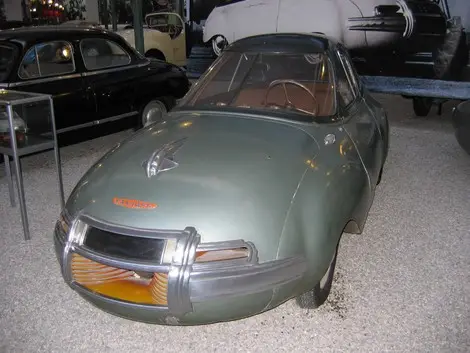
The Panhard Dynavia is a concept car built by Panhard in 1948 as an experiment in aerodynamics. It used the running gear of the Dyna X and a streamlined two-door body of aluminium and magnesium alloy.
Panhard Dynavia at a glance
| Maker | Panhard, Paris |
|---|---|
| Year | 1948 |
| Type | concept car, aerodynamic study |
| Chassis | Panhard Dyna X |
| Body | two-door, Duralinox aluminium/magnesium alloy |
| Engine | 610 cc air-cooled flat-twin |
| Power | 28 hp at 4,000 rpm |
| Weight | 650 kg |
| Drag coefficient | 0.26 |
| Top speed | 131 km/h |
| Fuel consumption | 3.5–5 L/100 km |
based on one source
History of the Panhard Dynavia
Before the end of the Second World War Panhard expected post-war demand for its large and expensive cars to be limited and that a smaller, cheaper model would be needed. Louis Bionier began work on a small two-box people’s car powered by Louis Delagarde’s new air-cooled two-cylinder boxer engine driving the front wheels. During the war Bionier had also pursued his interest in aerodynamics, watching the shapes and movements of birds and fish and building scale models of a streamlined seven-seat car he named the VP6; in 1945 he tested a one-fifth scale model in the wind tunnel of the Institut Aérodynamique at Saint-Cyr.
His work on the VP2, which entered production as the Panhard Dyna X, gave him a chassis on which to try his aerodynamic ideas at full scale. The result was the Panhard Dynavia, built in 1948.
The Dynavia was built on the Dyna X chassis with Panhard’s two-cylinder GM600 engine of 610 cc, driving the front wheels through a four-speed manual transaxle. Suspension was independent on all four corners, steering was by rack and pinion and the brakes were drums. The two-door body was executed in Duralinox, an aluminium and magnesium alloy, and gave a drag coefficient of just 0.26. The car was designed to seat four, although the narrow body and curving roof line limited passenger space; a tall greenhouse with a two-piece windscreen and backlite offered good visibility.
The Dynavia was first shown at the 1948 Paris Auto Salon and was well received by the public and the press. The car remained Panhard’s property and was eventually lent permanently to the Cité de l’Automobile museum in Mulhouse. A second car was sent to a Panhard dealer in Grenoble, sold to a Swiss owner and later scrapped after a crash, while parts for a third were produced but never assembled. The favourable impression made by the Dynavia, and the benefits of its shape, encouraged Paul Panhard to approve an aerodynamic body for the forthcoming Panhard Dyna Z.
Design and features
- Drag coefficient of 0.26: a very low figure for 1948, achieved with a curved two-door body.
- Duralinox body: an aluminium and magnesium alloy, light but more costly than steel.
- Central floodlight: a single lamp in the nose, with Cibié zero-dazzle headlamps concealed in tubes in the wings.
- Efficient flat-twin: 28 hp was enough for 131 km/h, about 18 per cent more than a Dyna X with the same drive train.
- Economy: fuel consumption reported between 3.5 and 5 litres per 100 km.
Panhard Dynavia versions
- First car: retained by Panhard and now in the Cité de l’Automobile, Mulhouse.
- Second car: sold to a Swiss owner and scrapped after a crash.
- Third car: parts made but never assembled.
The Dynavia was built on the Dyna X and led directly to the aerodynamic body of the Dyna Z. More cars are in the Panhard collection.
Video: #2085. Panhard dynavia 1948 (Prototype Car)
Video on YouTube.
Sources
- Panhard Dynavia, English Wikipedia: conception, specifications, history