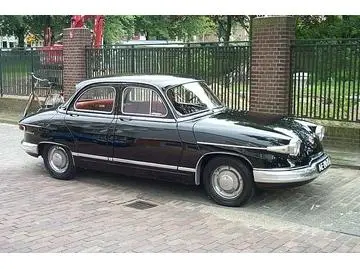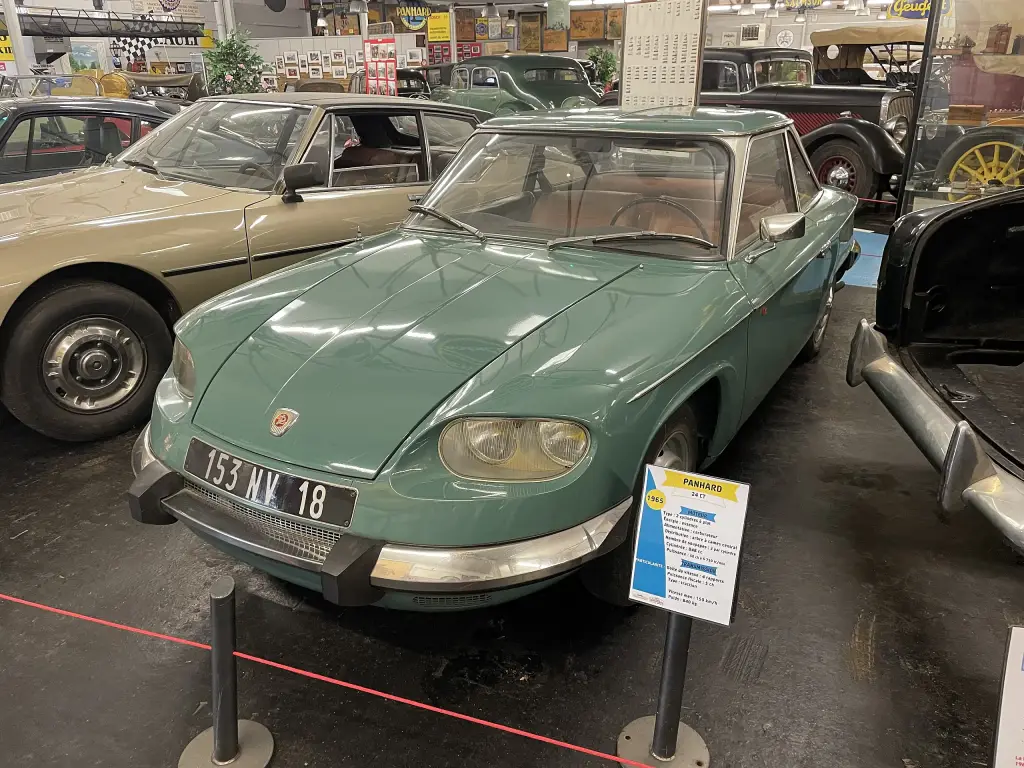
The Panhard 24 is a compact two-door coupé produced from 1964 to 1967 by the French maker Panhard. It was powered by a front-mounted air-cooled boxer twin whose basic design dated back to the 1940s. In 1965 a long-wheelbase version was added, sold as a two-door four- or five-seat saloon. The 24 was the last automobile produced by Panhard: from 1967 the company concentrated on light military vehicles.
Panhard 24 at a glance
| Maker | Panhard, Paris |
|---|---|
| Production | 1964–1967 (French sources give 1963) |
| Body | two-door coupé; long-wheelbase two-door saloon from 1965 |
| Engine | 848 cc air-cooled flat-twin |
| Power | 42 or 50 CV, depending on tune |
| Drive | front-wheel drive |
| Gearbox | four-speed, all-synchromesh |
| Chassis | separate tubular steel chassis |
| Top speed | 135–150 km/h; about 160 km/h with the Tiger 10 S engine |
| Built | 28,651 |
| Last car | a 24 B, 20 July 1967 |
History of the Panhard 24
In 1955 Citroën acquired a 25 per cent share of Panhard’s automobile business, and over the next two years the dealer networks of the two brands were merged. That gave dealers a small car in the Citroën 2CV, a medium saloon in the Panhard Dyna Z and a large car in the Citroën DS, and it boosted sales of the Dyna Z and of its successor, the Panhard PL 17. Citroën also gained production capacity at Panhard’s plant in the 13th arrondissement of Paris, which from then on built 2CV Fourgonettes alongside Panhard saloons.
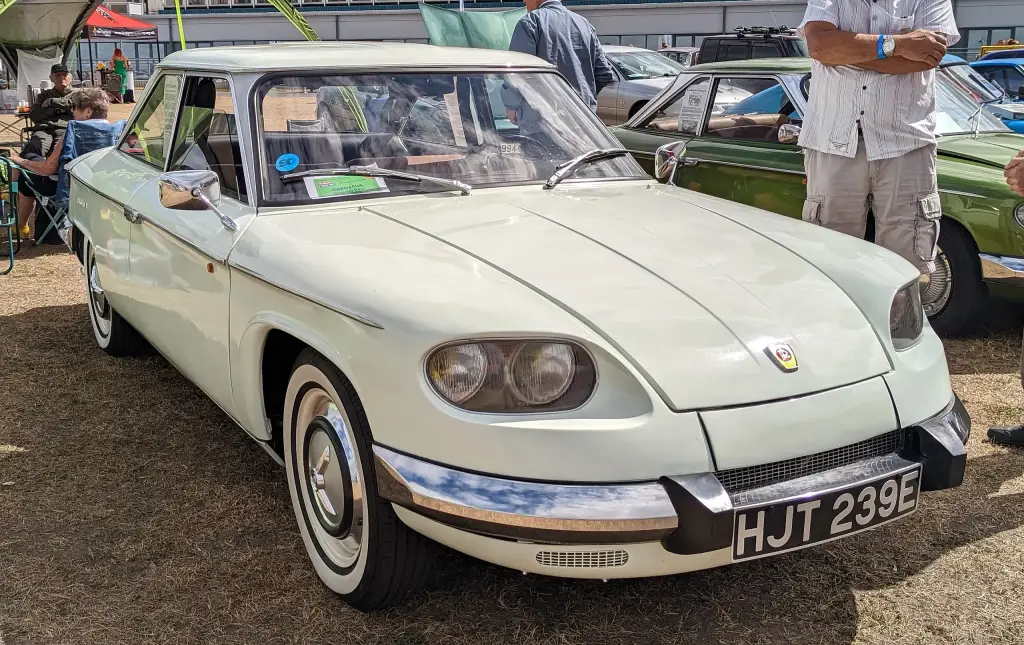
Panhard’s plan to replace the roomy four-door PL 17 met strong opposition from Citroën president Pierre Bercot, who did not want a new model intruding into any market segment where Citroën had an existing or planned car. That may explain why the PL 17 was eventually replaced by a coupé, the Panhard 24, while the design team’s proposal for a four-cylinder engine was rejected in favour of the existing two-cylinder unit on grounds of cost. Plans for a four-door 24 saloon and a five-door estate, which would have made the car a more direct replacement for the PL 17, were also blocked, although styling models for both were built, as was a cabriolet concept.
The styling of the 24 was well received by the press. It had a low, modern body with a prominent raised beltline reminiscent of the Chevrolet Corvair. At a time when monocoque construction was becoming the norm, the 24 sat on a separate tubular steel chassis, which allowed relatively thin window pillars, an airy cabin and good all-round visibility; the rigidity of the body was increased by pleating and reinforcing the roof panel. Under the skin the structural layout was little changed from that of the Dyna 54. The 24 incorporated twin headlamps recessed into the nose under a transparent cover, a motif that Citroën adopted for the DS in 1967.
Production of the 24 began in 1963 according to French sources, and sales fell away sharply: 5,224 cars in 1966 and 2,456 in 1967. The last Panhard, a 24 B, was built on 20 July 1967 and the end of production was announced on 28 August 1967. A total of 28,651 cars of the type were made, and the factory went on to assemble 2CV vans.
Design and features
- Modern body, old engine: a completely new coupé shape around an 848 cc flat-twin whose layout dated from 1947.
- Tubular chassis: a separate steel-tube frame with thin pillars and a light, airy cabin.
- Recessed twin headlamps: set under a transparent cover, a feature Citroën copied for the DS in 1967.
- Comfort details: height-adjustable seats, adjustable steering wheel, heated rear screen and a lit vanity mirror.
- Front-wheel drive: four-speed all-synchromesh gearbox, rack-and-pinion steering, independent suspension with a torsion bar at the rear.
Panhard 24 versions
- 24 CT coupé: the short-wheelbase two-door with the 50 CV engine and a claimed 150 km/h.
- 24 BT: the long-wheelbase version launched in 1965, sold as a four- or five-seat two-door saloon and capable of 135 km/h with 42 CV.
- Tiger 10 S: a more highly tuned version reported to reach about 160 km/h.
- 24 BA: a much more basic version offered briefly in 1966; only 161 were built.
- Unbuilt projects: four-door saloon, five-door estate and cabriolet, all dropped.
The 24 replaced the Panhard PL 17, itself developed from the Panhard Dyna Z. More cars are in the Panhard collection.
Video: Panhard 24 bt at French Toast Picnic
Video on YouTube.
Sources
- Panhard 24, English Wikipedia: design, body, engine, variants
- Panhard 24, French Wikipedia: production dates, sales, total built