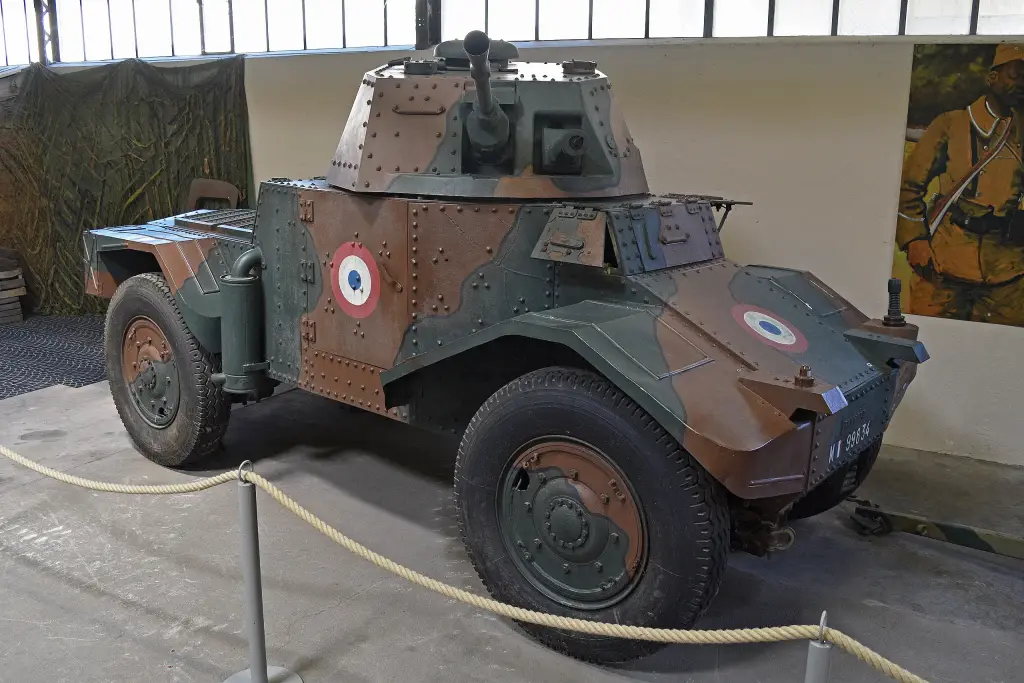
The Panhard 178 was a French four-wheel-drive reconnaissance armoured car designed for the cavalry before the Second World War. Officially the Automitrailleuse de Découverte Panhard modèle 1935, it carried a crew of four, a 25 mm gun and a coaxial 7.5 mm machine gun. The Germans used captured examples as the Panzerspähwagen P204 (f), and after the war France built a derived 178B.
Panhard 178 at a glance
| Official name | Automitrailleuse de Découverte Panhard modèle 1935 |
|---|---|
| Nickname | “Pan-Pan” |
| Type | 4×4 reconnaissance armoured car |
| Crew | four |
| Armament | 25 mm gun and 7.5 mm coaxial machine gun |
| Turret | APX3B |
| Production | from 1935; continued for Germany after June 1940 |
| Delivered by 1 September 1939 | 219, including prototypes |
| German designation | Panzerspähwagen P204 (f) |
| Post-war version | Panhard 178B |
based on one source
History of the Panhard 178
In December 1931 the French cavalry drew up a plan for future armoured fighting vehicles. One class was the Automitrailleuse de Découverte, a specialised long-range reconnaissance vehicle. The specification, approved in December 1932, asked for a weight of four tonnes, a range of 400 km, a speed of 70 km/h, a cruising speed of 40 km/h, a turning circle of 12 metres, 5–8 mm of armour, a 20 mm gun and a 7.5 mm machine gun.
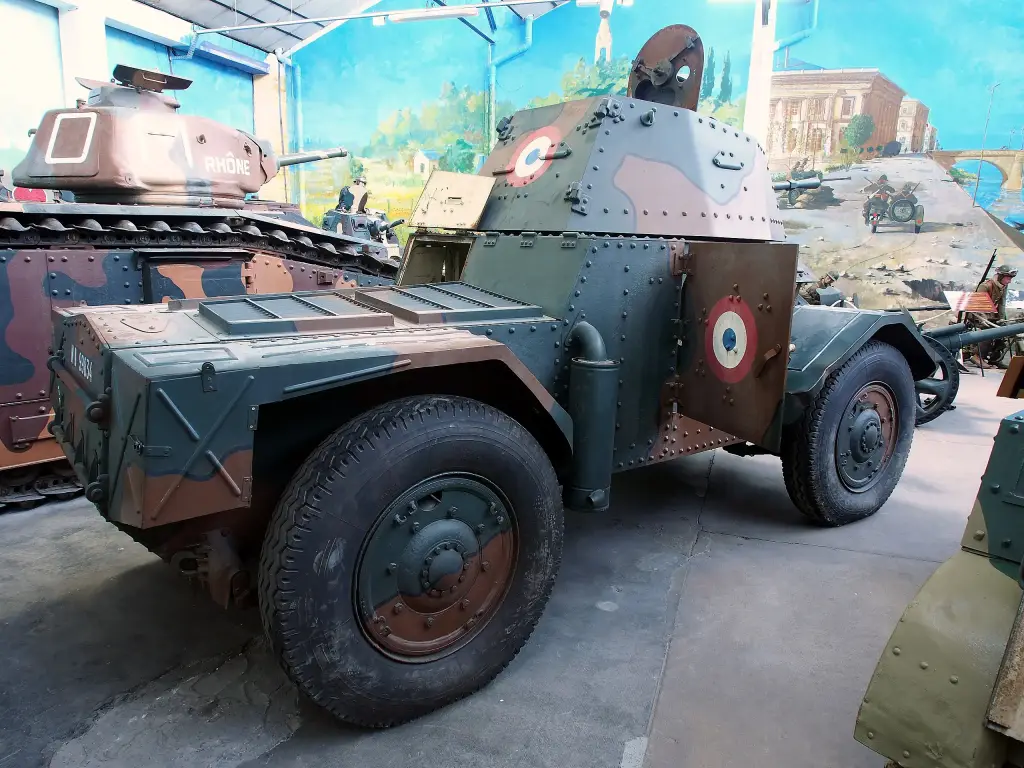
Panhard was one of four companies invited to build a prototype, alongside Renault, Berliet and Latil. Its vehicle was ready in October 1933 and was shown to the Commission de Vincennes in January 1934 as the Panhard voiture spéciale type 178, fitted for the trials with a temporary 13.2 mm machine gun turret. It was larger and much heavier than the four tonnes prescribed, but the commission still judged it the best of the competing projects and accepted it in February 1934; the improved prototype was accepted in late 1934 as the AMD Panhard Modèle 1935, now with the APX3B turret. A further test programme in 1937 led to modifications including a silencer and a ventilator on the turret. The design was very advanced for its day and still looked modern in the 1970s; it was the first 4×4 armoured car mass-produced for a major country.
Final assembly and painting took place at the Panhard & Levassor works on the Avenue d’Ivry in Paris, but the armoured hulls were prefabricated by forges acting as subcontractors, first mainly Batignolles-Châtillon at Nantes and from 1940 the forge at Firminy. The turrets, armed by the Atelier de construction de Rueil, came mainly from Cail at Denain, and turret production regularly lagged behind the hulls. Deliveries were delayed by strikes: the first vehicles of the initial orders were only handed over from 2 February 1937. By 1 September 1939, 219 vehicles had been delivered, 71 behind schedule.
After the fall of France in 1940 a number of the cars were taken over by the Germans and employed as the Panzerspähwagen P204 (f); for some months after the June armistice production continued for the benefit of Germany. After the war a derived version, the Panhard 178B, was again put into production by France.
Design and features
- Four-wheel drive: the first 4×4 armoured car mass-produced for a major country.
- 25 mm gun: a powerful weapon for a vehicle of this size in the 1930s, with a coaxial 7.5 mm machine gun.
- APX3B turret: the standard French turret of the period, fitted after the early trials.
- Advanced design: still regarded as modern in the 1970s, three decades after it entered service.
Panhard 178 versions
- Type 178 prototype (1933–34): trial vehicle with a temporary 13.2 mm machine gun turret.
- AMD Panhard Modèle 1935: the production car with the APX3B turret.
- Preseries of thirty: the first two orders, differing in detail from later vehicles.
- Panzerspähwagen P204 (f): captured cars taken into German service after 1940.
- Panhard 178B: post-war French derivative built after 1945.
The 178 was the ancestor of the post-war Panhard EBR and of the Panhard AML. More vehicles are in the Panhard collection.
Sources
- Panhard 178, English Wikipedia: development, production, German use