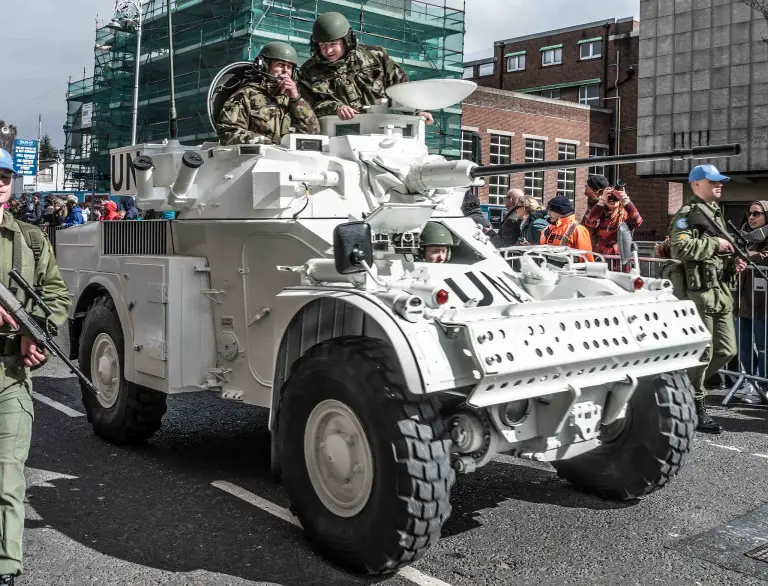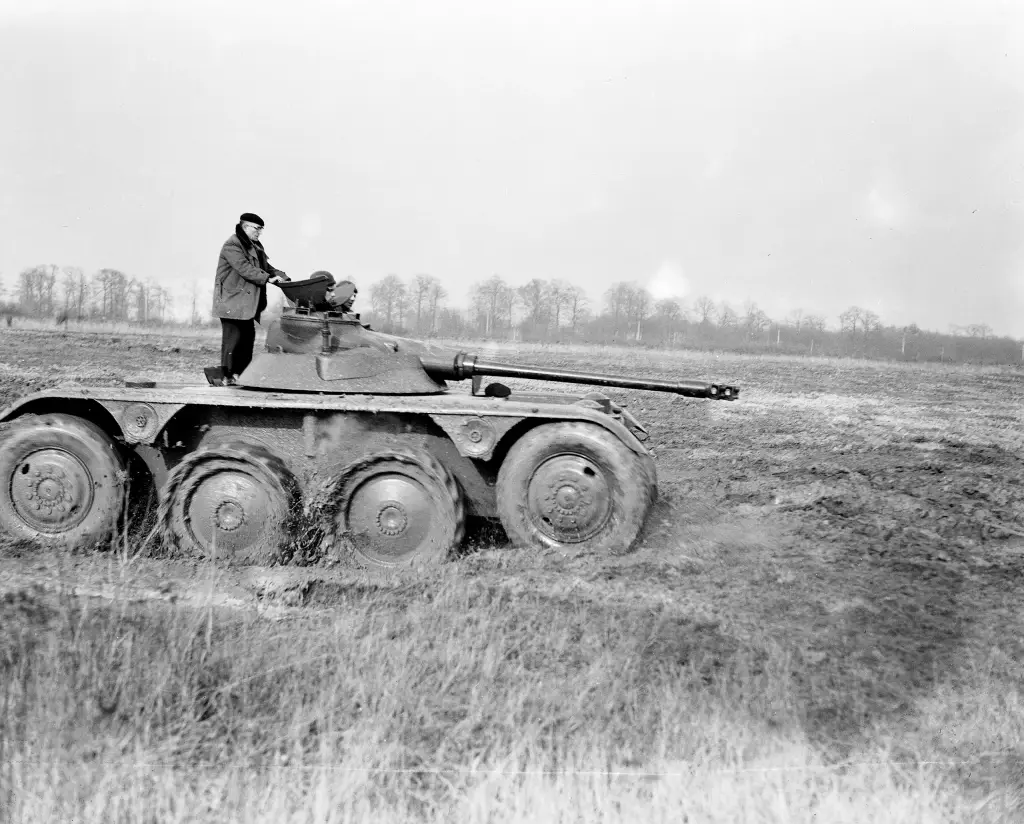
The Panhard EBR, for Engin Blindé de Reconnaissance, is an eight-wheeled armoured car designed by Panhard for the French Army and later used around the world, notably in Algeria and by Portugal during the Portuguese Colonial War. It had four crew, two of them drivers at opposite ends, and an oscillating turret with a 75 mm gun.
Panhard EBR at a glance
| Type | 8×8 armoured reconnaissance vehicle |
|---|---|
| Maker | Panhard, France |
| Crew | four: two drivers, gunner and commander |
| Engine | 200 hp, 6-litre air-cooled flat-12 |
| Weight | 13 tonnes |
| Armament (1951) | 75 mm SA 49 in an FL 11 oscillating turret |
| Armament (1954) | 75 mm SA 50 with autoloader in an FL 10 turret |
| Model 1951 built | 836, between 1951 and 1954 |
| Model 1954 built | 279, between 1954 and 1956 |
| Ground pressure | 0.7 kg/cm² with all eight wheels down |
based on one source
History of the Panhard EBR
The EBR was based on the earlier Panhard AM 40 P/Model 201, a light armoured car designed before the Second World War that never got beyond the prototype stage. After the war a new contest for a reconnaissance armoured car saw the Panhard proposal beat two other French firms. The two basic ideas of the M.201 were kept, eight wheels and an oscillating turret, but the new vehicle was much heavier, 13 tonnes against 8, carried a crew of four instead of two and mounted a 75 mm gun rather than a 25 mm weapon.
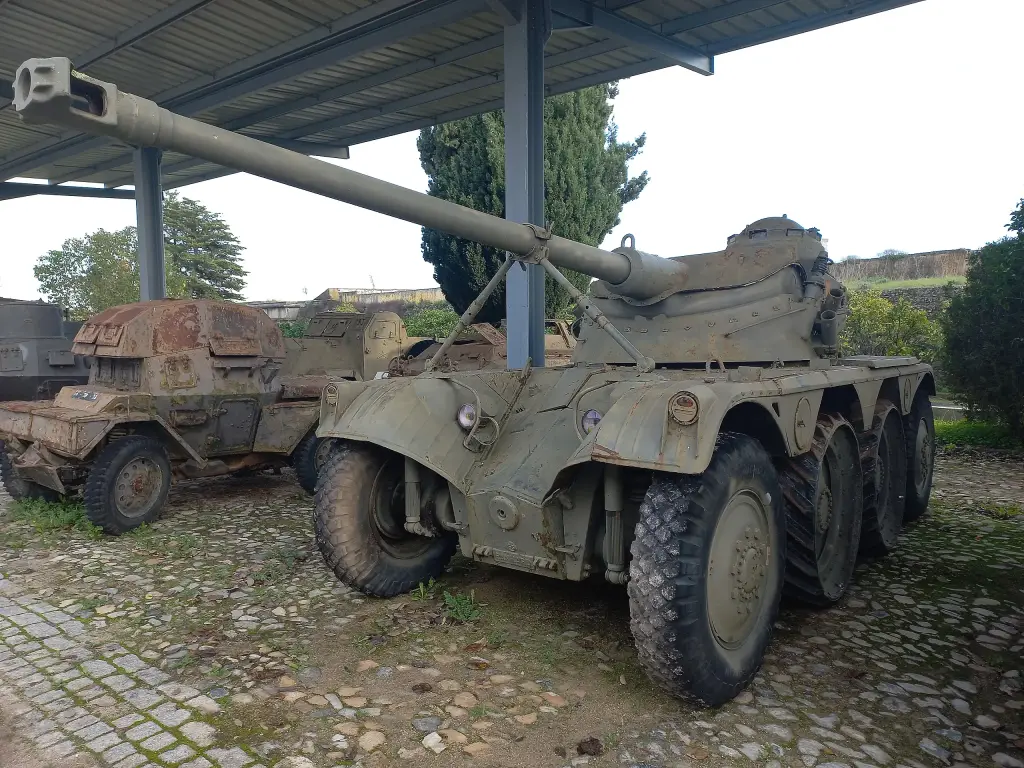
Among its novelties were Michelin anti-bullet tyres and Veil-Picard tubes, which contain a series of nitrogen-filled cells so that a tyre can absorb bullet hits without going flat. The hull sits on an eight-wheel drive with four inner metal wheels that can be raised for road driving, while the four central wheels have aluminium rims with steel grousers separated by rubber blocks; with all eight wheels down the ground pressure is only 0.7 kg per square centimetre. The engine, a 200 hp 6-litre air-cooled flat-twelve derived from Panhard’s two-cylinder car unit, was mounted under the floor of the fighting compartment, which meant the turret had to be removed for major repairs.
The model 1951 was the first mass-produced EBR, with 836 built between 1951 and 1954. It had a round FL 11 oscillating turret armed with a manually loaded 75 mm SA 49 gun, which used the ammunition and ballistics of the US 75 mm guns fitted to the Sherman and Chaffee. Between 1964 and 1968, 650 of these cars were upgraded, their guns rebored to 90 mm and fitted with a single-baffle muzzle brake as the CN 90 F2.
The model 1954 was developed to improve the firepower of reconnaissance units. A total of 279 were built between 1954 and 1956 with the FL 10A2C oscillating turret of the AMX-13, armed with a long 75 mm SA 50 fed by an autoloader with two six-round drums and carrying 36 rounds. The suspension was strengthened for the heavier turret. The 1954 model was phased out in 1964, though a few served on as command post vehicles nicknamed sauterelle, with guns deactivated and a chart table and radios fitted in place of the ammunition racks. Some were bought by West Germany, Indonesia and Portugal, the last seeing action in the Portuguese Colonial War, and 28 ETT troop-carrier variants were bought by Portugal. A turretless EBR carried the coffin of President Charles de Gaulle at his state funeral.
Design and features
- Eight wheels, four of them retractable: the inner metal wheels can be raised for road driving.
- Oscillating turret: the gun elevates with the upper half of the turret, a French speciality of the period.
- Two drivers: one at each end, so the car can withdraw as quickly as it advances.
- Run-flat tyres: Michelin anti-bullet tyres with Veil-Picard nitrogen cells.
- Low ground pressure: 0.7 kg/cm² with all eight wheels deployed.
Panhard EBR versions
- EBR model 1951: 836 built, FL 11 turret and 75 mm SA 49 gun.
- EBR revalorisé: 650 model 1951 cars rebuilt between 1964 and 1968 with a 90 mm gun.
- EBR model 1954: 279 built with the FL 10 turret, 75 mm SA 50 and autoloader.
- EBR-ETT: troop transport variant; two prototypes, then 28 bought by Portugal.
The EBR led to the lighter Panhard AML and shared its role with the Panhard ERC; its ancestor was the Panhard 178. More vehicles are in the Panhard collection.
Video: panhard ebr 1951
Video on YouTube.
Sources
- Panhard EBR, English Wikipedia: development, models, service