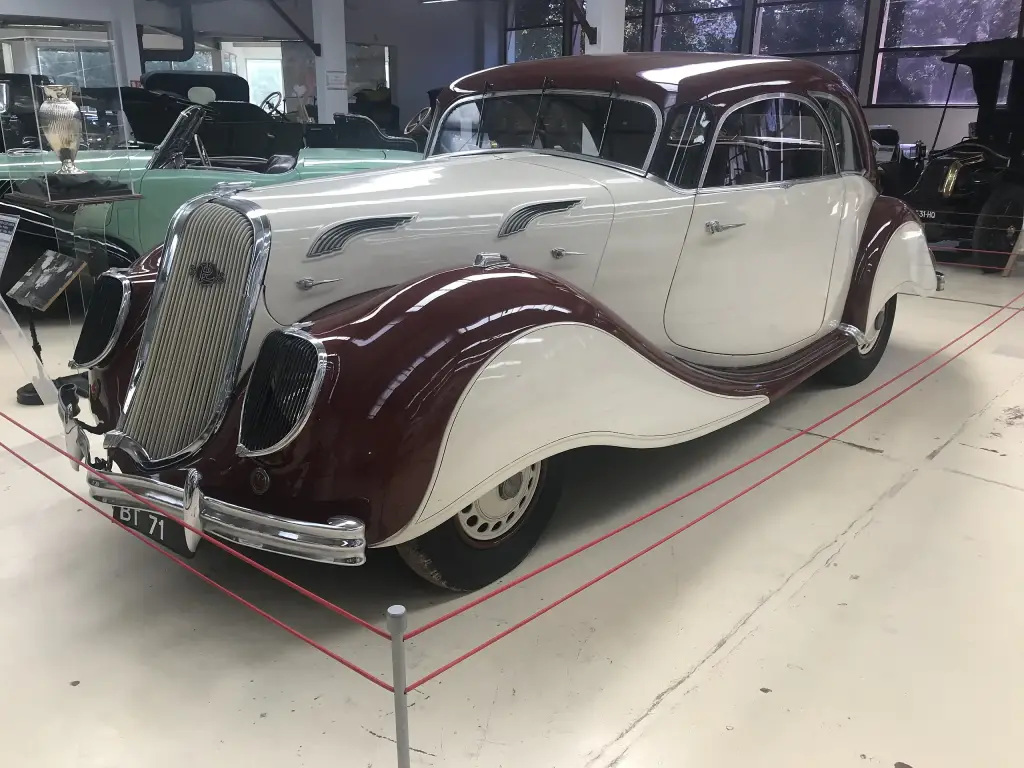
The Panhard et Levassor Dynamic is a large car produced by the French maker from 1936 to 1940 as a replacement for its CS. It was introduced at the Paris Motor Show in October 1936 and combined a streamlined body with an early welded steel monocoque and independent front suspension.
Panhard Dynamic at a glance
| Maker | Panhard et Levassor, Paris |
|---|---|
| Production | 1936–1940 |
| Introduced | Paris Motor Show, October 1936 |
| Designer | Louis Bionier |
| Body | welded steel monocoque, no separate chassis |
| Engines | 2,516 cc six (130), 2,861 cc six (140), 3,834 cc six (160) |
| Power | 75 hp in the 140, 100 PS in the 160 |
| Claimed top speed | 130 km/h for the Dynamic 130 |
| Steering | central until 1939, then conventional |
| Wheelbases | three; 280 cm for most cars |
| Dynamic 140 built | 2,230 by 1940 |
| Dynamic 160 built | 153 by 1938 |
History of the Panhard Dynamic
For the Dynamic, Panhard’s in-house designer Louis Bionier created a Streamline Moderne shape with front and rear wheel spats, two or three windscreen wipers and split A-pillars with curved glass inserts that he had pioneered on the earlier Panoramique. The headlamps were built into the front wings, with surrounds that echoed the shape of the grille. Several of these ideas were taken up by other makers, and headlamps integrated into the bodywork soon became normal; in 1936 they gave the car a very modern look.
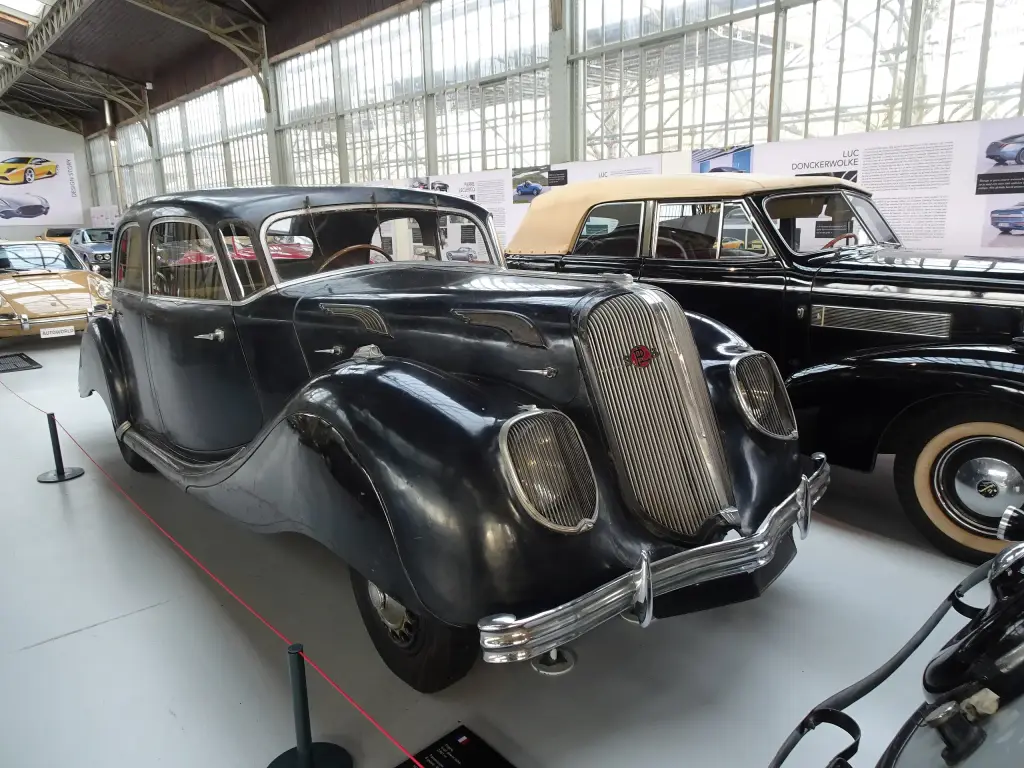
The bodies were also technically remarkable. Despite its size, the Dynamic offered little work to traditional coachbuilders: it was the first French luxury car with a steel body welded together electrically and built as a monocoque, without a separate chassis. A six-light four-door saloon with a long cabin and no boot was added in the autumn of 1937 and could seat nine, while a four-door berline with a shorter cabin and a protruding boot was also available. The car was unusually wide, allowing three abreast, and on early cars the steering wheel was placed in the middle of the front panel in the hope of giving a better view out. It was the feature most commented on at the 1936 show, but the market found it too much and drivers complained about the contortions needed to reach the centre seat; from 1939 the steering wheel was conventionally placed.
The first prototype, the Dynamic 20 CV of March 1936, had a 3,485 cc six. The production car, sold from 1936 as the Dynamic 130, used the 2,516 cc sleeve-valve six of the CS, placing it in the 14 CV class, and the name referred to a claimed 130 km/h. Beside it Panhard offered the Dynamic 140 with the 2,861 cc engine of the CS Spécial, 75 hp and 16 CV; this was the most popular version, with 2,230 built by 1940. In 1937 came the Dynamic 160, successor to the DS, with a 3,834 cc six of 100 PS, of which 153 were built by 1938. By 1940 the Dynamic was the last production car in the world with a sleeve-valve engine.
The Dynamic was never cheap, reflecting its technical progress, and less than six months after the launch Panhard raised many prices by more than 20 per cent. After February 1937 the short-wheelbase Junior 130 coupé cost 53,850 francs and the four-door Berline 130 started at 58,850 francs, against 22,500 francs for a Renault Primaquatre berline in October 1936. Production ended when war stopped it in 1940.
Design and features
- Steel monocoque: the first French luxury car with an electrically welded steel body and no separate chassis.
- Integrated headlamps: built into the wings with grille-shaped surrounds, a style soon copied elsewhere.
- Independent front suspension: wishbones with their upper elements mounted directly on the engine.
- Central steering: fitted on early cars for a better view, replaced by a conventional layout in 1939.
- Nine-seat saloon: the six-light body of 1937 had a long cabin and no boot.
Panhard Dynamic versions
- Dynamic 130 (X76): 2,516 cc, 14 CV, discontinued for 1938.
- Dynamic 140 (X77, then X81): 2,861 cc, 75 hp, the most popular version.
- Dynamic 160 (X80, then X82): 3,834 cc, 100 PS, the range-topping successor to the DS.
- Coupé and cabriolet: two-seater and open versions, only 358 built by the end of 1938.
- Limousine: a six-window car with an optional partition, added in 1938.
The Dynamic was Panhard’s last large luxury car before the war; the company’s post-war line began with the Dyna X and continued through the Dyna Z. More cars are in the Panhard collection.
Video: Panhard Dynamic comme si vous y étiez
Video on YouTube.
Sources
- Panhard et Levassor Dynamic, English Wikipedia: bodies, engines, variants, prices
- Panhard et Levassor Dynamic, French Wikipedia: body details, production figures