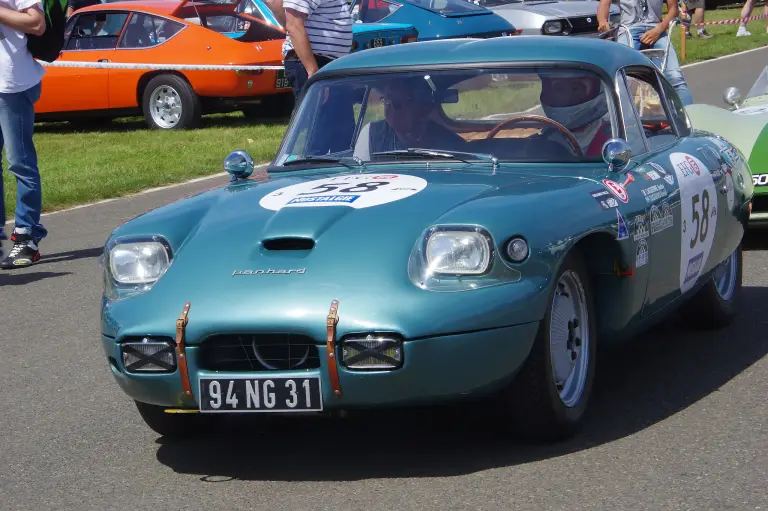
The Panhard Dyna Junior is a small roadster produced by the French maker Panhard from April 1952 until 1956. It was created at the insistence of Panhard’s American importer, J.B. Ferguson, who saw the success of small MG, Triumph and Alfa Romeo roadsters with young American buyers and offered to finance a rival.
Panhard Junior at a glance
| Maker | Panhard, France |
|---|---|
| Production | April 1952–1956 |
| Type | two-seat roadster, later a cabriolet |
| Chassis | Panhard Dyna X |
| Body | aluminium at first, steel on the production model |
| Engine | 747 cc, then 850 cc air-cooled flat-twin |
| Power | 35 ch, then 42 ch; 60 ch with the MAG supercharger in 1955 |
| Layout | front-wheel drive |
| Top speed | 145 km/h with the supercharged engine |
| Last version | the cabriolet, built until April 1956 |
based on French Wikipedia only
History of the Panhard Junior
The Junior owed its existence to the pressure of Panhard’s American importer, J.B. Ferguson. Tired of seeing MG, Triumph and Alfa Romeo roadsters sell to young American customers, he suggested a small roadster designed for his market and offered to finance the study and the build. Panhard, whose finances were in a poor state, accepted. A prototype was built in record time by the coachbuilder Di Rosa, but the Korean War made the situation difficult, Ferguson withdrew and Panhard continued the development alone.
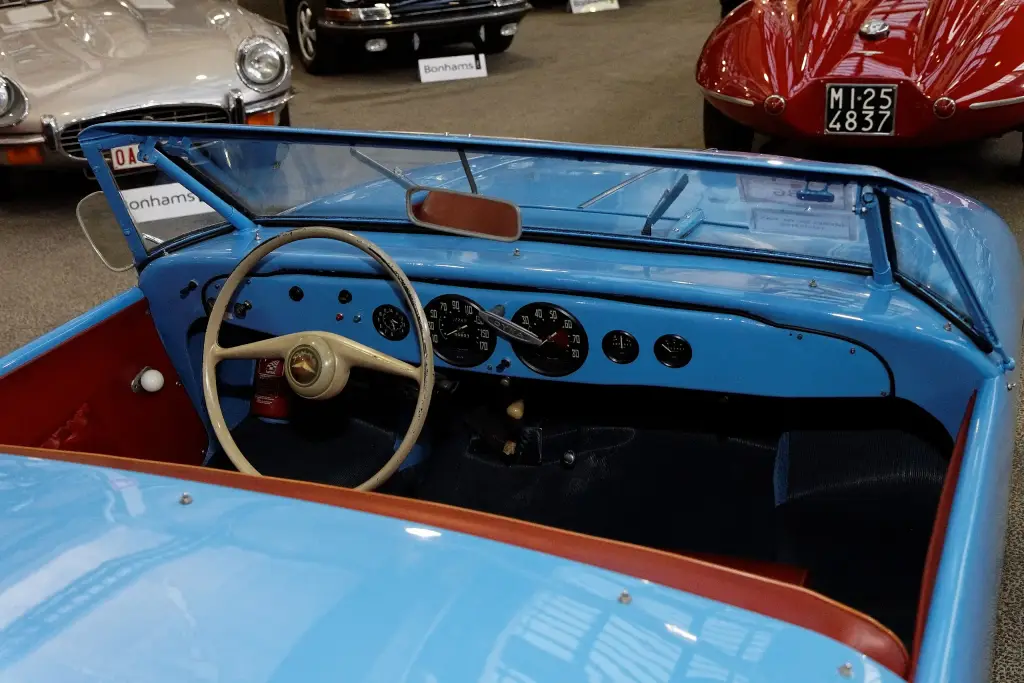
A second prototype was built for the Paris Salon of 1951, based on the Dyna X chassis and with an aluminium body like the saloon. The boot was reached by folding down the two-seat bench, and the car used the saloon’s 747 cc flat-twin, which despite its efficiency and modest appetite developed only 35 ch. The Junior inherited Panhard’s legendary roadholding and was capable of startling performance; spartan and light, it became the darling of impecunious young drivers.
The original plan was for 500 cars, but demand in France, the only market since Panhard had no foreign network apart from the American importer, made the company change its strategy. A more standard model was presented with a steel body replacing the costly aluminium one; the weight rose by more than 100 kg, compensated by a new 850 cc engine of 42 ch. The Junior was offered with the 4 CV and 4 CV Sprint engines, and for 1953 the 5 CV and 5 CV Sprint engines appeared.
Around February 1953 the roadster was joined by a cabriolet with winding side windows in place of the door transparencies and with exterior door handles, and in March a three-place bench was fitted after a chassis modification. For 1954 the Dyna X grille gave way to an oval opening with an aluminium bar and the dashboard gained two dials; in March 1954 the bumpers were raised. For 1955 a MAG supercharger option raised power to 60 ch and top speed to 145 km/h. The 4 CV versions were dropped in June 1954 and the roadster in March 1955; the cabriolet continued until April 1956, by then outclassed by more modern, better finished and more powerful cars. The resemblance between the Junior and the 1991 Nissan Figaro leaves little doubt about the Japanese car’s inspiration.
Design and features
- Dyna X underpinnings: the chassis and flat-twin engine of Panhard’s small saloon.
- Very light: an aluminium body on the prototype, which made the most of modest power.
- Panhard roadholding: the Junior was known for its grip and lively handling.
- Growing engine range: from 35 ch in 747 cc to 42 ch in 850 cc, and 60 ch with the optional MAG supercharger.
- Open or closed: a roadster from 1952 and a cabriolet with winding windows from 1953.
Panhard Junior versions
- Prototype (1951): Dyna X chassis, aluminium body, 747 cc engine.
- Roadster (1952–1955): steel body and 850 cc engine from the production model onwards.
- Cabriolet (1953–1956): winding side windows, exterior handles and a three-place bench.
- Supercharged version (1955): MAG blower, 60 ch and 145 km/h.
The Junior was built on the Dyna X and sold alongside the Dyna Z saloon. More cars are in the Panhard collection.
Video: Panhard X87 Junior Cabriolet 1954
Video on YouTube.
Sources
- Panhard Junior, French Wikipedia: history, engines, versions