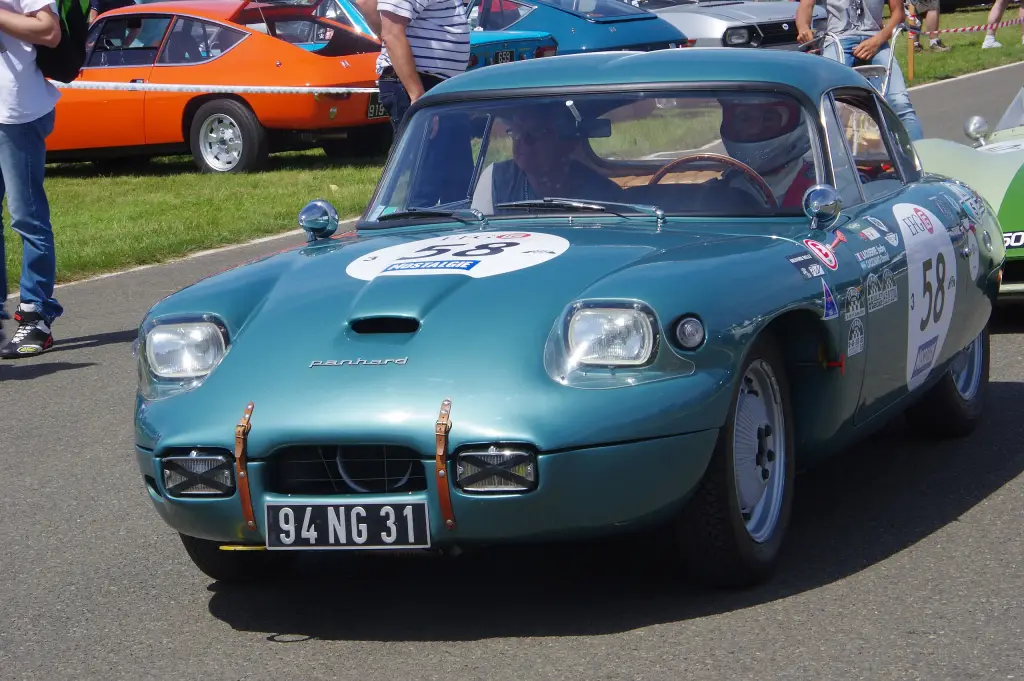
The Panhard CD is a small coupé designed by Charles Deutsch and built by Panhard from 1963 to 1965. The CD took its name from Deutsch and continued the line of Panhard-powered cars built by Deutsch-Bonnet. It was the production version of the CD Dyna that raced at Le Mans in June 1962.
Panhard CD at a glance
| Designer | Charles Deutsch, with aerodynamicist Lucien Romani |
|---|---|
| Built by | Panhard, 1963–1965 |
| Body | fibreglass coupé, “double-bubble” roof, tapered tail |
| Chassis | steel backbone frame, 40 kg |
| Engine | 848 cc Panhard M5-T Tigre flat-twin |
| Power | 49 hp in the GT, 59 hp in the Rallye |
| Drive | front-wheel drive, four-speed gearbox |
| Drag coefficient | 0.22 |
| Top speed | 165 km/h GT, 180 km/h Rallye |
| Price when new | 15,500 francs GT, 16,500 francs Rallye |
based on one source
History of the Panhard CD
At the end of 1961 the partnership between Charles Deutsch and his long-time collaborator René Bonnet ended. Shortly afterwards Panhard asked Deutsch to design a successor to his DB HBR 5 for the 1962 24 Hours of Le Mans. Work was approved at the end of January 1962 and five cars were built: one prototype with a hand-hammered steel body and four with glass-reinforced plastic bodywork by Chappe et Gessalin. The first car, chassis 101, was finished in seventy days. The cars were variously called the CD-Panhard coach, the Panhard et Levassor CD Le Mans and the CD-Panhard Dyna Coupé, but in the Le Mans results they appear as the CD Dyna.
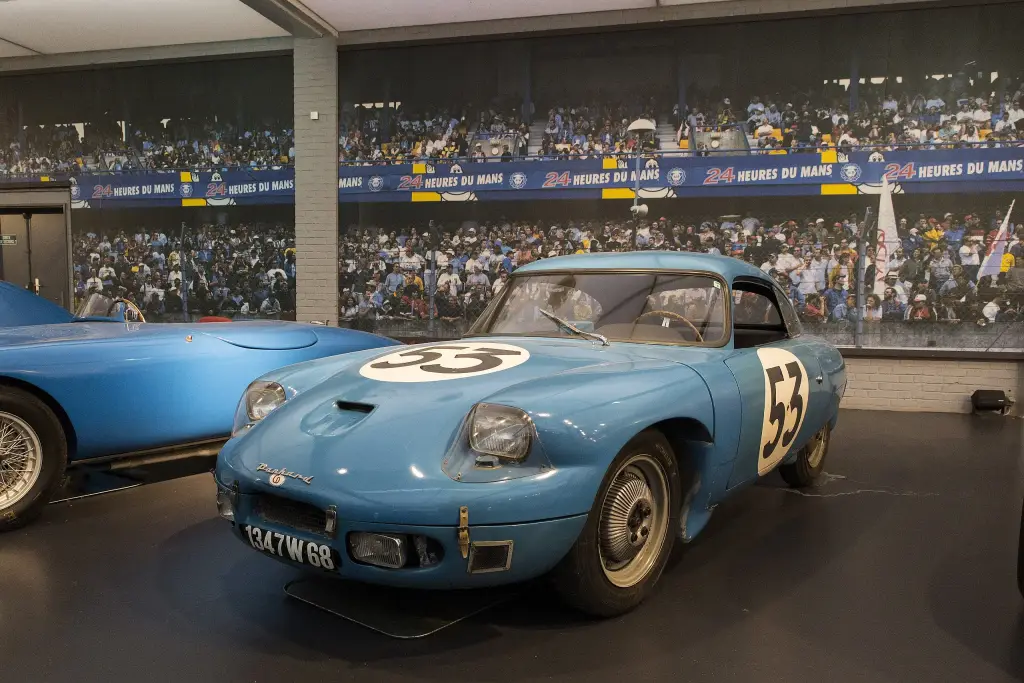
The bodies were shaped by Deutsch with the aerodynamicist Lucien Romani and his protégé Marcel Hubert. The engines were Panhard’s air-cooled boxer twins, designed by Louis Delagarde and tuned with enlarged valves, a higher-lift camshaft and two Zenith down-draught carburettors; the Le Mans cars used a 702 cc version, and the transaxle came from the Panhard PL 17. The coupé first appeared at the Le Mans test days in April 1962, where two cars set the 20th and 21st best times. At the 1000 km of Nürburgring in May one car finished 24th overall.
Four cars were entered for the 24 Hours of Le Mans on 23–24 June 1962. Number 54 was eliminated in the ninth hour after overturning and catching fire, and number 55 retired in the fourteenth hour with an overheated engine. Number 53, driven by André Guilhaudin and Alain Bertaut, finished 16th overall, won its class and took the Indice de Performance, with an average speed of 142.793 km/h and a fastest lap at 160.403 km/h. In September a modified car reached 204 km/h on the Hunaudières straight, and on 21 October the same drivers finished 20th in the 1000 km of Paris, which ended the racing career of the Dyna Coupés.
The production Panhard CD inherited the grand touring coupé body with its tapering rear and double-bubble roof. The fibreglass shell was extremely aerodynamic, with a drag coefficient of 0.22, and was mounted on a torsionally rigid central backbone frame of the kind used by earlier DB designs; the complete chassis weighed 40 kg. The front bodywork tilted up and back as a single piece to expose the front chassis and the entire drive train. The car was sold in two trim levels, GT and Rallye.
Design and features
- Very low drag: a coefficient of 0.22 from the fibreglass body shaped by Deutsch and Romani.
- Light backbone chassis: a 40 kg central frame carrying the mechanicals.
- Tilting front bodywork: the whole nose lifts to give access to the engine and suspension.
- Tigre engine: Panhard’s 848 cc flat-twin, with two carburettors and 59 hp in the Rallye.
- Racing pedigree: a direct descendant of the class-winning CD Dyna of Le Mans 1962.
Panhard CD versions
- CD Dyna (1962): the five racing cars, with 702 cc engines and GRP or steel bodies.
- CD GT: 49 hp from a single carburettor, 165 km/h, 15,500 francs.
- CD Rallye: twin carburettors, about 59 hp, a taller final drive and 180 km/h, 16,500 francs.
The CD used the transaxle of the Panhard PL 17 and was sold alongside the Panhard 24. More cars are in the Panhard collection.
Video: Panhard CD Rallye (collection Monsieur Paul)
Video on YouTube.
Sources
- Panhard CD, English Wikipedia: racing history, production versions, specifications