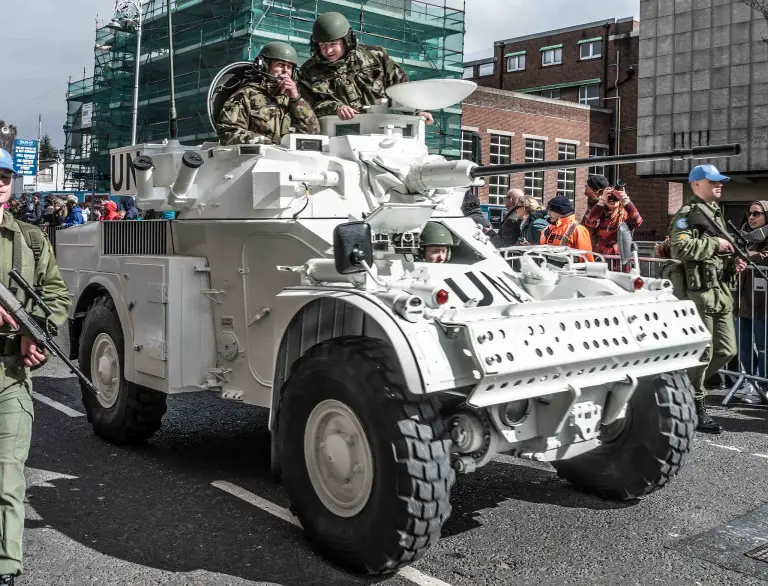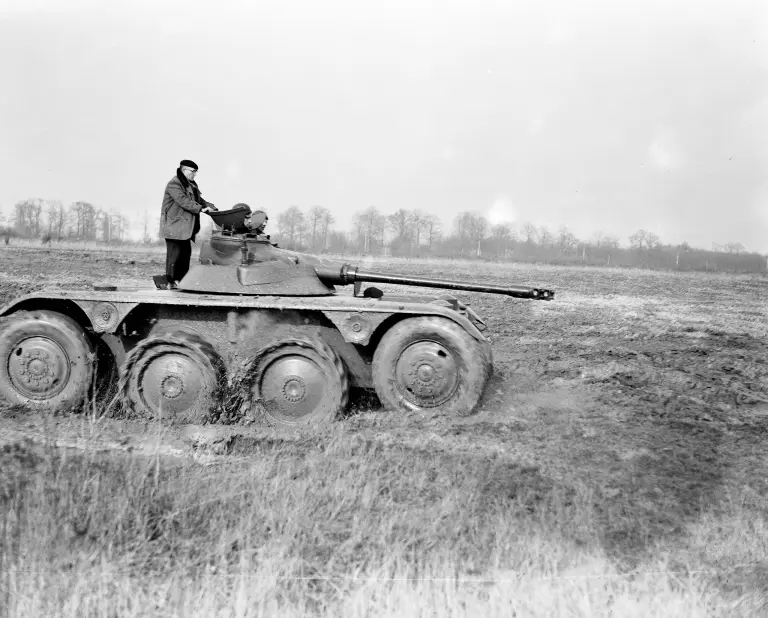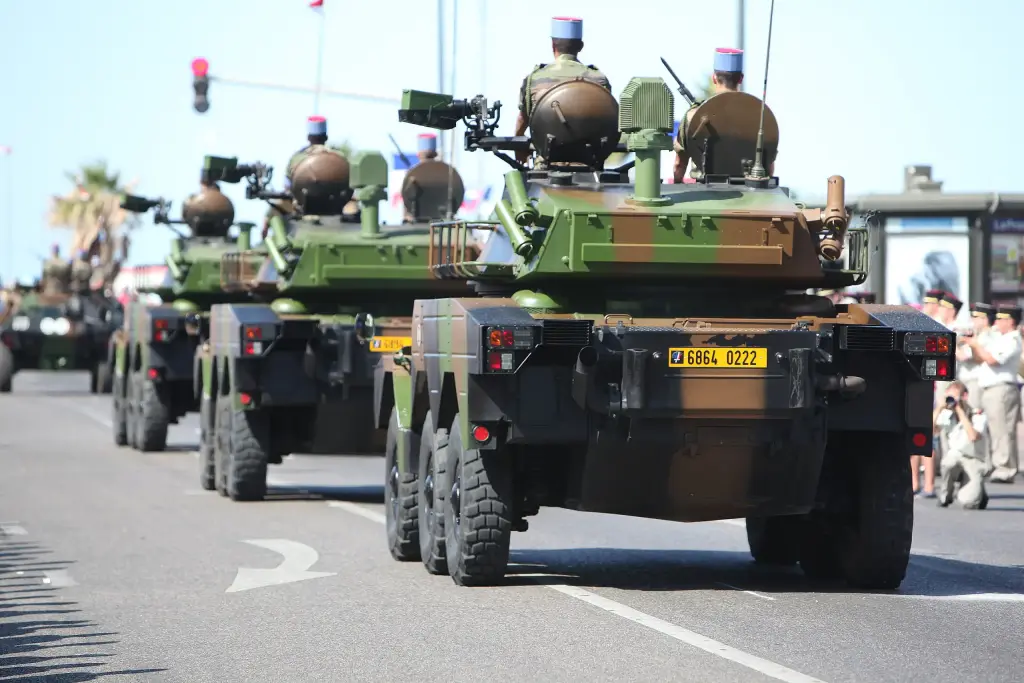
The Panhard ERC, for Engin à Roues, Canon, is a French six-wheeled armoured car, highly mobile and amphibious, with an option of NBC protection. Two versions entered large-scale production: the ERC-90 Lynx and the ERC-90 Sagaie, which differ mainly in their turrets and 90 mm guns. Sagaie is French for assegai, an African spear.
Panhard ERC at a glance
| Maker | Panhard, France |
|---|---|
| Type | six-wheeled armoured reconnaissance car |
| Developed | from the mid-1970s |
| Versions | ERC-90 F1 Lynx, ERC-90 F4 Sagaie |
| Lynx | introduced about 1977 |
| Sagaie | introduced about 1979 |
| Main armament | 90 mm cannon |
| Amphibious | two hydrojets, no preparation needed |
| Wheels | six, the central pair can be raised or lowered |
| French Army service | from 1984 |
based on one source
History of the Panhard ERC
The ERC was a private venture by Panhard aimed at the export market. It was developed in the second half of the 1970s as a heavier, six-wheeled successor to the highly successful AML range. The ERC and VCR form a family of six-wheeled armoured reconnaissance vehicles: the ERC is the cannon-armed turret model and the VCR the armoured personnel carrier, sharing many components. Two main versions were developed, the ERC F1 90 Lynx and then the ERC F4 90 Sagaie; the Lynx appeared about 1977 and the Sagaie roughly two years later, in 1979. Both were reconnaissance vehicles, but the Sagaie also had a secondary tank-destroyer role.
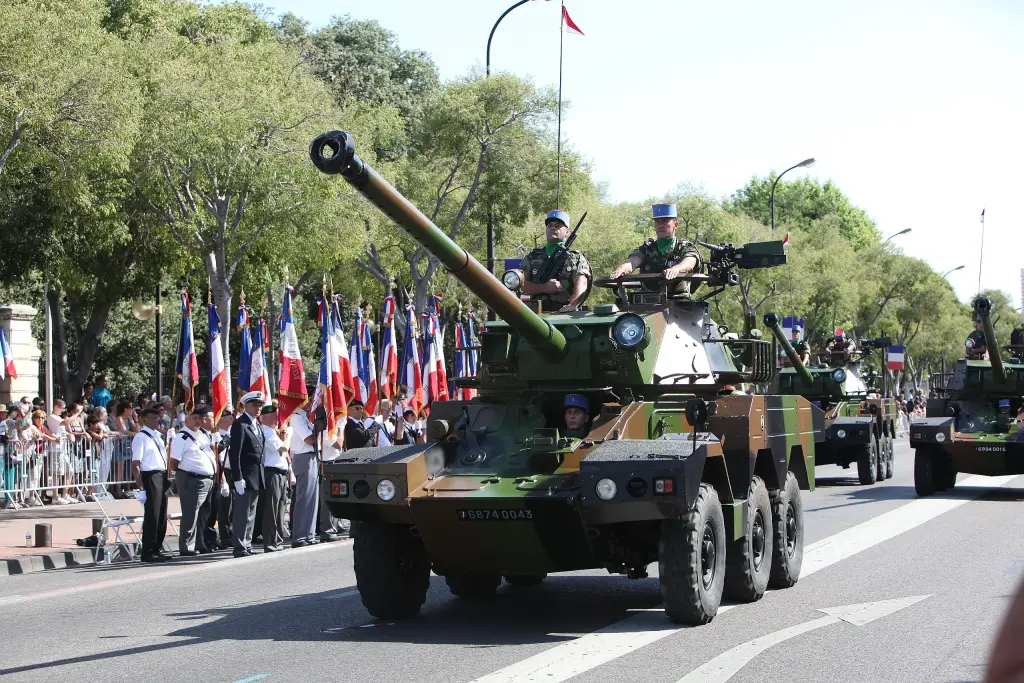
In 1977 Panhard offered the ERC and VCR to the French Army. The Army chose the four-wheeled Saviem VAB for the personnel carrier requirement and the AMX 10 RC for reconnaissance, and when Panhard also offered the vehicles to the Mobile Gendarmerie, that force picked the Saviem VBC-90. Panhard found success abroad instead, and later with the French Army as well, where the ERC entered service in 1984.
The first production order for the ERC 90 F1 Lynx came in October 1979 from Argentina, for 36 vehicles for the Argentine Marines to patrol the long border with Chile. Mexico ordered 42 in early 1981. Both countries chose the Lynx because its 90 mm cannon could be elevated and depressed over a wider range, useful in steep mountain terrain, and because of its all-terrain mobility, helped by the ability to raise or lower the central pair of wheels on sand or mud. All versions have two hydrojets behind the rear wheels and need no preparation for swimming.
Soon after the Lynx went into production Panhard saw the need for a light armoured vehicle able to defeat a modern main battle tank such as the T-72. The Lynx could fire only medium-velocity HEAT rounds, which lacked the penetration. Panhard therefore designed a turret for the long-barrelled GIAT F4 90 mm smoothbore gun, able to fire APFSDS rounds at much higher velocity; GIAT and Panhard both claimed it could penetrate heavy armour at 2,000 metres. The Ivory Coast was the first export customer, with five Sagaies to replace its AMX-13s. In December 1980 the French Army Staff ordered the Sagaie for its new Fast Deployment Force, because the larger AMX-10RC could not be carried by Transall C-160 or Hercules C-130 aircraft and most bridges in Africa were limited to six to eight tonnes. The Sagaie served in Africa and in urban conditions during the siege of Sarajevo, with the last known combat use in Ivory Coast and in Mali in 2013. Between 2005 and 2009 the French Army upgraded 160 of its 192 ERCs with a 170 hp MTU diesel and an automatic gearbox.
Design and features
- Six wheels: the central pair can be raised or lowered to suit the terrain, especially sand and mud.
- Amphibious: two hydrojets behind the rear wheels and no preparation needed before entering water.
- 90 mm gun: the Sagaie’s GIAT F4 smoothbore fires APFSDS rounds, with claimed penetration of heavy armour at 2,000 metres.
- Air-transportable: small and light enough for C-160 and C-130 transports, unlike the AMX-10RC.
- NBC protection: available as an option on the ERC.
Panhard ERC versions
- ERC-90 F1 Lynx (about 1977): the first production version, with a 90 mm gun elevating over a wide arc.
- ERC-90 F4 Sagaie (about 1979): long-barrelled 90 mm smoothbore for anti-tank work.
- ERC-90 Sagaie 2 (1985): a lengthened twin-engine version with two 98 hp Peugeot turbodiesels; six ordered by Gabon as the ERC-2.
- VCR: the armoured personnel carrier of the same six-wheeled family.
- Upgraded French cars: 160 rebuilt between 2005 and 2009 with a 170 hp MTU diesel and a new gearbox.
The ERC succeeded the Panhard AML and followed the Panhard EBR; its smaller stablemate was the Panhard VBL. More vehicles are in the Panhard collection.
Video: ERC-90 SAGAIE ARMORED PANHARD IN ACTION
Video on YouTube.
Sources
- Panhard ERC, English Wikipedia: development, versions, orders