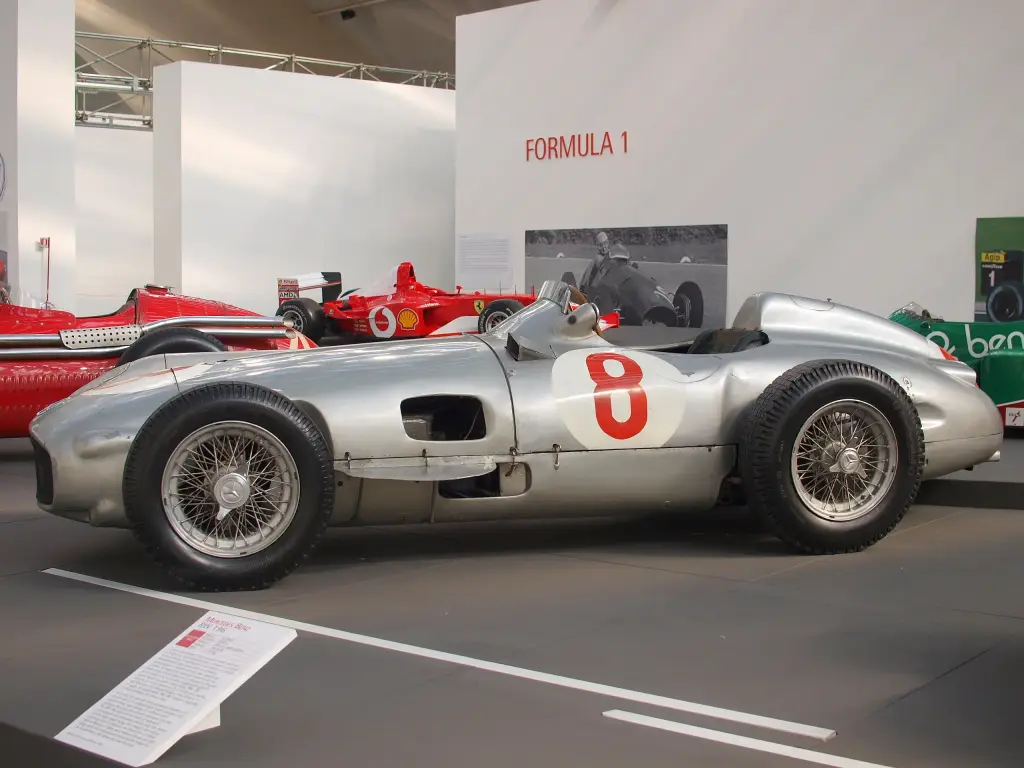
Silver Arrows is the nickname given to silver racing cars with a significant connection to a German car manufacturer. The term was coined in 1932 and became widely used for the Mercedes-Benz and Auto Union Grand Prix cars of 1934 to 1939.
Silver Arrows at a glance
| Coined | 1932 |
|---|---|
| Popular use | Germany’s Grand Prix cars, 1934–1939 |
| Makers | Mercedes-Benz and Auto Union |
| Later use | Mercedes-Benz Formula One and sports cars in 1954 and 1955 |
| Group C | Sauber-Mercedes cars of the late 1980s |
| Formula One | McLaren-Mercedes from the late 1990s |
| Today | Mercedes-AMG Petronas from 2010 |
| German racing colour | silver |
| Earlier German colour | white |
| Alternative name | White Elephant for the 1931 SSKL |
This article is based on one source, the English Wikipedia article on the Silver Arrows. The photographs are free images from Wikimedia Commons.
History of the Silver Arrows
For decades before sponsorship liveries, each country had its traditional racing colour: silver for Germany, rosso corsa red for Italy, British racing green for Britain and bleu de France for France. German cars such as the Blitzen Benz were white, as were the three Mercedes that finished first, second and third in the 1914 French Grand Prix. Mercedes also won the Targa Florio in red in 1922 and 1924 to blend in with local rivals, and the big supercharged 200 hp Mercedes-Benz SSKL with which Rudolf Caracciola won the 1931 Mille Miglia was called the White Elephant.
The name was coined in 1932, when Manfred von Brauchitsch raced a streamlined silver SSKL at the Avus and live radio coverage called it a silver arrow. From 1934 to 1939 the term came into popular use for the dominant Mercedes-Benz and Auto Union Grand Prix cars. The best-known story of its origin comes from Alfred Neubauer in 1958: in 1934, with a 750 kg weight limit, the new W25 was said to weigh 751 kg at scrutineering before the Eifelrennen, so the team stripped the white lead-based paint from the bodywork, exposing shining silver aluminium and passing the check; when von Brauchitsch won, the nickname was born.
That story is doubted. It first appeared in 1958 and no contemporary source has been found, while von Brauchitsch had already raced a silver SSKL in 1932 and both German teams entered silver cars at the 1934 Avusrennen. By the 1930s polished unpainted aluminium was also standard in aircraft construction for streamlining and weight saving, and Neubauer’s autobiography is known to contain embellished stories. The name was later applied to the Mercedes-Benz Formula One and sports cars of 1954 and 1955, to the Sauber-Mercedes Group C prototypes at Le Mans in the late 1980s, to the McLaren-Mercedes Formula One cars of the late 1990s and 2000s, and to the Mercedes-AMG Petronas cars from 2010.
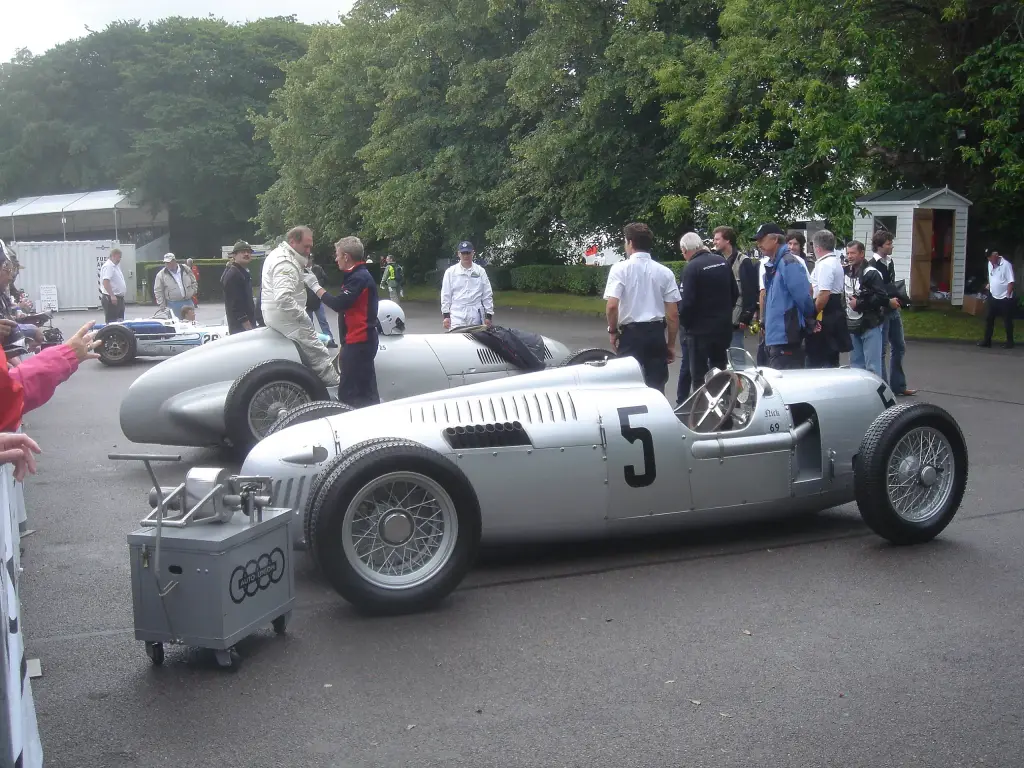
Design and features
- German racing colour: silver, after an earlier period of white.
- 1930s Grand Prix cars: the W25, W125, W154 and W165 among them.
- 1950s return: the W196 Formula One and 300 SLR sports cars.
- Modern use: Sauber Group C, McLaren-Mercedes and Mercedes-AMG Petronas.
Silver Arrows versions
- SSKL streamliner (1932): the car first called a silver arrow.
- Mercedes-Benz Grand Prix cars: W25, W125, W154 and W165.
- 1954–55 cars: the W196 and 300 SLR.
- Sauber-Mercedes Group C: the C9, C11 and C291.
- Mercedes-AMG Petronas: Formula One cars since 2010.
Individual cars have their own pages, among them the W25, W125, W154 and W196. More in the Mercedes-Benz collection.
Sources
- Silver Arrows, English Wikipedia: origin, use, later applications, doubts about the legend