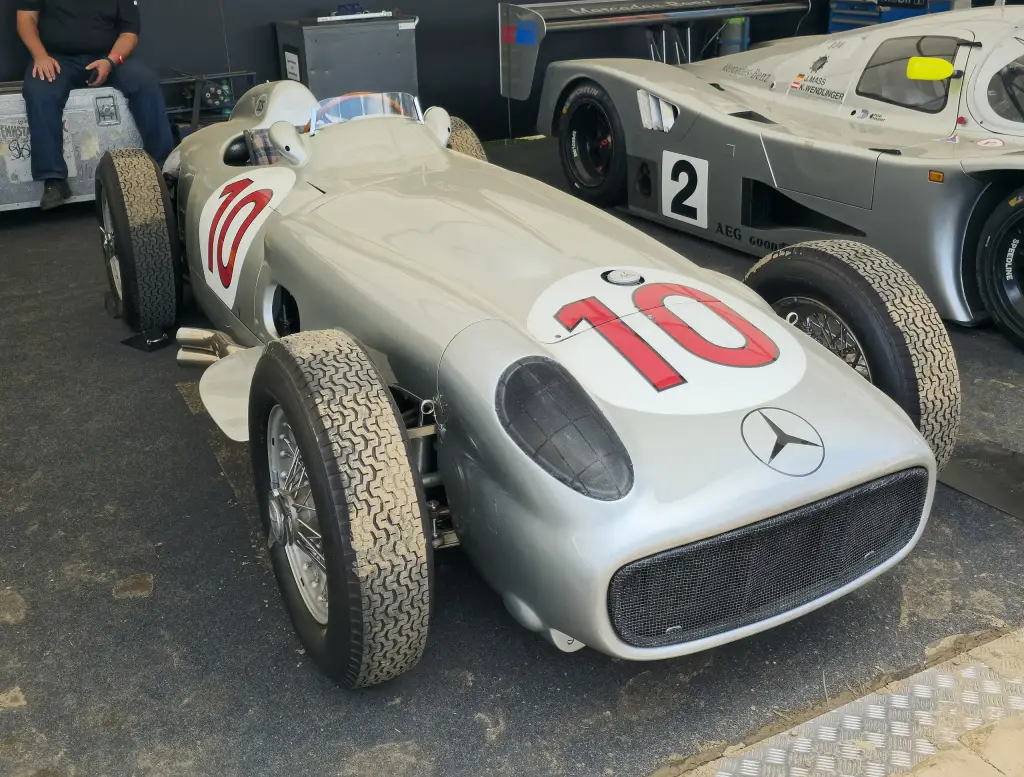
The Mercedes-Benz W196 was a Formula One racing car built for the 1954 and 1955 seasons. In the hands of Juan Manuel Fangio and Stirling Moss it won 9 of the 12 races it entered and took both world championships in which it competed.
Mercedes-Benz W196 at a glance
| Seasons | 1954 and 1955 |
|---|---|
| Predecessor | W194 300 SL and the W195 concept |
| Drivers | Juan Manuel Fangio and Stirling Moss |
| Races entered | 12 |
| Races won | 9 |
| Titles | drivers’ and constructors’ championships |
| Engine | 2.5-litre straight eight |
| Firsts | desmodromic valves and mechanical direct fuel injection |
| Bodies | Type Monza streamliner and open wheel |
| Monza wins | 1954 French, 1954 and 1955 Italian Grands Prix |
| Derivative | 3-litre 300 SLR of 1955 |
| Withdrawal | Mercedes left racing in 1955 |
This article is based on one source, the English Wikipedia article on the Mercedes-Benz W196.
History of the Mercedes-Benz W196
The W196 introduced two technical firsts: desmodromic valves and mechanical direct fuel injection developed from the DB 601 V12 of the Messerschmitt Bf 109E. Its debut came late, at the 1954 French Grand Prix, with an aerodynamic closed-wheel aluminium body called Type Monza for the high-speed Reims circuit. Fangio and Karl Kling finished first and second, and Hans Herrmann set the fastest lap.
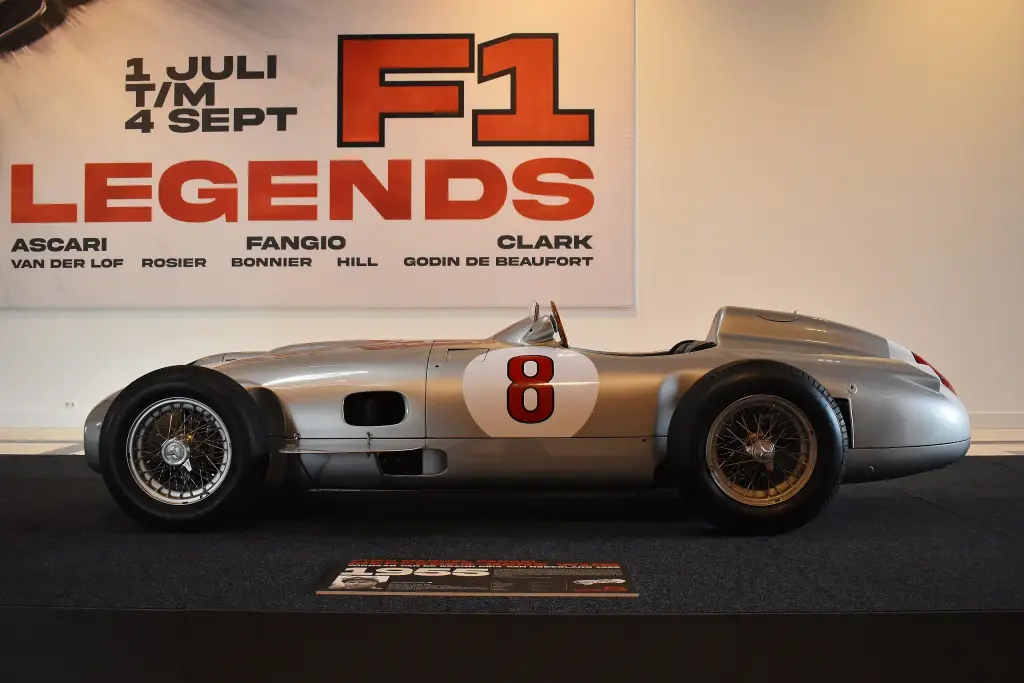
The streamliner was used only three more times: at the 1954 British and Italian Grands Prix and again at Monza in 1955. In all it won three races, all with Fangio, and those remain the only Grands Prix won by a closed-wheel car in Formula One history. At Silverstone, dominated by high-speed corners, the body proved unsuitable and Fangio hit oil barrels marking the circuit, so a conventional open-wheel version was introduced for the German Grand Prix at the Nürburgring. Fangio won there and in Switzerland with the open car and at Monza with the streamliner to take his second world championship. At the last race of 1954 in Barcelona a low-mounted air intake clogged with leaves, costing the race, after which the intake was moved to the top of the bonnet.
In the shortened 1955 season, cut short after the Le Mans disaster, the W196 won every race except Monaco, where Hans Herrmann crashed in practice and the other three cars failed to finish. Stirling Moss took his first Grand Prix win at Silverstone, beating Fangio by 0.2 seconds. The 3-litre 300 SLR was derived from the W196 for the 1955 World Sportscar Championship, and its crash at Le Mans that year ended both its domination and the W196 programme. Mercedes-Benz withdrew from racing and did not return for three decades.
Design and features
- Desmodromic valves: a first in Formula One.
- Direct fuel injection: adapted from the DB 601 aircraft engine.
- Two bodies: the closed Type Monza and the open-wheel car.
- Record: 9 wins from 12 starts and two titles.
Mercedes-Benz W196 versions
- Type Monza streamliner: closed-wheel body for fast circuits.
- Open-wheel car: for twisty tracks such as the Nürburgring.
- 300 SLR (1955): the 3-litre sports car derivative.
The W196 followed the 300 SL racing car and was the last of the Silver Arrows before Mercedes-Benz left racing. More in the Mercedes-Benz collection.
Video: Stirling Moss drives the W196
Video by YouTube on YouTube.
Sources
- Mercedes-Benz W196, English Wikipedia: seasons, bodies, races, engine, withdrawal