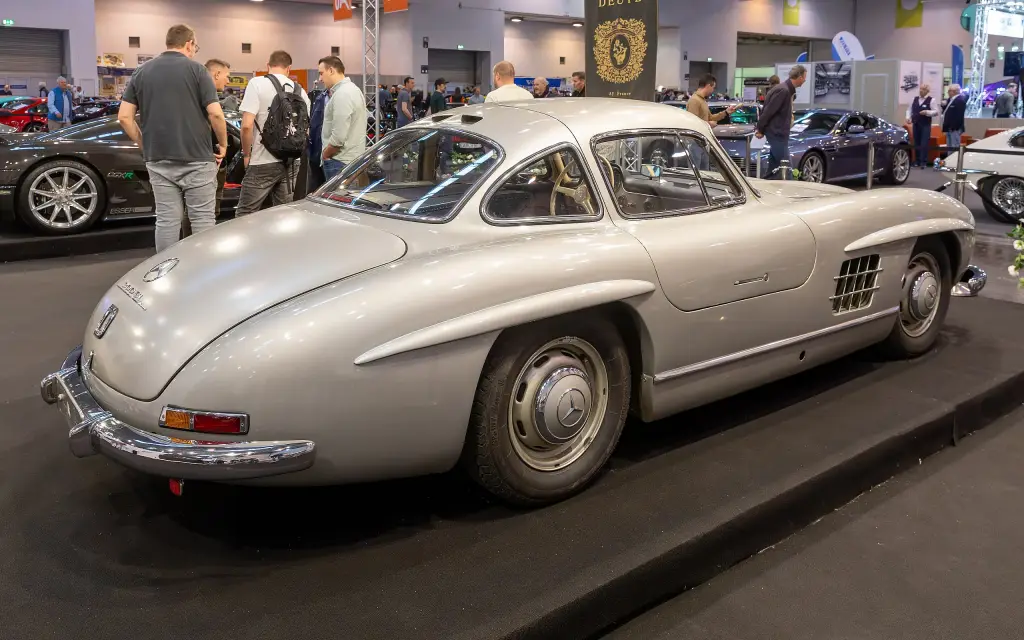
The Mercedes-Benz 300 SL, chassis code W198, is a two-seat sports car produced from 1954 to 1957 as a gullwing coupé and from 1957 to 1963 as a roadster. Its fuel-injected six-cylinder engine gave it a top speed of about 260 km/h.
Mercedes-Benz 300 SL at a glance
| Production | 1954–1963 |
|---|---|
| Coupé | 1954–1957, with gullwing doors |
| Roadster | 1957–1963 |
| Chassis code | W198 |
| Engine | 3.0-litre straight-six, overhead camshaft |
| Fuel system | mechanical direct petrol injection |
| Top speed | about 260 km/h |
| Chassis | steel tubular frame |
| Body | steel with aluminium bonnet, doors, dashboard and boot lid |
| Coupé price in Germany | DM 29,000 |
| Roadster price in Germany | DM 32,500 |
| All-aluminium cars | 29 built |
This article is based on one source, the English Wikipedia article on the Mercedes-Benz 300 SL.
History of the Mercedes-Benz 300 SL
The 300 SL descends from the W194 endurance racer of 1951, which used the three-litre straight-six of the 300 Adenauer saloon and the 300 S grand tourer. Although the W194 had only 175 hp, its low weight and low drag made it competitive, and in 1952 it won the 24 Hours of Le Mans and the Carrera Panamericana. For 1953 Mercedes-Benz prepared a version with direct fuel injection, 16-inch wheels and a gearbox on the rear axle, with a body of Elektron magnesium alloy that saved 85 kg, but the company decided not to race it and went into Formula One instead.
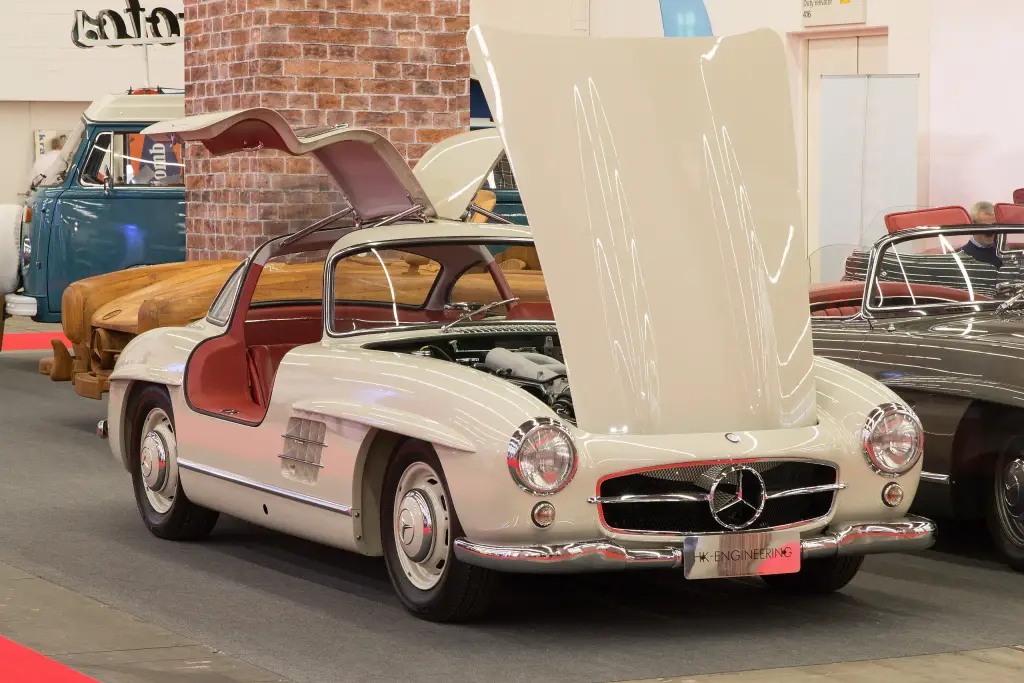
The road car came from an idea of the American importer Max Hoffman, who saw demand for a high-performance sports car in the United States. At a directors’ meeting in Stuttgart in 1953 he ordered 1,000 cars to guarantee the production run. The 300 SL was therefore shown at the New York International Auto Show in February 1954 rather than in Frankfurt or Geneva, together with the smaller 190 SL, and production began at Sindelfingen in August 1954. In Germany the coupé cost DM 29,000 and in America $6,820; the roadster cost DM 32,500 and $10,950.
The car had a steel tubular frame with a steel body and aluminium bonnet, doors, dashboard and boot lid. An all-aluminium body saved another 80 kg but only 29 were made. The gullwing doors were a consequence of the high door sills required by the tubular frame. In 1957 a special 300 SLS version was built for the American SCCA championship, with a cover over the passenger seat, a low racing screen, a roll bar and no bumpers; its weight fell from 1,420 kg to 1,040 kg and power rose to 235 hp. The 300 SL was replaced by the 230 SL in 1963.
Design and features
- Gullwing doors: hinged in the roof because the tubular frame made ordinary doors impossible.
- Fuel injection: one of the first production cars with mechanical direct petrol injection.
- Tubular frame: light and stiff, borrowed from the racing W194.
- High speed: about 260 km/h, making it the fastest production car of its time.
Mercedes-Benz 300 SL versions
- 300 SL coupé (1954–1957): the gullwing car.
- 300 SL roadster (1957–1963): with a conventional folding roof and lower sills.
- All-aluminium coupé: 29 cars with a lighter body.
- 300 SLS (1957): two racing roadsters for the American SCCA series.
The 300 SL was joined by the smaller 190 SL and replaced by the 230 SL. Its racing cousin was the W196. More in the Mercedes-Benz collection.
Sources
- Mercedes-Benz 300 SL, English Wikipedia: development, prices, chassis, racing versions