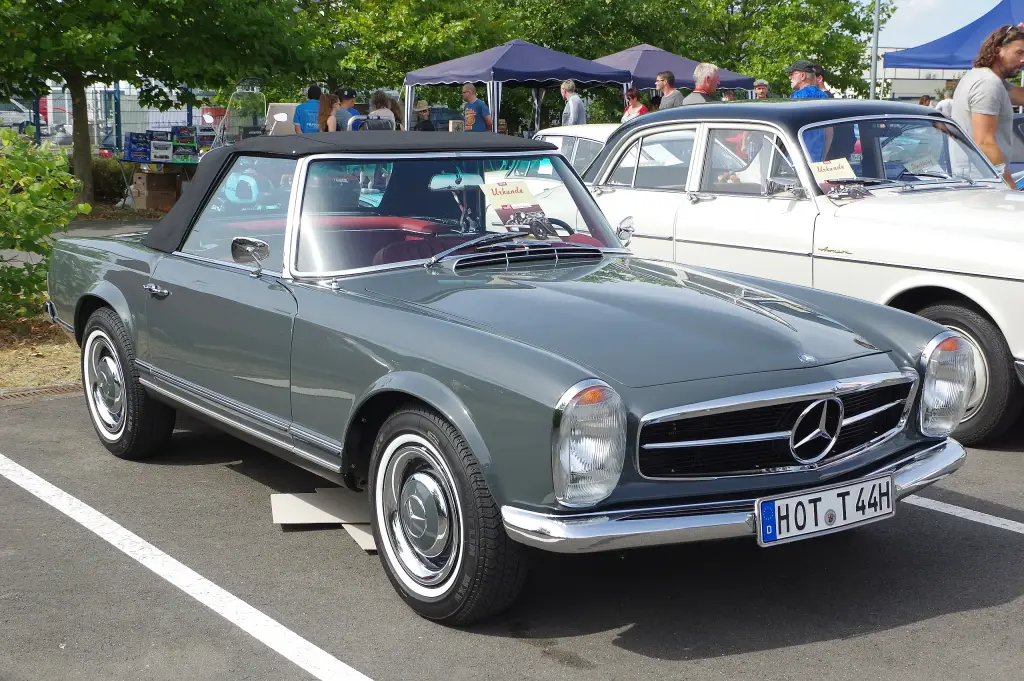
The Mercedes-Benz W113 is a two-seat luxury roadster and coupé introduced at the 1963 Geneva Motor Show and produced until 1971. It replaced both the 300 SL and the 190 SL and was sold as the 230 SL, 250 SL and 280 SL.
Mercedes-Benz W113 at a glance
| Introduced | March 1963, Geneva Motor Show |
|---|---|
| Production | 1963–1971 |
| Models | 230 SL, 250 SL and 280 SL |
| Nickname | Pagoda, from the concave hardtop |
| Total built | 48,912 |
| US sales | 19,440 |
| Engine | fuel-injected straight six |
| Body panels | aluminium bonnet, boot lid, door skins and tonneau cover |
| Roof | soft top with optional removable hardtop |
| Variant | 250 SL California Coupé with a folding rear bench |
| Safety | the first sports car with a safety body |
| Tyres | the first Mercedes-Benz on radial tyres |
This article is based on one source, the English Wikipedia article on the Mercedes-Benz W113.
History of the Mercedes-Benz W113
The W113 was developed under technical director Fritz Nallinger, chief engineer Rudolf Uhlenhaut and head of styling Friedrich Geiger, with Paul Bracq and Béla Barényi as lead designers. Their patented, slightly concave hardtop gave the car its Pagoda nickname. The front, with upright Bosch fishbowl headlights and a simple chrome grille dominated by the large star, paid homage to the 300 SL roadster.
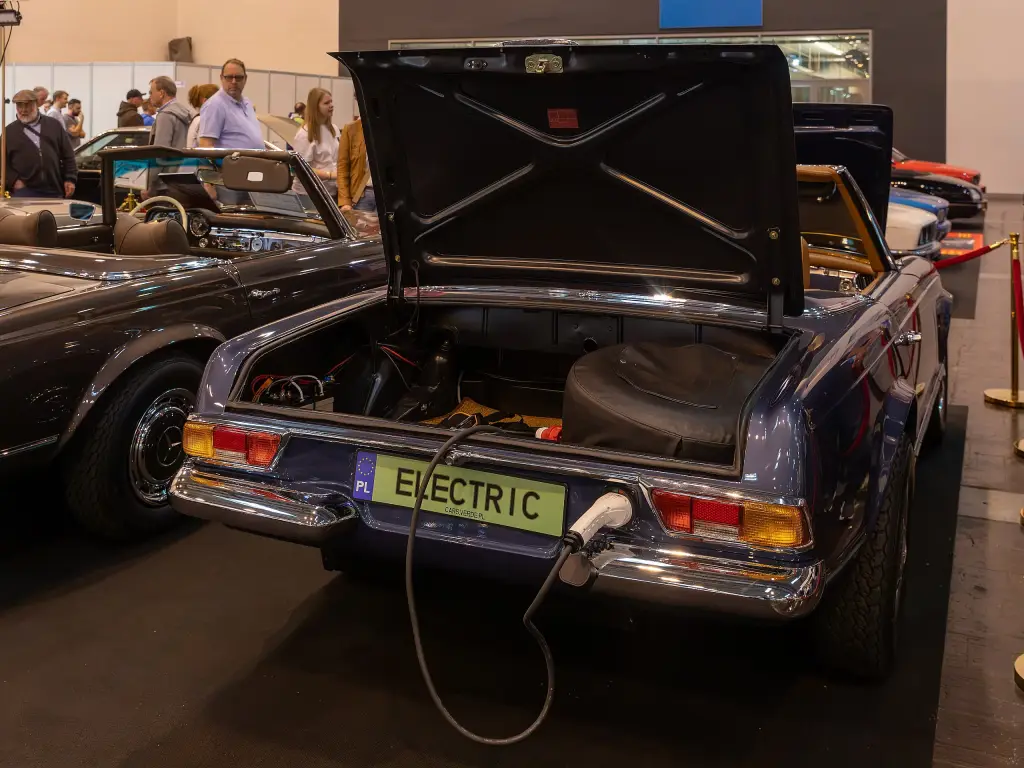
From 1955 Nallinger knew that the 190 SL lacked performance while the 300 SL was too expensive for most buyers, so the company began work on a W127 220 SL with a fuel-injected 2.2-litre six. Production problems kept postponing it, and the new W112 platform brought new body manufacturing technology, so in 1960 Nallinger proposed a completely new design on the Fintail W111 platform, shortened by 30 cm, with W112 technology. That became the W113, with an improved fuel-injected 2.3-litre six and the pagoda hardtop, launched as the 230 SL. At Geneva Nallinger described the aim as a very safe and fast sports car with high performance that still offered a high degree of travelling comfort.
All models had a fuel-injected inline six, and the bonnet, boot lid, door skins and tonneau cover were aluminium to save weight. The short, wide chassis with good suspension, powerful brakes and radial tyres gave excellent handling for its time. Cars were normally configured as coupé/roadster with a soft top and an optional hardtop, and a 2+2 arrived with the 250 SL California Coupé, which had a folding rear bench instead of the soft top. The W113 was the first sports car with a safety body, inheriting a rigid passenger cell and crumple zones from the W111, and the first Mercedes-Benz on radial tyres; the interior had all hard corners removed and the steering gear was moved back to the firewall.
Design and features
- Pagoda roof: a patented concave hardtop.
- Fuel-injected six: fitted to every version.
- Aluminium panels: bonnet, boot lid, doors and tonneau cover.
- Safety body: rigid cell and crumple zones, the first in a sports car.
Mercedes-Benz W113 versions
- 230 SL (1963): 2.3-litre six.
- 250 SL (1967): larger 2.5-litre engine.
- 280 SL (1968): 2.8-litre engine.
- 250 SL California Coupé: 2+2 with a folding rear bench.
The W113 replaced the 300 SL and 190 SL and was followed by the R107. More in the Mercedes-Benz collection.
Sources
- Mercedes-Benz W113, English Wikipedia: development, design, models, safety