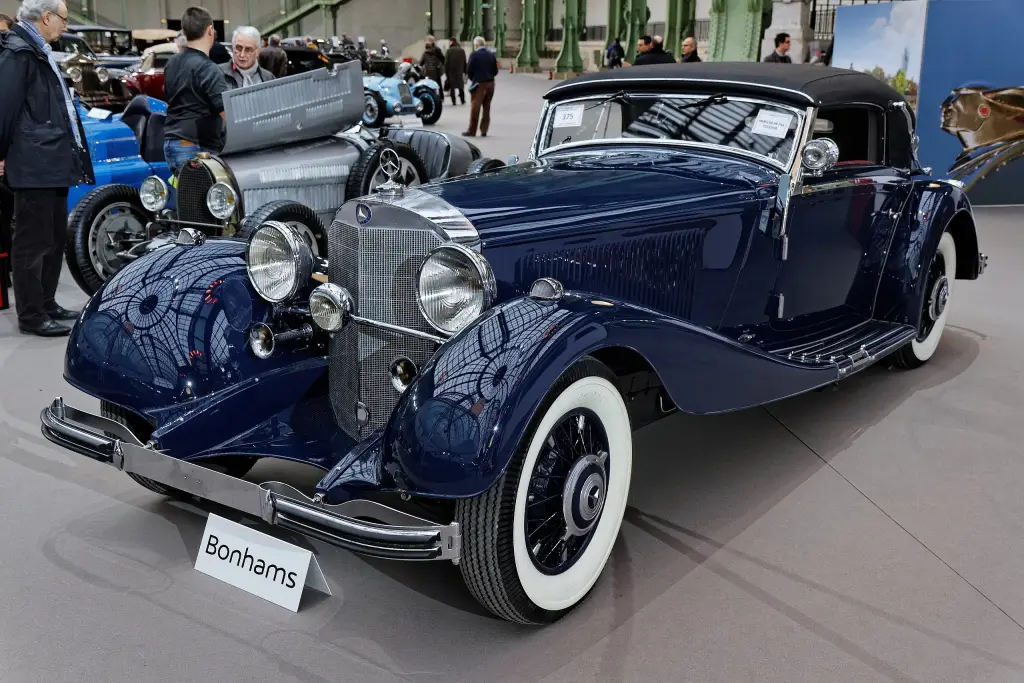
The Mercedes-Benz 500K, type W29, is a grand touring car built between 1934 and 1936 and first shown at the 1934 Berlin Motor Show. The letter K stands for Kompressor, the supercharger that turned the five-litre engine into a 160 hp unit.
Mercedes-Benz 500K at a glance
| Shown | 1934 Berlin Motor Show |
|---|---|
| Production | 1934–1936 |
| Chassis code | W29 |
| Engine | five-litre straight-eight |
| Power | up to 160 hp (120 kW) with the Roots supercharger |
| Top speed | over 160 km/h |
| Fuel consumption | up to 30 L/100 km under full throttle |
| Suspension | double wishbones at the front, double-joint swing axle at the rear |
| Chassis | three lengths; short A at 2,980 mm, long B and C at 3,290 mm |
| Bodies | eight available |
| Equipment | safety glass, hydraulic brakes, 12-volt electrics |
| Built | 342, including 29 Special Roadsters |
This article is based on one source, the English Wikipedia article on the Mercedes-Benz 500K.
History of the Mercedes-Benz 500K
The 500K succeeded the 380 of 1933 and was first exhibited in Berlin in 1934. It offered a larger and more powerful engine together with more opulent coachwork, in answer to customers who wanted greater luxury and performance. The five-litre straight-eight used a Roots supercharger that came in when the throttle pedal was pressed fully, raising output to 160 hp and pushing the car past 160 km/h, though fuel consumption could reach 30 litres per 100 km.
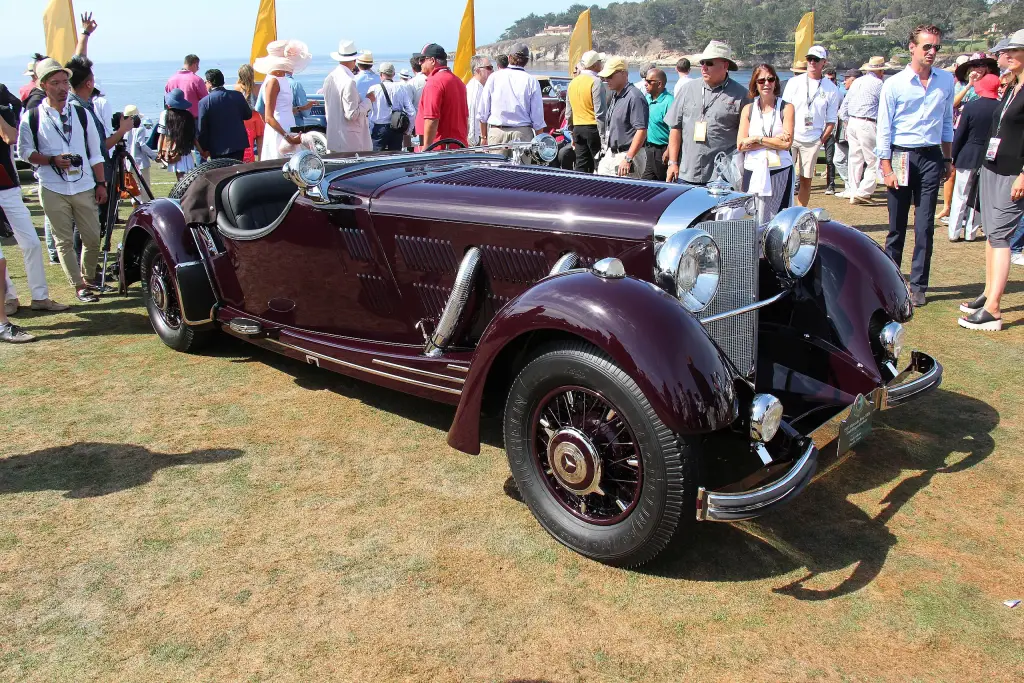
The car used the independent suspension introduced on the 380, with double wishbones in front, a double-joint swing axle at the rear, separate wheel location, coil springs and dampers. That made it more comfortable and better handling than the S, SS and SSK roadsters of the 1920s and attracted a growing number of wealthy women drivers. Three chassis and eight bodies were offered. The two longer B and C four-seat cabriolets used a wheelbase of 3,290 mm, later shared with other saloons and touring cars, while the short A chassis of 2,980 mm carried the two-seaters, the Motorway Courier and the 1936 Special Roadster, which offered the highest performance.
All versions had safety glass, hydraulic brakes and a 12-volt electrical system able to carry electric windscreen wipers, door locks and indicators. The 500K was produced for only two years; 342 cars were built, including 29 Special Roadsters. The production figures for the 500K and the later 540K together list 70 bare chassis, 28 open touring cars, 23 four-door saloons, 29 two-door saloons, 12 coupés, 6 Autobahn cruisers, 58 roadsters, 116 Cabriolets A, 296 Cabriolets B and 122 Cabriolets C.
Design and features
- Roots supercharger: engaged by full throttle, raising power to 160 hp.
- Independent suspension: the world-first layout carried over from the 380.
- Choice of chassis: short A and long B and C versions.
- Lavish equipment: safety glass, hydraulic brakes and 12-volt electrics.
Mercedes-Benz 500K versions
- Cabriolet A: two-seat open car on the short chassis.
- Cabriolet B: four-seat open car with four side windows.
- Cabriolet C: four-seat open car with two side windows.
- Motorway Courier: a two-seat Autobahn cruiser.
- Special Roadster (1936): the highest-performance version, 29 built.
- Saloons and coupés: closed bodies on the long chassis.
The 500K followed the 380 and was developed into the 540K. Its racing ancestors were the S-Series cars. More in the Mercedes-Benz collection.
Video: Classic 1930s Mercedes-Benz 500K
Video by YouTube on YouTube.
Sources
- Mercedes-Benz 500K, English Wikipedia: engine, chassis, bodies, production figures