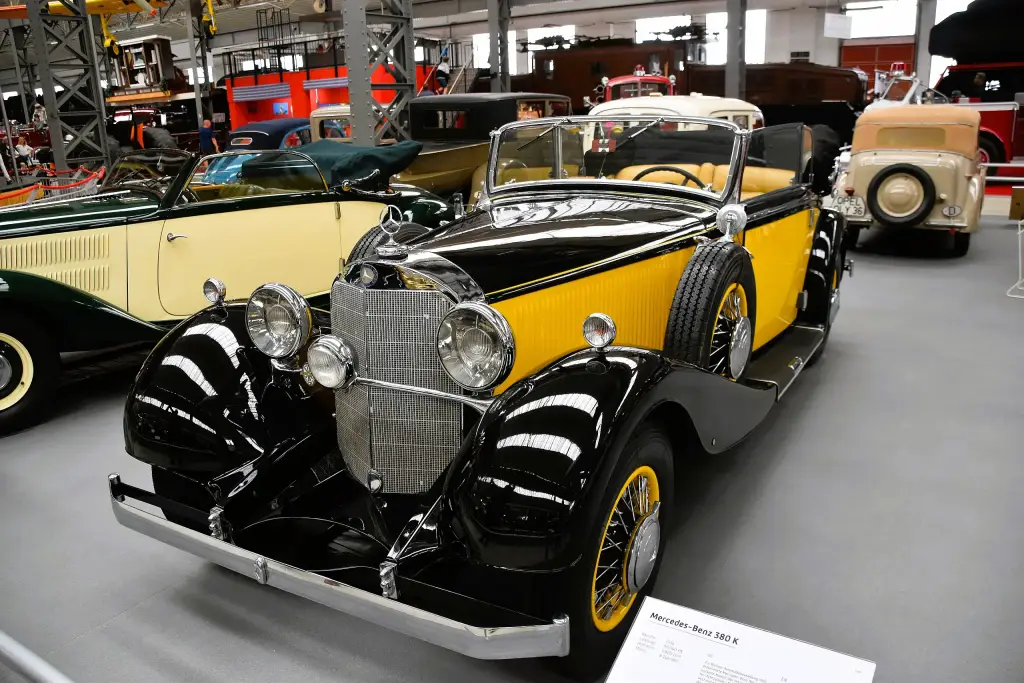
The Mercedes-Benz 380, type W22, is an eight-cylinder car introduced at the Berlin Motor Show in February 1933. It was withdrawn during 1934 after 154 cars had been built.
Mercedes-Benz 380 at a glance
| Shown | February 1933, Berlin Motor Show |
|---|---|
| Production | 1933–1934 |
| Chassis code | W22 |
| Engine | 3,820 cc overhead-valve straight-eight |
| Power without compressor | 90 PS at 3,200 rpm |
| Power with supercharger | 120 PS at 3,400 rpm |
| Power with integrated Kompressor | 140 PS at 3,600 rpm |
| Top speed | 120 to 145 km/h, depending on version |
| Suspension | double wishbones at the front, double-joint swing axle at the rear |
| Gearbox | four-speed, synchromesh on the top two ratios |
| Price | 13,000 marks as a chassis, 19,500 with a standard body |
| Built | 154 |
This article is based on one source, the English Wikipedia article on the Mercedes-Benz 380 of 1933. The car is sometimes called 380 K, but that name was never official.
History of the Mercedes-Benz 380
The 380 was introduced in February 1933 as a sports tourer and was one of the most advanced cars on the market. Its engine began as the 3,820 cc straight-eight of its predecessor but gained overhead valves and a new two-barrel carburettor. Buyers could have it without a compressor at 90 PS, with a supercharger at 120 PS, or with an integrated Kompressor, coded M22K, at 140 PS. The fastest version reached up to 145 km/h, depending on the final drive.
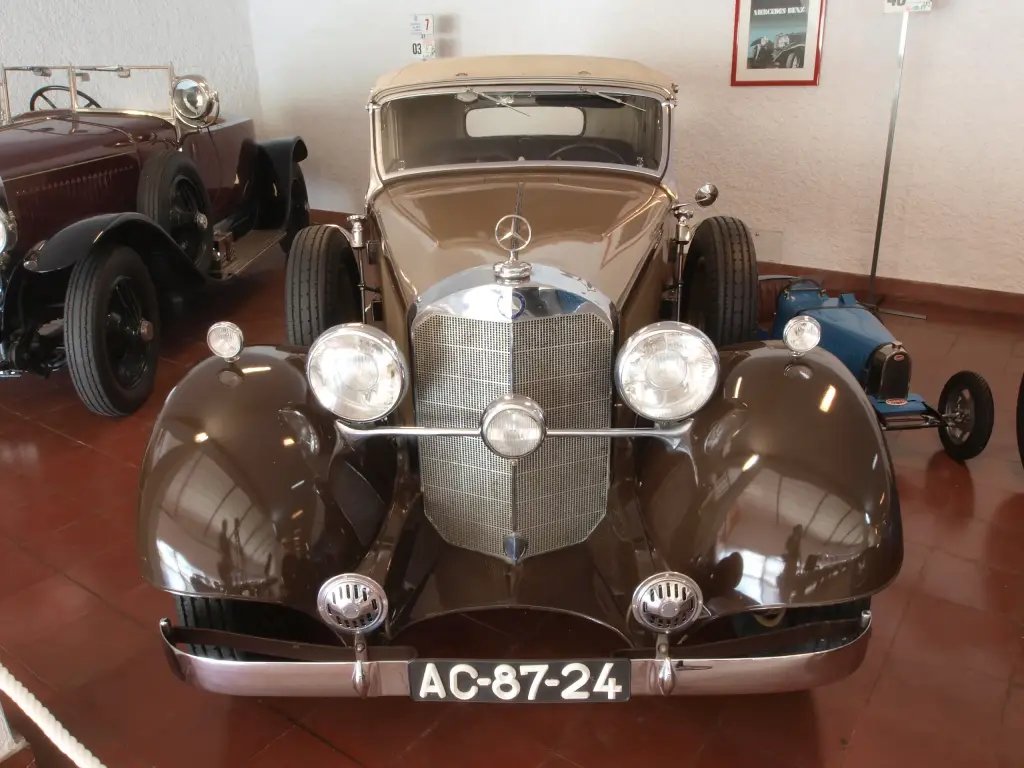
Its chassis was the first on a Mercedes-Benz to use independent suspension at both ends, with double wishbones in front, a double-joint swing axle at the rear, separate wheel location, coil springs and dampers. Contemporary observers praised its handling as far better than that of powerful rivals that still used rigid axles. The car had a four-speed gearbox with synchromesh on the top two ratios, hydraulic brakes on all four wheels and Carl Zeiss headlamps set either side of the radiator grille.
Bodies were a matter of choice. A bare chassis cost 13,000 marks and many buyers went to an independent coachbuilder, while any of the six standard Mercedes-Benz bodies cost 19,500 marks. The range included a four-door Limousine, a two-door Tourenwagen, a Sport-Roadster and Cabriolet A, B and C, differing in the number of seats and side windows. Only seven lightweight two-seat sporting roadsters were bodied by Sindelfingen. Demand for more speed led to the larger 500K in 1934, and production of the 380 ended after less than two years with 154 cars built.
Design and features
- Independent suspension: a first for Mercedes-Benz, with double wishbones in front and a swing axle at the rear.
- Supercharger options: three engine states from 90 to 140 PS.
- Hydraulic brakes: acting on all four wheels.
- Coachbuilt bodies: six standard styles plus bespoke work from independent builders.
Mercedes-Benz 380 versions
- 380: the unsupercharged car with 90 PS.
- 380 with Kompressor: 120 PS and 130 km/h.
- 380 with integrated Kompressor: 140 PS and up to 145 km/h.
- Sport-Roadster: the open two-seater.
- Cabriolet A, B and C: with two or four seats and two or four side windows.
The 380 was replaced by the 500K in 1934, which used the same suspension layout. More pre-war cars are in the Mercedes-Benz collection.
Video: 1934 Mercedes-Benz 380K Sport Roadster
Video by YouTube on YouTube.
Sources
- Mercedes-Benz 380 (1933), English Wikipedia: engines, suspension, bodies, prices