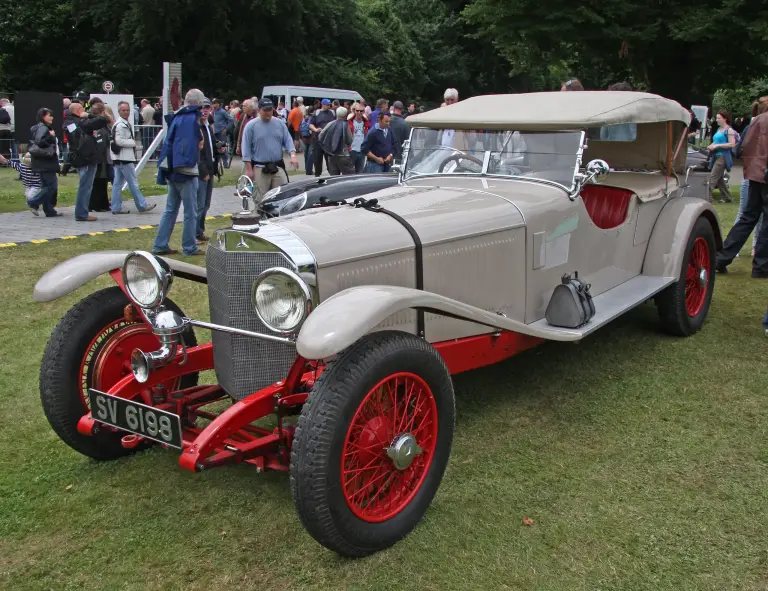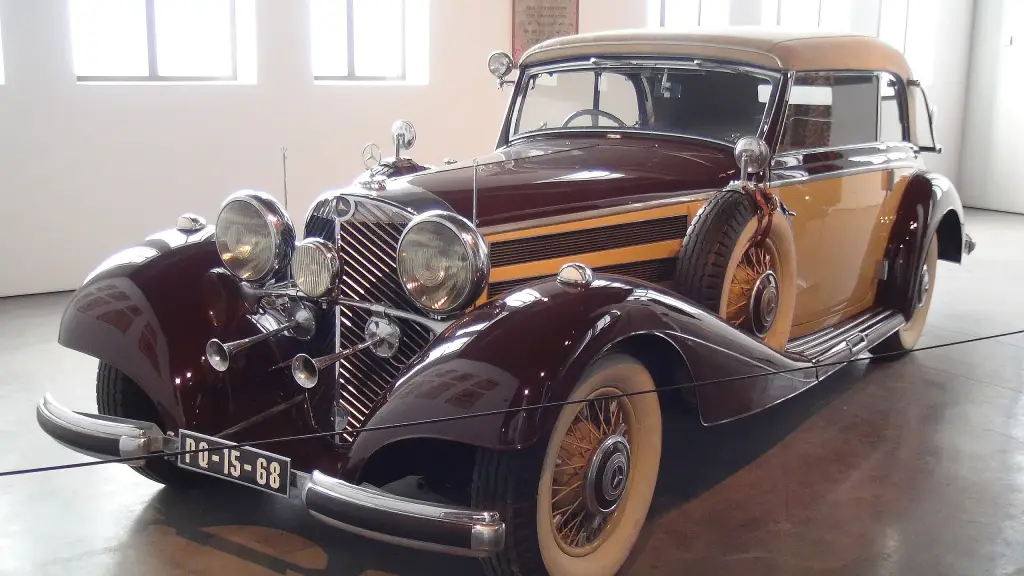
The Mercedes-Benz 540K, type W29, is a grand touring car built between 1936 and 1940 and introduced at the 1936 Paris Motor Show. It was designed by Friedrich Geiger as a development of the 500K.
Mercedes-Benz 540K at a glance
| Shown | 1936 Paris Motor Show |
|---|---|
| Production | 1936–1940 |
| Designer | Friedrich Geiger |
| Engine | 5,401 cc straight-eight |
| Power | 115 hp without supercharger, 180 hp with it |
| Top speed | 170 km/h |
| Gearbox | four-speed, optional five-speed, synchromesh on the top three gears |
| Brakes | vacuum-assisted hydraulic |
| Chassis | oval-section tubes, lighter than the 500K frame |
| Wheelbases | 3,290 mm for B and C, 2,980 mm for A |
| Price in 1936 | 28,000 Reichsmark |
| Built | 419 |
This article is based on one source, the English Wikipedia article on the Mercedes-Benz 540K.
History of the Mercedes-Benz 540K
The 540K was introduced at the Paris Motor Show in 1936. Its straight-eight of the 500K was enlarged to 5,401 cc and fed by twin pressurised updraught carburettors, giving 115 hp. A Roots supercharger could be engaged manually for short periods or automatically when the accelerator reached the floor, raising power to 180 hp and the top speed to 170 km/h. A four-speed gearbox was standard and a five-speed optional, with synchromesh on the top three gears, and vacuum-assisted hydraulic brakes kept the car under control.
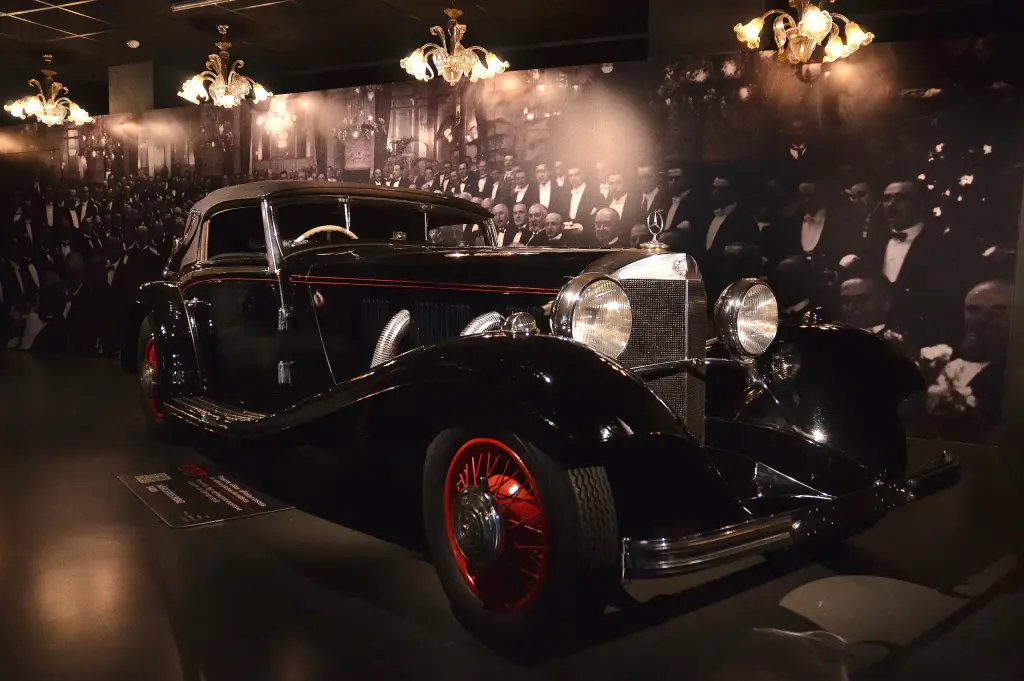
The chassis layout was that of the 500K, but the girder-like frame was replaced by oval-section tubes, an influence of the Silver Arrows racing programme, which made the car significantly lighter. Three chassis were offered as before: two long versions with a 3,290 mm wheelbase for the four-seat Cabriolets B and C, touring cars and saloons, and a short 2,980 mm chassis for the two-seat Cabriolet A, whose radiator, engine and cockpit sat 185 mm further back. Sindelfingen built the bodies in house with 1,500 people, so owners could customise heavily; only 70 chassis were bodied by independent builders.
Production of the chassis ended in 1940, with the last two completed that year and a few cars bodied up to 1943. A plan to bore the engine out to 5.8 litres for a 580K was abandoned at the outbreak of the war, probably after a single car. On top of the standard range, twelve special cars were built on a 3,880 mm wheelbase as six-seat convertible saloons (type W24), with De Dion rear suspension to carry armour plate. From 1942 the Reich Chancellery also ordered armoured two-door 540K saloons. The best known special is the 540Ks of Hermann Göring, the armoured blue car nicknamed the Blue Goose, one of 32 built.
Design and features
- Supercharged straight-eight: 5,401 cc, 115 hp normally and 180 hp with the Roots blower.
- Lighter frame: oval-section tubes instead of the 500K’s girder frame.
- Custom coachwork: Sindelfingen built most bodies, with room for owner requests.
- Armoured variants: the W24 saloons and the special 540Ks.
Mercedes-Benz 540K versions
- Cabriolet A: two-seat open car on the short chassis.
- Cabriolet B and C: four-seat open cars on the long chassis.
- Four-seat coupé and seven-seat limousine: closed bodies, some with armour.
- 540Ks: the short-chassis special, 32 built.
- W24 special saloon: twelve six-seat convertibles on a 3,880 mm wheelbase.
- 580K: an aborted 5.8-litre version.
The 540K developed the 500K and was the last of the pre-war supercharged cars before the 770 took over as the largest Mercedes. More in the Mercedes-Benz collection.
Video: Mercedes 540K
Video by YouTube on YouTube.
Sources
- Mercedes-Benz 540K, English Wikipedia: engine, chassis, production, special bodies