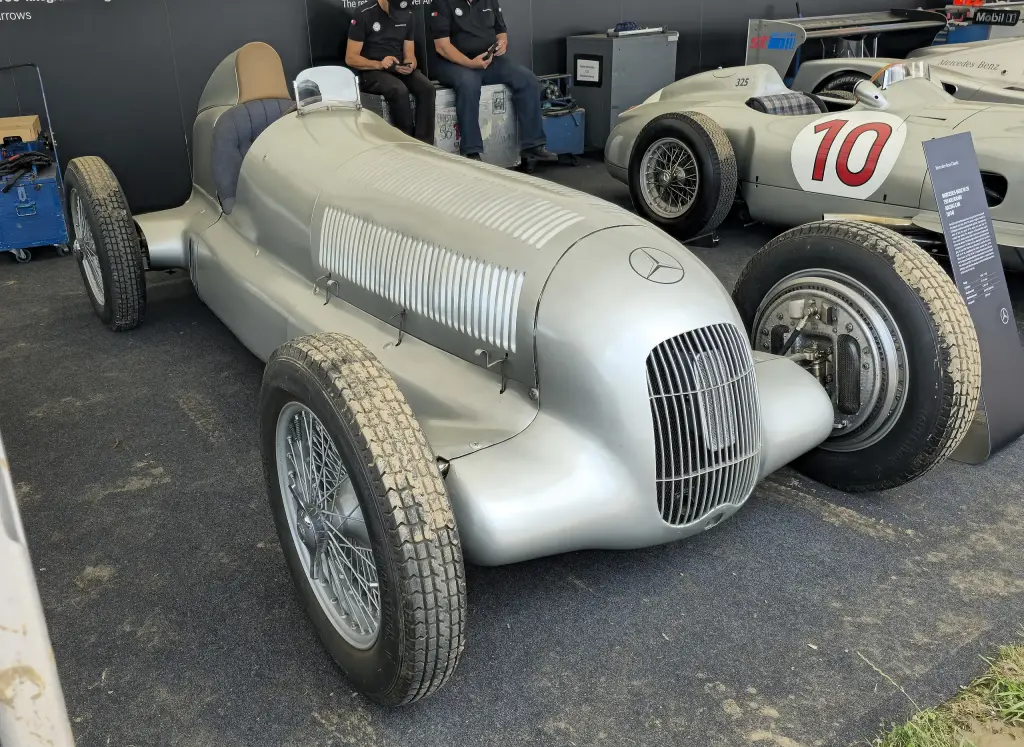
The Mercedes-Benz W25 is a Grand Prix racing car designed for the 1934 season, when new rules were introduced. In modified form it stayed in use until 1937, when it was succeeded by the W125.
Mercedes-Benz W25 at a glance
| Season | 1934, with updates to 1937 |
|---|---|
| Formula | maximum weight of 750 kg |
| Engine | supercharged straight-eight M25 |
| Power | more than the 300 hp of the SSK |
| First appearance | Avusrennen, Berlin, 27 May 1934 |
| First win | Eifelrennen, Nürburgring, June 1934 |
| Driver | Manfred von Brauchitsch |
| 1934 wins | Eifelrennen, Coppa Acerbo, Spanish and Italian Grands Prix |
| 1935 title | Rudolf Caracciola, European Championship |
| Successor | Mercedes-Benz W125 |
This article is based on one source, the English Wikipedia article on the Mercedes-Benz W25.
History of the Mercedes-Benz W25
For 1934 the governing body AIACR introduced a formula limited mainly by a maximum weight of 750 kg, far less than the outdated seven-litre Mercedes-Benz SSK used before. That car had been developed in the 1920s by Ferdinand Porsche, by then independent, who proposed his P-Wagen concept to Adolf Hitler. Hitler decided to support both the new company Auto Union, which took over Porsche’s concept, and Mercedes-Benz, which had more than a quarter of a century of experience in international racing.
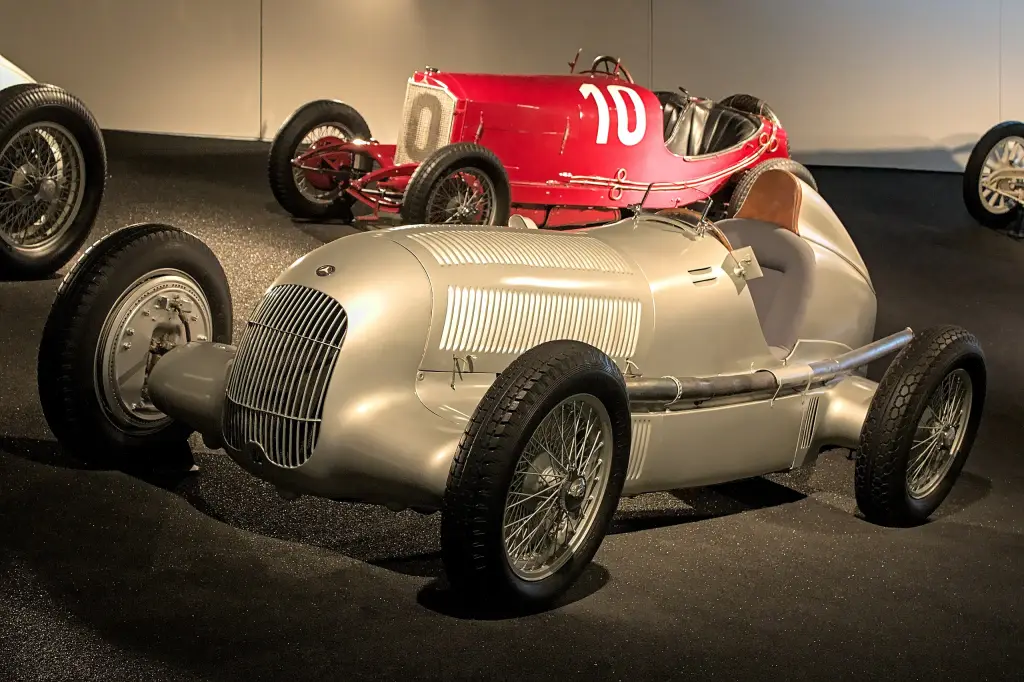
Although the weight and engine size were roughly halved, the Daimler engineers soon extracted more power from the supercharged straight-eight M25 engine than the maximum 300 hp of the SSK. The W25 was developed in 1933 and was due to appear at the Avusrennen in Berlin on 27 May 1934, but after carburettor or fuel pump problems in practice Mercedes withdrew. A week later at the Nürburgring Eifelrennen, on home soil, Manfred von Brauchitsch won. It is often said this race began the Silver Arrows name, though it has since been shown that von Brauchitsch raced an SSKL covered with streamlined aluminium sheets at the AVUS in 1932 and that the media called it a silver arrow. Both German rounds were run to Formula Libre rules to attract more entries.
In 1934 the W25 won four major races, the Eifelrennen, Coppa Acerbo, Spanish and Italian Grands Prix, against three for Auto Union, plus the Klausenpass hillclimb. The hillclimbs were usually dominated by the traction of Hans Stuck’s mid-engined Auto Union, which won at Felsberg, Kesselberg, Freiburg Schauinsland and Mont Ventoux. The German cars also won twice in Italy. In France and Belgium the season was embarrassing: none of the German cars finished in France, and at Spa the Belgians demanded duty on the alcohol-bearing race fuel, so both teams withdrew at short notice. In 1935 the European Championship resumed and Rudolf Caracciola won it in a W25.
Design and features
- 750 kg formula: a car built to the new weight limit.
- Supercharged straight eight: more than 300 hp.
- First win: the 1934 Eifelrennen with von Brauchitsch.
- Silver Arrows: the car at the start of the nickname’s popular use.
Mercedes-Benz W25 versions
- W25 (1934): the original car.
- Modified W25: developed through 1935 and 1936.
- W25 of 1937: the final version before the W125.
The W25 was the first of the Silver Arrows and was replaced by the W125. More in the Mercedes-Benz collection.
Video: Mercedes-Benz W 25 at the Klausenpass
Video by YouTube on YouTube.
Sources
- Mercedes-Benz W25, English Wikipedia: formula, engine, races, silver arrow story