The Mercedes-Benz O 321 H is a rear-engined bus produced by Daimler-Benz from 6 December 1954 to 1970. It was built at Mannheim and in Brazil, Argentina and Greece, 29,586 in all.
Mercedes-Benz O 321 H at a glance
| Production | 1954–1970 |
|---|---|
| Built | 29,586 |
| Main plant | Mannheim |
| Other production | Brazil about 11,000, Greece 116, Argentina 4 |
| Layout | front control, high floor, rear engine |
| Seat rows | nine, or eleven in the long version |
| Long version | O 321 H-L, 1.5 m longer, from 1956 |
| Engine | OM 321 diesel, 5,103 cc, 110 PS |
| Later engine | OM 322 diesel, 5,675 cc, 126 PS, from 1962 |
| City bus capacity | 26 seats and 46 standing |
| Coach capacity | 46 seats |
| Facelifts | 1957 and 1961 |
This article is based on the German Wikipedia article on the O 321. Free photographs of the O 321 H were not available, so the record keeps its earlier picture.
History of the Mercedes-Benz O 321 H
The O 321 H was conceived mainly as a line and touring bus and shared part of its drivetrain with the L 321 truck. From 1956 it was also built as the O 321 H-L, 1.5 m longer, and Daimler-Benz supplied the bus without a body, with only a front bulkhead, to independent coachbuilders. The interior was adapted to its use: as a city bus it had 26 seats and 46 standing places, as a coach 46 seats; the long version carried 36 seats and 48 standing places as a city bus and 45 seats as an intercity bus.
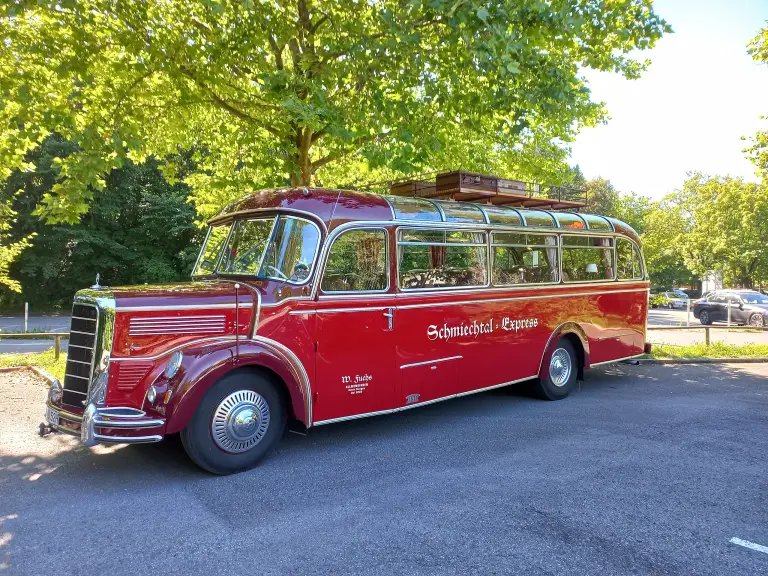
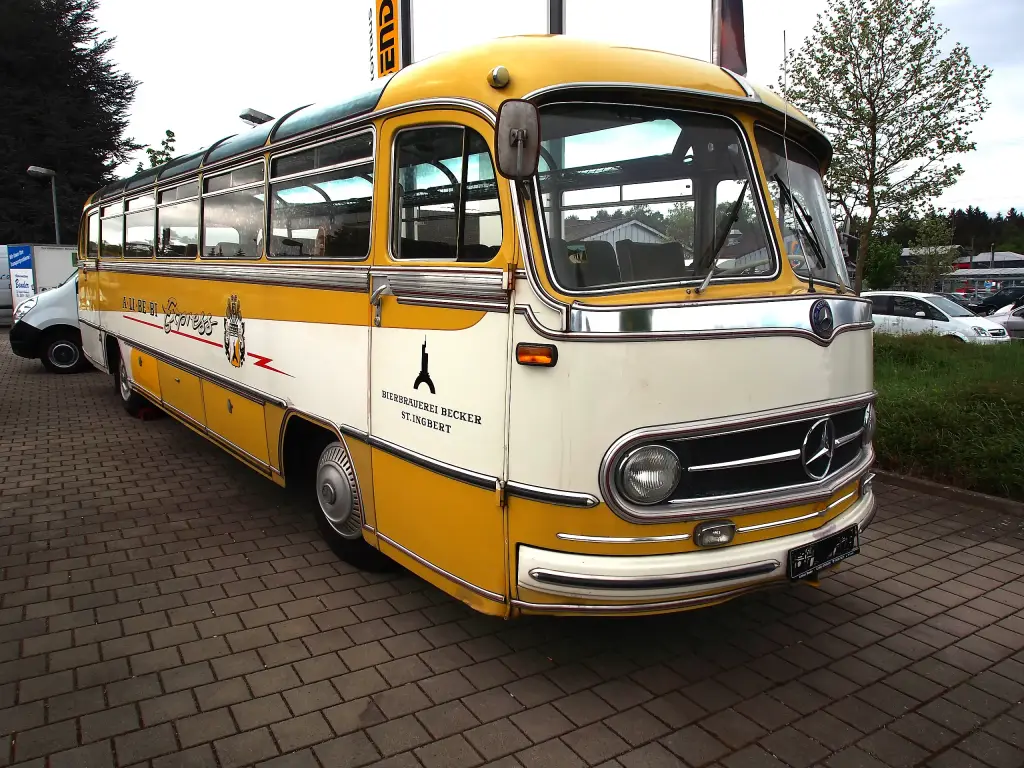
The first facelift in 1957 extended the windscreens downwards and the second in 1961 extended them upwards and made the rear window one piece. Coaches had glazed roof edges and luggage nets inside, and were usually more decorated outside, with multi-coloured paint and chrome; city buses had folding doors inside, less decoration and fewer seats so more passengers could stand. A destination display at the front was available.
Technically the bus was a two-axle high-floor vehicle with a front-control body and the engine at the rear, welded to the floor group and self-supporting, with luggage bays possible beneath the passenger area. Both axles were rigid; the rear ran on two semi-elliptic leaf springs with a stabiliser, the front on a V-shaped wishbone with a Panhard rod, coil springs with helper springs and telescopic dampers. Brakes were hydraulic with air assistance and drums on all wheels, and the bus could be ordered as right-hand drive. The OM 321 diesel of 5,103 cc and 110 PS was standard, with the 5,675 cc OM 322 of 126 PS available from 1962.
Design and features
- Rear engine: a front-control bus with the diesel mounted at the back.
- Two bodies: the standard O 321 H and the 1.5 m longer O 321 H-L.
- Many uses: city, intercity and touring versions with different seating.
- Worldwide production: Mannheim plus Brazil, Argentina and Greece.
Mercedes-Benz O 321 H versions
- O 321 H: the standard nine-row bus.
- O 321 H-L: 1.5 m longer with eleven rows, from 1956.
- City bus: 26 seats and 46 standing places.
- Coach: 46 seats with glazed roof edges.
- Bare chassis: supplied to independent bodybuilders.
The O 321 H came before the O 3500 generation ended and was followed by the O 302. More in the Mercedes-Benz collection.
Video: Mercedes-Benz O 321
Video by YouTube on YouTube.
Sources
- Mercedes-Benz O 321, German Wikipedia: production, versions, seating, chassis, engines