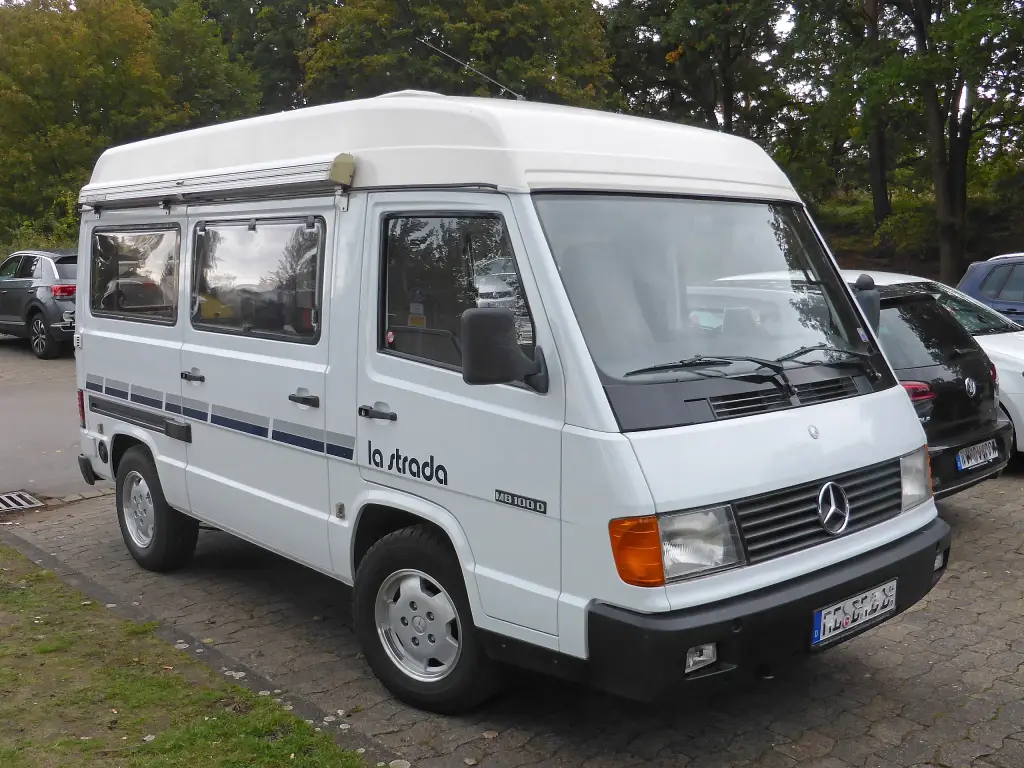
The Mercedes-Benz MB100, model type 631, is a light commercial cabover van made by Mercedes-Benz España from 1981 to 1996 at its Vitoria-Gasteiz factory in northern Spain.
Mercedes-Benz MB100 at a glance
| Model type | 631 |
|---|---|
| Builder | Mercedes-Benz España, Vitoria-Gasteiz |
| Production | 1981–1996 |
| Layout | cabover van |
| Bodies | cargo van, passenger van and pickup |
| First generation | from September 1980 |
| Model names | MB90 to MB180, reflecting payload in tens of kilograms |
| 2.0 diesel | OM615, 58 PS |
| 2.4 diesel | OM616, 72 PS, later 75 PS |
| Second generation | January 1987, type W631 |
| AMG versions | 95 hp turbo four and 120–127 hp turbo five |
| Successor | Mercedes-Benz Vito, 1996 |
This article is based on one source, the English Wikipedia article on the Mercedes-Benz MB100.
History of the Mercedes-Benz MB100
The Vitoria factory had previously belonged to Industrias del Motor, which built the DKW F1000 L van there, itself a development of the DKW Schnellaster with a Mercedes-Benz diesel engine instead of the original two-stroke. That van became the Mercedes-Benz N1300 and then, after another facelift, the first MB100-series. Elements of Fissore’s trapezoidal design for Auto Union were still visible, for example in the front door window profiles. The new model was offered as a cargo van, a passenger van and a pickup and was redesigned entirely during 1986.
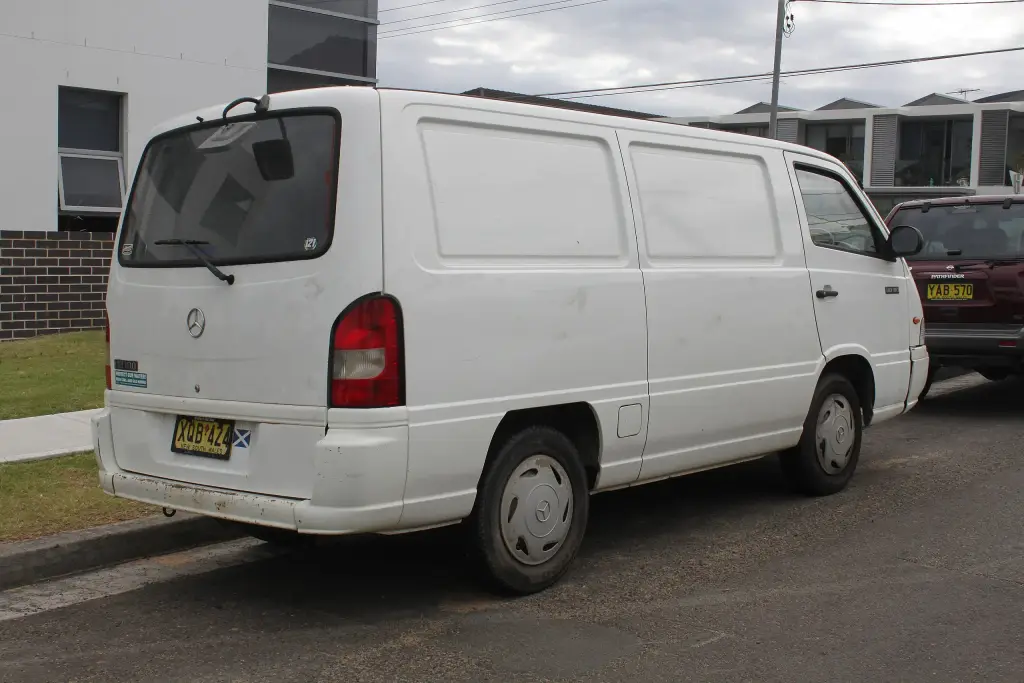
The first generation arrived in September 1980 as the MB100 and the heavier MB130. The names, from MB90 to MB180, reflected the payload in tens of kilograms. The MB100 and MB90 used the 2.0-litre OM615 diesel of 58 PS, while the heavier MB130, 140, 150 and 180 had the 2.4-litre OM616 with 72 PS. In 1981 the company, then called MEVOSA and 52.77 per cent owned by Mercedes-Benz, was renamed Mercedes-Benz España.
The second generation, model type W631, was presented in Mallorca in January 1987 as a very square van, and from then the Spanish-built vans were also sold in northern Europe, including Germany. Most had the 2.4-litre OM616 of about 72 PS, later 75 PS, the same engine as the 207 D. A 2.9-litre five-cylinder diesel and petrol fours were added later, and AMG offered versions with a 2.4 turbo four of 95 hp and a 3.0 turbo five of 120 to 127 hp, distinguished by different lights, bumpers, side skirts and Alcantara seats. In 1992 the van received a slanted radiator and a longer front for crash safety. The Vito replaced it in 1996, though exports continued to 1997, and a third generation was built under licence by SsangYong from 1995 to 2003 and by Maxus in China from 2009 to 2014.
Design and features
- Spanish origin: descended from the DKW F1000 L built in Vitoria.
- Payload-based names: from MB90 to MB180.
- Square second generation: the W631 of 1987 sold across northern Europe.
- AMG versions: turbocharged four- and five-cylinder vans.
Mercedes-Benz MB100 versions
- MB100 and MB130 (1980): first generation.
- W631 (1987): second generation.
- MB140 and MB180: heavier-duty versions.
- AMG MB100: 95 hp turbo four or 120–127 hp turbo five.
- SsangYong Istana: Korean-built third generation.
The MB100 was replaced by the Vito, which in turn led to the Sprinter. More in the Mercedes-Benz collection.
Sources
- Mercedes-Benz MB100, English Wikipedia: generations, engines, production, licensed versions