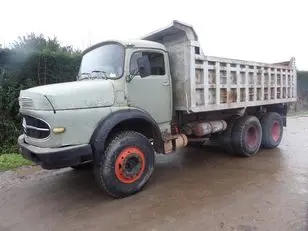
The Mercedes-Benz LK, or Leichte Klasse, was the company’s range of light trucks built between 1984 and 1998. It replaced the light LP models and was itself replaced by the Atego in 1998.
Mercedes-Benz LK at a glance
| Production | 1984–1998 |
|---|---|
| Name | LK, Leichte Klasse |
| Internal code | LN 2 |
| Model series | 673 to 679 |
| Model numbers | 609 to 1520 |
| Gross weights | 6.5 to 13 tonnes, 15 tonnes from 1989 |
| Engine power | 66 to 155 kW (90 to 211 PS) |
| Naming | gross weight in tonnes and about a tenth of the power in PS |
| Best-selling model | 814, 7.5 tonnes and 136 PS |
| All-wheel drive | from 1988 |
| Successor | Mercedes-Benz Atego, 1998 |
This article is based on the German Wikipedia article on the LK. Free photographs of the LK were not available, so the record keeps its earlier picture.
History of the Mercedes-Benz LK
The LK was introduced in 1983 and 1984 as a completely new range, internally called LN 2, after its predecessor had stayed in production almost unchanged for eighteen years. At launch it covered gross weights of 7, 8, 9, 11 and 13 tonnes, with diesel engines of 66, 100, 125 and 148 kW (90, 136, 170 and 201 PS). The model names followed the usual Mercedes-Benz pattern: the first digits gave the gross weight in tonnes and the last two about a tenth of the engine power in PS. The most common version was the 7.5-tonne 814 with 136 PS, later known without the LP prefix.
The new engines were four- and six-cylinder units with direct injection, and the cab was new, now able to tilt even in the smallest class. Its shape, with the lower edge of the door windows rising towards the rear, recalled the T 1 vans of 1977 and was later adopted by the heavy class. The wheel arches and bumper were more prominent than before, and because the truck was no longer meant only for local distribution, a full long-distance cab with two bunks under a higher roof was offered.
From 1989 a heavier 15-tonne version appeared with 170, 211 or 177 kW (240 PS). In 1988 the range took the name LK, paralleling the heavy SK and medium MK classes, and from then the lighter models could be ordered with all-wheel drive, mostly for construction and fire services. The tilt cabs were offered from 6.5 to 13 tonnes under the model numbers 609 to 1320, with engines from 66 to 155 kW, and a long-distance cab for 15 to 19 tonnes. Tippers and flatbed versions were available in the larger weights. Production ended in 1998 with the arrival of the Atego.
Design and features
- Tilt cab: for the first time in the smallest truck class.
- Wide range: 6.5 to 15 tonnes and 90 to 211 PS.
- Clear naming: gross weight in tonnes plus a tenth of the power in PS.
- Long-distance cab: two bunks under a raised roof.
Mercedes-Benz LK versions
- 609 to 809: 6.5 to 8 tonnes with 90 PS four-cylinder engines.
- 814: the best-selling 7.5-tonne model with 136 PS.
- 917 and 1117: 170 PS six-cylinder versions.
- 1120: 201 PS six-cylinder.
- All-wheel-drive AK and AF: tippers and fire appliances from 1985 and 1988.
- 15-tonne models (1989): up to 240 PS.
The LK was replaced by the Atego and sat below the heavy SK and NG ranges. More in the Mercedes-Benz collection.
Video: Mercedes-Benz LK 710
Video by YouTube on YouTube.
Sources
- Mercedes-Benz LK, German Wikipedia: history, weights, engines, model numbers