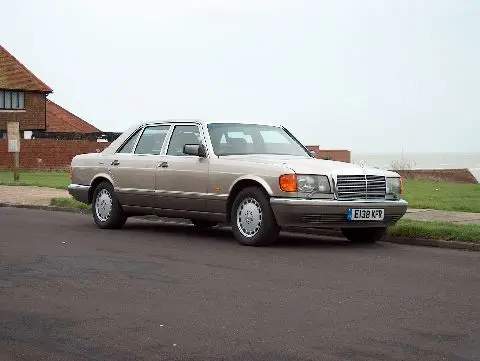
The Mercedes-Benz W126 is the second generation of the S-Class, made from 1979 to 1991 as a saloon and from 1981 as the coupé. It followed the W116 and became by far the most successful S-Class generation.
Mercedes-Benz W126 at a glance
| Production | 1979–1991 |
|---|---|
| Saloon | 1979–1991, 818,066 built |
| Coupé | C126, from September 1981, 74,060 built |
| Total | 892,126 |
| Chassis codes | W126 and V126 for saloons, C126 for the coupé |
| Project start | October 1973 |
| Design chief | Bruno Sacco |
| Fuel consumption | 10 per cent lower than the W116 |
| Engines at launch | one six-cylinder and two V8 petrol |
| Diesel | from September 1981, for North America |
| Coupé models | 380 SEC and 500 SEC |
| Revision | 1985, for the 1986 model year |
This article is based on one source, the English Wikipedia article on the Mercedes-Benz W126. Free photographs of the W126 were not available, so the record keeps its earlier picture.
History of the Mercedes-Benz W126
Preparation for the next S-Class began in October 1973 as Project W126, aiming at a better ride, better handling and improved fuel efficiency. The oil crisis of 1973 and stricter emission and safety rules in the United States shaped the development, pushing the car towards lower emissions and lower fuel consumption. The design team under Bruno Sacco wanted a more aerodynamic shape while keeping the unmistakable S-Class elements; drag was cut through long wind tunnel work, reshaping the front end and bumpers and hiding the wipers under the bonnet, while weight fell through extensive use of high-strength low-alloy steel and polyurethane for bumpers and side cladding. Lighter alloys were used for the revised M116 and M117 V8s, and together these changes cut fuel consumption by 10 per cent against the W116.
After six years of development the W126 was introduced at the Frankfurt motor show in September 1979, with two wheelbase lengths and three petrol engines: one six-cylinder inline and two V8s. A diesel option followed in September 1981, at first only for North America. At the 1981 Frankfurt show the C126 coupé appeared with 380 SEC and 500 SEC versions. It was the first time a coupé was derived from an S-Class chassis, and it had fully distinct styling, later evolving into the CL-Class; it kept the traditional pillarless design with no B-pillar between the side windows. The same show brought the Energiekonzept, an energy concept of engine revisions to improve fuel efficiency.
The W126 was revised in 1985 for the 1986 model year, with the second-series range presented at the Frankfurt show that year with new six-cylinder petrol and diesel engines and revised V8 petrol units. Over its twelve years of production 818,066 saloons and 74,060 coupés were built, 892,126 in total, making it the most successful S-Class generation so far and the longest in production.
Design and features
- Aerodynamics: wind tunnel work, reshaped bumpers and hidden wipers.
- Lower weight: high-strength steel, polyurethane cladding and alloy V8 engines.
- Two wheelbases: W126 and V126, with a separate C126 coupé.
- Coupé line: the first S-Class coupé, later the CL-Class.
Mercedes-Benz W126 versions
- W126 saloon (1979): the standard and long-wheelbase cars.
- Diesel (1981): at first for North America only.
- 380 SEC and 500 SEC (1981): the coupés.
- Second series (1985): new six-cylinder and diesel engines.
The W126 followed the W116 and preceded the later S-Class generations; its coupé became the CL-Class. More in the Mercedes-Benz collection.
Video: 1990 Mercedes-Benz 560 SEL W126
Video by YouTube on YouTube.
Sources
- Mercedes-Benz W126, English Wikipedia: development, design, models, production