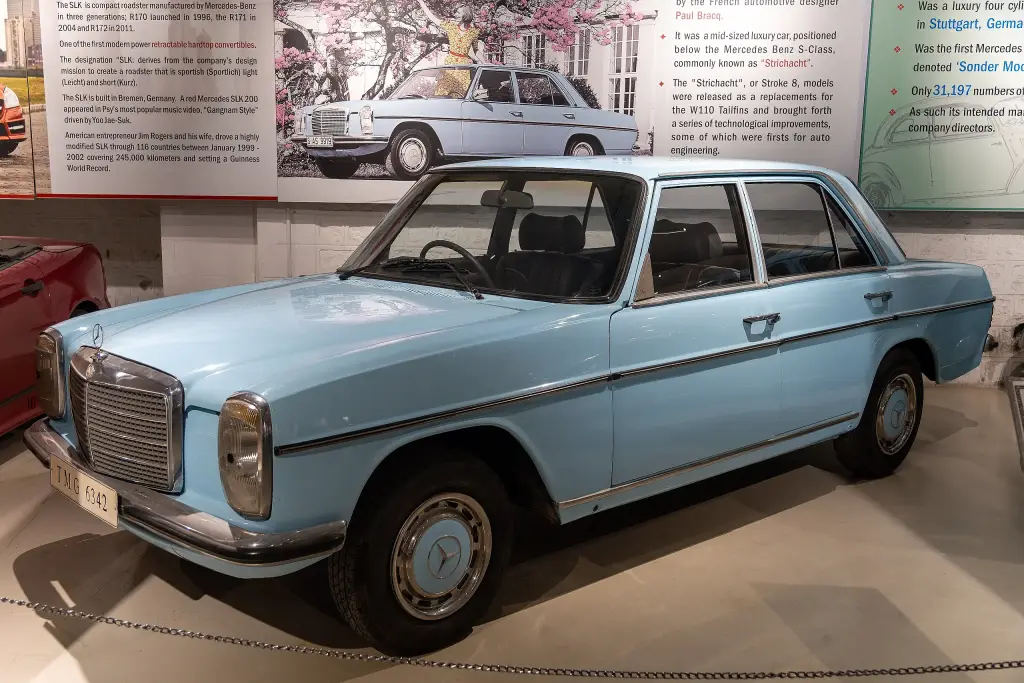
The Mercedes-Benz W114 and W115 are ranges of executive cars introduced in 1968 to succeed the W110. With squared-off three-box styling by Paul Bracq, they were built until 1976, when the W123 took over.
Mercedes-Benz W114/W115 at a glance
| Introduced | 1968 |
|---|---|
| Production | to 1976 |
| Nickname | /8 or Strich Acht, stroke eight |
| Design | Paul Bracq |
| W114 models | 230.6, 250 and 280 with six cylinders |
| W115 models | 200, 220, 230.4 and 240, plus diesel versions with D |
| Coupé | from 1969, 67,048 built |
| Saloons | 1,852,008 built |
| Coupé models | 250 C and 250 CE, 280 C and 280 CE |
| Suspension | semi-trailing rear arms and ball-joint front end |
| Innovation | first five-cylinder diesel, OM617 |
| Facelift | August 1973 |
This article is based on one source, the English Wikipedia article on the W114 and W115.
History of the Mercedes-Benz W114/W115
The W114 and W115 were marketed as New Generation models, the only Mercedes-Benz cars to receive that designation, and the /8 on their identification plates, marking the 1968 launch, gave them the nicknames /8 or stroke eight. They were the first post-war Mercedes-Benz production cars to use the new semi-trailing rear arm and ball-joint front suspension, a layout used in all new passenger models until the multi-link rear suspensions of the 1980s. The first S-Class, the W116, used the same engineering on a larger platform.
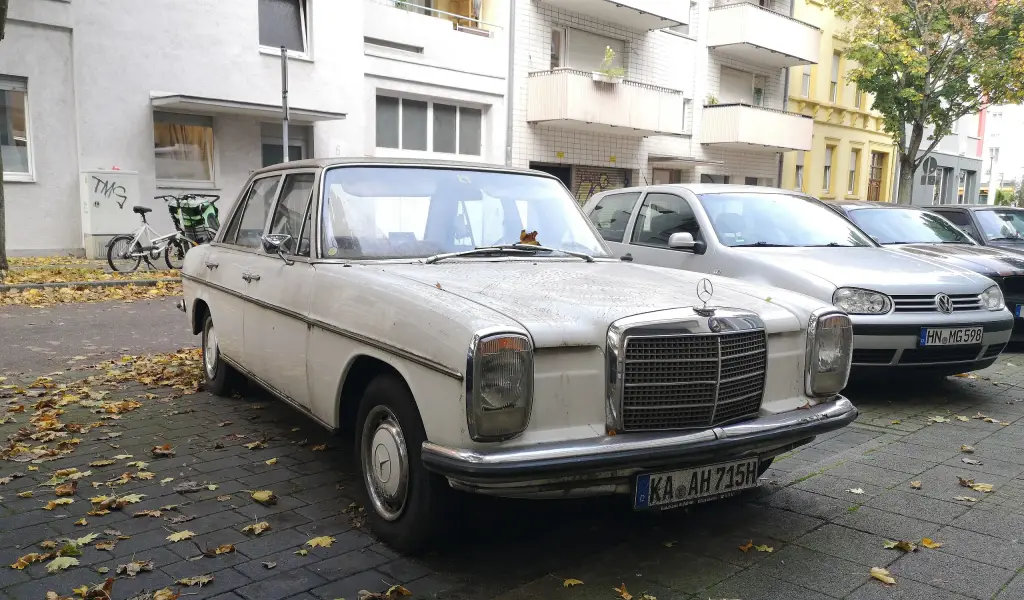
The cars were distinguished by nameplates relating to engine size: the W114 had six-cylinder engines and was sold as the 230.6, 250 and 280, while the W115 had four-cylinder engines and was sold as the 200, 220, 230.4 and 240, with diesel versions carrying a D. The W114/W115 was also where Mercedes-Benz launched its first five-cylinder diesel, the OM617. A coupé joined in 1969 with a longer boot lid and a choice of 2.5 or 2.8-litre six, its pillarless design allowing all the windows to be lowered; 67,048 coupés were built against 1,852,008 saloons, 24,669 of them 280 C and 280 CE and 42,379 the 250 C and 250 CE.
In 1968 the W114/W115 was the first Mercedes-Benz to receive the fully electronic Bosch D-Jetronic fuel injection, first in the 250 CE and later the 280 CE. In August 1973 the range was facelifted with a lower bonnet line, a lower and broader grille, a single front bumper replacing the double bumpers, lower headlamps, new A-pillar treatment to keep the side windows clear, ribbed tail lights and larger mirrors, while the interior gained inertia-reel seatbelts and a padded four-spoke steering wheel. The W115 is remembered for its durability: in 2004 the Greek taxi driver Gregorios Sachinidis gave his 1976 240 D to the Mercedes-Benz museum with 4.6 million kilometres on the odometer, the highest recorded mileage of any Mercedes-Benz.
Design and features
- New suspension: semi-trailing rear arms and ball-joint front end.
- Two ranges: six-cylinder W114 and four-cylinder W115.
- Pillarless coupé: from 1969, with all windows able to drop.
- Durability: the 240 D with the highest recorded Mercedes-Benz mileage.
Mercedes-Benz W114/W115 versions
- W114 saloons: 230.6, 250 and 280.
- W115 saloons: 200, 220, 230.4 and 240, with diesel versions.
- Coupés: 250 C, 250 CE, 280 C and 280 CE.
- Facelift (1973): lower bonnet and single bumper.
The W114 and W115 replaced the W110 and were followed by the W123; their engineering carried into the W116. More in the Mercedes-Benz collection.
Video: Driving a 1969 Mercedes-Benz 220D W114
Video by YouTube on YouTube.
Sources
- Mercedes-Benz W114/W115, English Wikipedia: ranges, suspension, coupés, facelift, diesel record