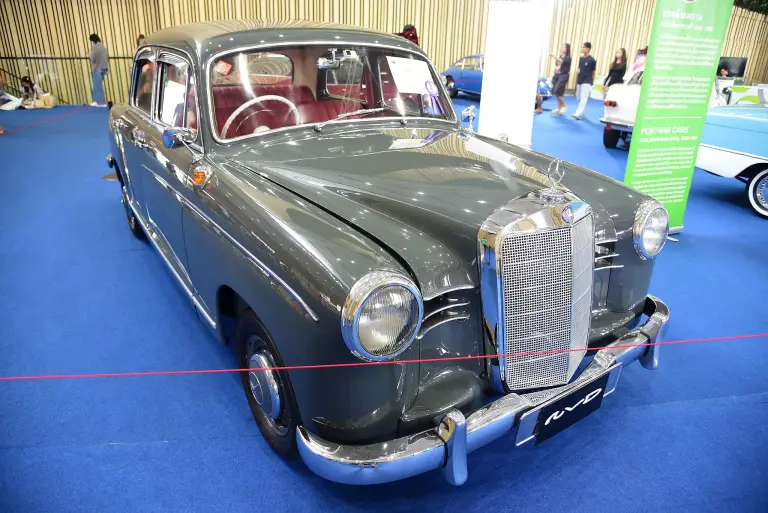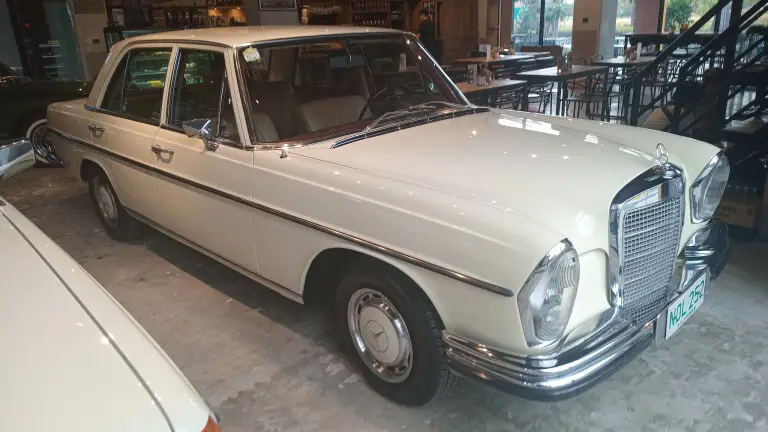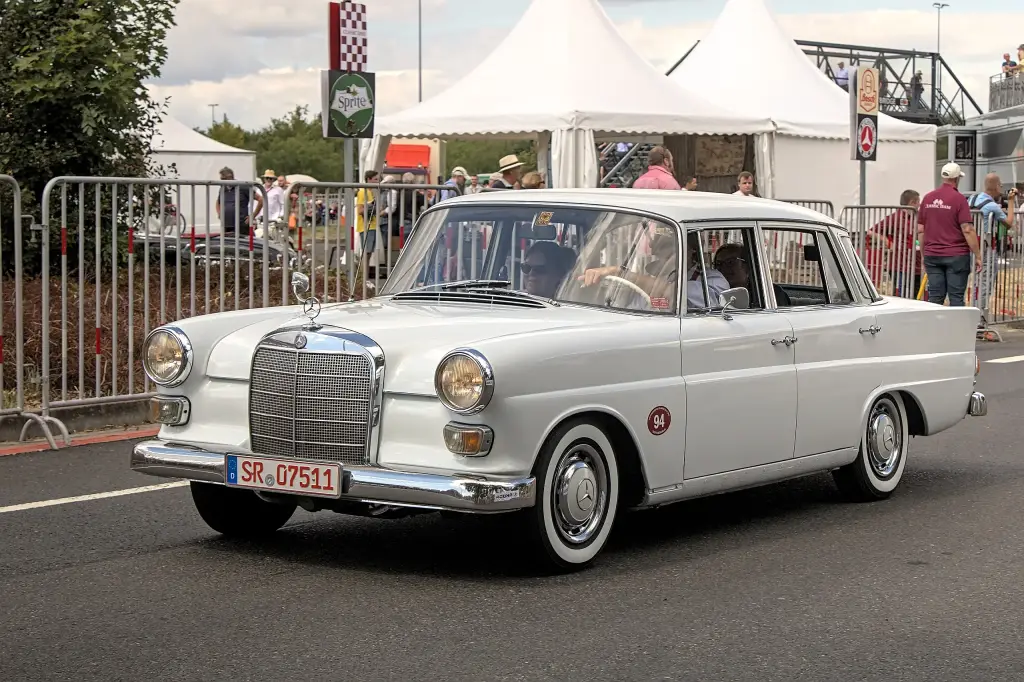
The Mercedes-Benz W110 is a line of mid-size executive cars produced between 1961 and 1968. It was the company’s basic line for much of the 1960s and part of the unified Fintail family.
Mercedes-Benz W110 at a glance
| Production | 1961–1968 |
|---|---|
| Family | Fintail, Heckflosse |
| First models | 190c and 190Dc, April 1961 |
| Replaced | 180c, 180Dc, 190b and 190Db |
| 190c engine | 1.9-litre M121 petrol |
| 190Dc engine | 2.0-litre OM621 diesel |
| Second series | 1965, with the 200, 200D and 230 |
| 200 engine | 1,988 cc M121 BIX with two carburettors |
| 230 engine | 2,307 cc straight six, 105 PS, 120 PS from 1966 |
| Body | W111-based, with a nose 145 mm shorter and round headlights |
| Safety | among the first Mercedes-Benz cars extensively crash tested |
| Replaced by | W114 and W115 in 1968 |
This article is based on one source, the English Wikipedia article on the Mercedes-Benz W110.
History of the Mercedes-Benz W110
The 190c and 190Dc saloons debuted in April 1961, replacing the W120 180c and 180Dc and the W121 190b and 190Db. The petrol 190c used the 1.9-litre M121, an upgrade from the 1.8-litre M136, while the 190Dc had the 2.0-litre OM621 diesel, an upgrade from the obsolete 1.8-litre OM636. The D stood for diesel, a technology Mercedes-Benz pioneered and championed despite mockery in the motoring press.
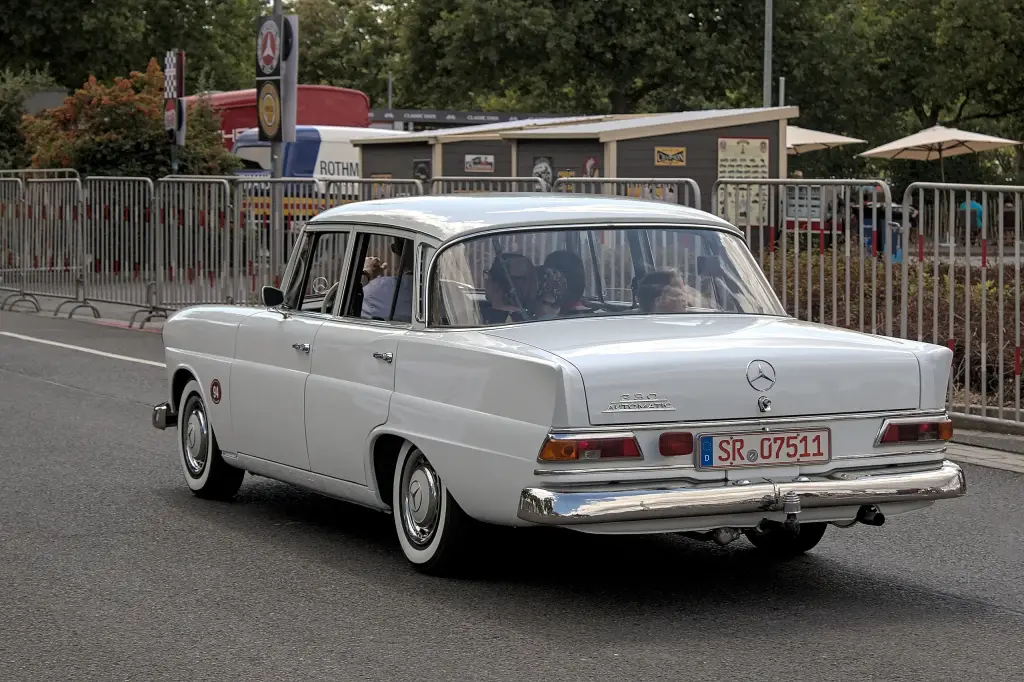
The body was derived from the W111 but with a nose 145 mm shorter and round headlights; the rear end was identical to the base W111 220b. The interior layout and dimensions matched the 220b, but with less luxurious fittings and fewer options, such as bakelite rather than wood on the dashboard and fixed-back seats. Being shorter and more manoeuvrable while offering the same interior and luggage space made the more economical 190c and 190Dc very popular with taxi drivers, and production of the 190Dc exceeded that of the petrol car by nearly 100,000 units.
In July 1965 a refreshed range appeared with the 200, 200D and 230. The 200 had the M121 engine bored from 85 to 87 mm, taking it to 1,988 cc and giving it a second carburettor as the M121 BIX; the 200D kept the 55 PS diesel but with a five-main-bearing crankshaft instead of three. The new 230 used a 2,307 cc version of the straight-six M180 with the carburettor of the two-litre four, producing 105 PS, and from July 1966 the unmodified 230S engine raised that to 120 PS. Visually the second-series cars moved the front indicators below the headlights and squared off the tail lights. Production lasted three more years, until the W114 and W115 of 1968; the W110 and the six-cylinder W111 were the first Mercedes-Benz cars to be extensively crash tested for occupant safety.
Design and features
- Fintail body: the W111 shape with a shorter nose and round headlights.
- Petrol and diesel: the M121 1.9 and the OM621 2.0.
- Taxi favourite: economical and manoeuvrable with the same space inside.
- Crash testing: one of the first Mercedes-Benz lines tested for occupant safety.
Mercedes-Benz W110 versions
- 190c (1961): 1.9-litre petrol.
- 190Dc (1961): 2.0-litre diesel.
- 200 (1965): 1,988 cc with two carburettors.
- 200D (1965): improved 2.0-litre diesel.
- 230 (1965): six-cylinder model.
The W110 sat between the four-cylinder 180 and the six-cylinder W111, and was replaced by the W114 and W115. More in the Mercedes-Benz collection.
Sources
- Mercedes-Benz W110, English Wikipedia: models, engines, body, second series, safety