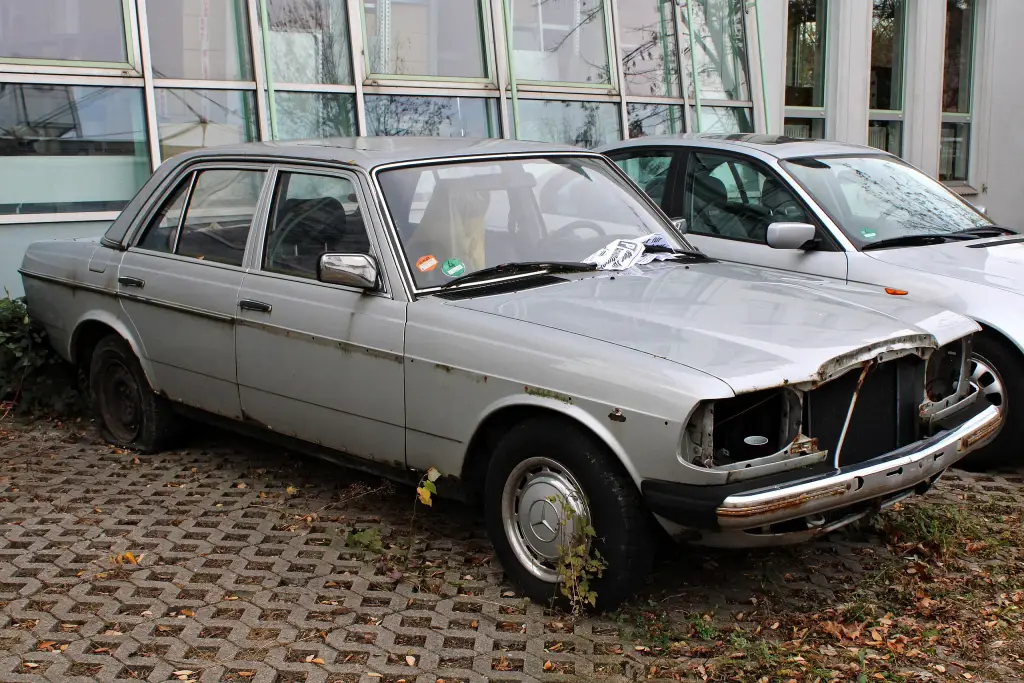
The Mercedes-Benz W123 is a range of executive cars produced from November 1975 to January 1986. It outsold its predecessor, the W114, and became the most successful Mercedes-Benz of its time, with 2.7 million cars built.
Mercedes-Benz W123 at a glance
| Production | November 1975 – January 1986 |
|---|---|
| Built | 2.7 million |
| Bodies | saloon, coupé and estate |
| Most popular models | 240 D with 455,000, 230 E with 442,000, 200 D with 378,000 |
| Styling | Friedrich Geiger, design finalised in 1973 |
| Chassis codes | W123 saloon, C123 coupé, S123 estate, V123 long, F123 chassis |
| Diesel suffix | D, as in 240 D |
| Injection suffix | E, as in 230 E |
| Coupé wheelbase | 2,710 mm against 2,795 mm for the saloon |
| Long version | V123 from August 1976, 3,425 mm wheelbase |
| Waiting time | nine to twelve months, with a black market premium |
This article is based on one source, the English Wikipedia article on the Mercedes-Benz W123.
History of the Mercedes-Benz W123
The W123 was launched at a time of slow production build-up, and customers who ordered faced waiting periods of nine to twelve months. A black market emerged for buyers willing to pay more for immediate delivery, and slightly used cars commanded about 5,000 Deutsche Mark over their original price. Like its predecessors it gained a reputation for being well built and reliable, and many German taxi companies chose it for its durability: reaching 500,000 km or more with only minor mechanical problems was common. At the end of their service life many were shipped to Africa, where they were valued for handling rough roads with little maintenance.
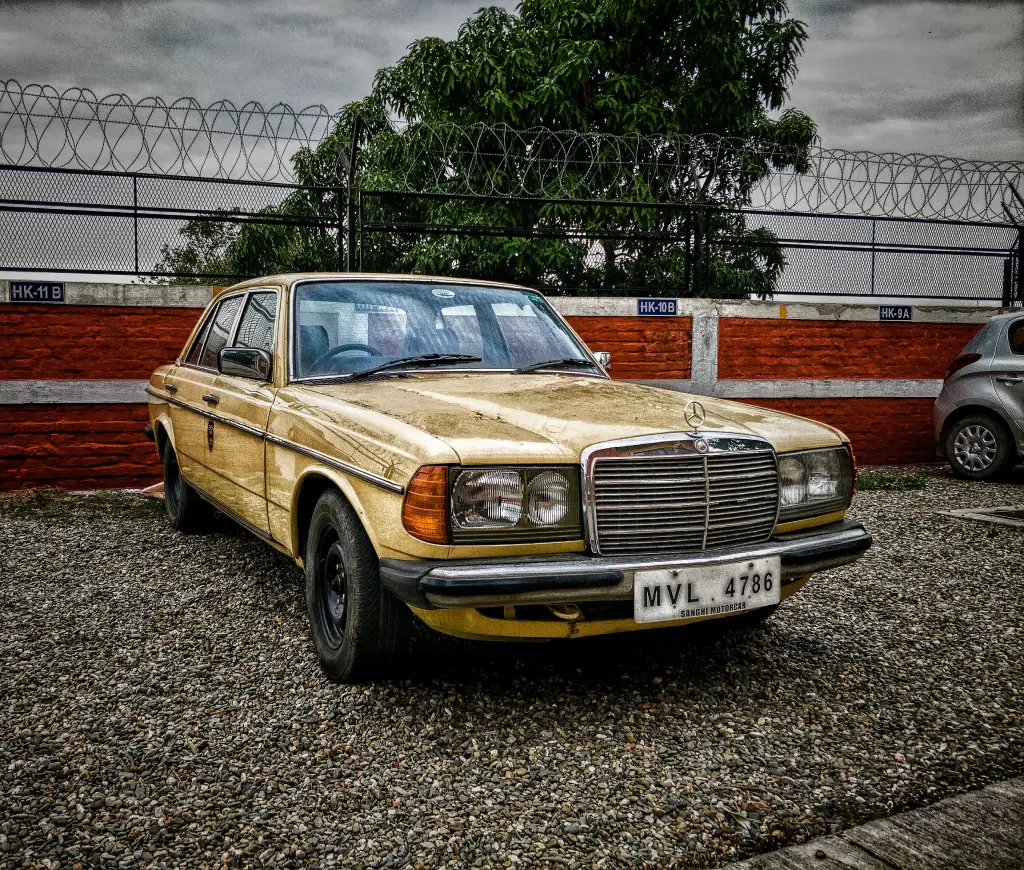
The design shared technical similarities with its predecessors, including engines, steering and suspension, but took styling cues from the larger W116: wider ribbed tail lights, horizontal headlamps, front turn signals on the outer edge and pull-to-open door handles. Friedrich Geiger headed styling when the design was finalised in 1973. Chief engineer Hans Scherenberg wanted a balanced, dynamic, non-aggressive form with horizontal lines at front and rear, a slight wedge shape, less chrome and rounded lines. The interior had a larger instrument panel, round central ventilation outlets and a single row of switches, with three large gauges behind one plastic cover.
Model names followed Mercedes-Benz tradition: W for Wagen, C for Coupé, T for Tourismus und Transport for the estate, D for diesel and E for Einspritzung, fuel injection. No suffix marked the long-wheelbase version, simply called Lang. The four-door saloon went on sale on 29 January 1976, a coupé on a shortened wheelbase followed in spring 1977, and a long-wheelbase V123 with seating for seven or eight was produced from August 1976. Production ended in January 1986 with 63 final estates built; the most popular single models were the 240 D with 455,000 cars, the 230 E with 442,000 and the 200 D with 378,000.
Design and features
- Legendary durability: half a million kilometres with minor repairs was common.
- Taxi work: a favourite of German taxi fleets.
- Three bodies: saloon, coupé and estate, plus a long-wheelbase V123.
- Clear naming: D for diesel, E for fuel injection, T for estate.
Mercedes-Benz W123 versions
- W123 saloon: the main body, from 1976.
- C123 coupé: shorter wheelbase, from 1977.
- S123 estate: the Tourismus und Transport version.
- V123 Lang: long-wheelbase saloon for seven or eight.
- F123 chassis: bare long chassis for ambulances and conversions.
- 240 D and 230 E: the most popular models.
The W123 replaced the W114 and W115 and was followed by the W124; it is one of the ancestors of the E-Class. More in the Mercedes-Benz collection.
Video: Mercedes-Benz W123 300TD test
Video by YouTube on YouTube.
Sources
- Mercedes-Benz W123, English Wikipedia: production, design, bodies, models, reputation