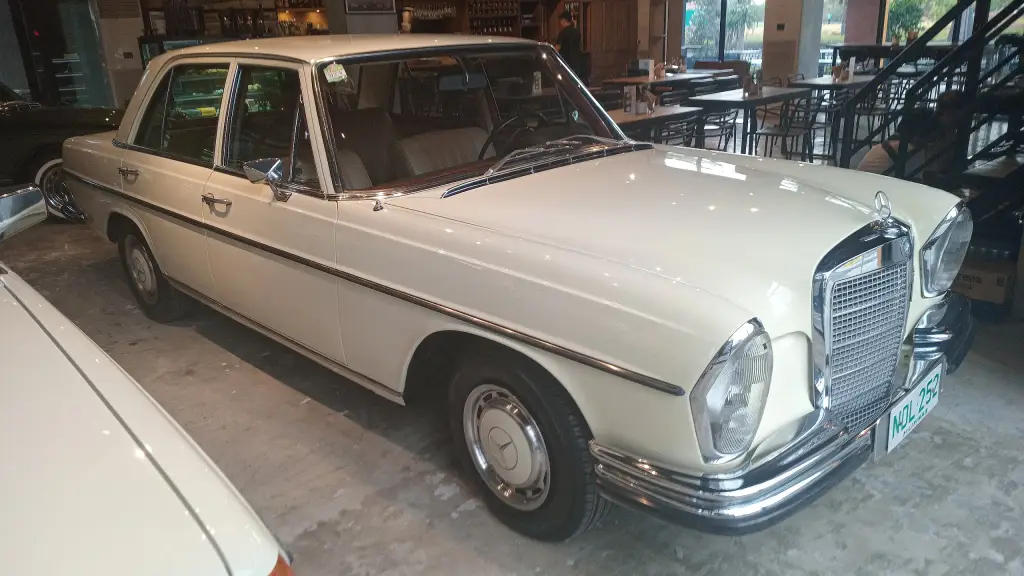
The Mercedes-Benz W108 and W109 are luxury cars produced from 1965 to 1972. They succeeded the W111 and W112 fintail saloons and were designated by the company as a new upper middle class range.
Mercedes-Benz W108/W109 at a glance
| Production | 1965–1972 |
|---|---|
| Replaced | W111 and W112 fintail saloons |
| Class | upper middle class |
| Bodies | four-door only |
| Total built | 383,072 |
| Design | Paul Bracq, finalised by 1963 |
| Platform | carried over from the W111 and W112 |
| Length | 25 mm longer than the 220 S |
| Width | 15 mm wider |
| Height | 60 mm lower |
| Interior width | 70 mm more at the rear, 90 mm more at the front |
| Windscreen | 17 per cent larger than the W111’s |
| Two-doors | the W111 and W112 coupés and cabriolets |
This article is based on one source, the English Wikipedia article on the W108 and W109.
History of the Mercedes-Benz W108/W109
The W108 and W109 succeeded the W111 and W112 fintail saloons. Those cars had helped Mercedes-Benz bring the whole range onto one platform and body, cutting cost and production time, but their tailfins quickly went out of fashion in favour of simplicity and practicality. Paul Bracq, who took over the design school at Mercedes-Benz in 1957, began steering the styling away from flamboyance towards function; the two-door W111 and W112 of 1961 were the first to show it, with the fins drastically rounded off, followed by the W113 Pagoda and the W100 with perfectly square rear wings. Work on the replacement for the saloon began in parallel and the design was finalised by 1963.
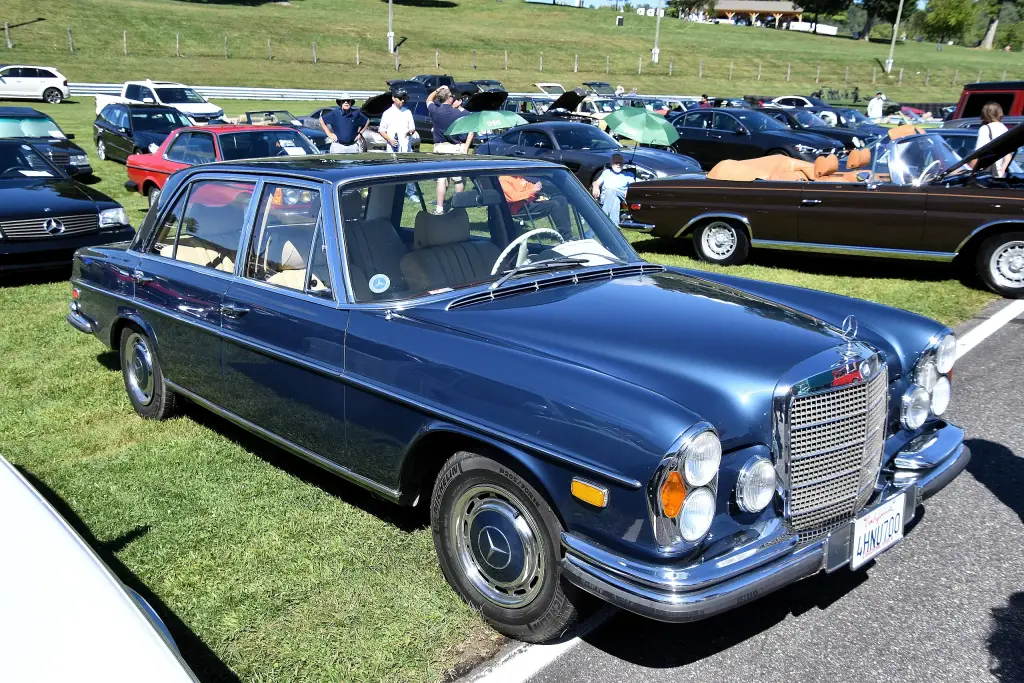
The new cars kept the W111 and W112 platform and underpinnings but aimed at maximum passenger space within compact exterior dimensions, with high safety, ride comfort and performance. The top W112 saloons had sold poorly because they looked too much like the cheaper four-cylinder W110, so the new saloons were not to share their underpinnings with lower models. Externally the cars grew only marginally, 25 mm longer, 15 mm wider and 60 mm lower than the 220 S, but curved side windows and a lowered beltline increased rear interior width by 70 mm and front width by 90 mm. The floor ahead of the rear seats was lowered by 20 mm, the centre of gravity came down and the windscreen alone was 17 per cent larger, with total glass area up 12 per cent.
The flat roof and smooth rear end recalled the W111 coupés, W113 roadster and W100 limousine. The front carried the traditional Mercedes-Benz grille with a wide opening, a lowered bonnet and vertical light units combining high and low beam, parking and turn signals and fog lamps in one assembly, though American export cars used round sealed-beam headlamps. Only four-door bodies were made, with the two-door W111 and W112 coupés and cabriolets filling that niche, which is why they are often mistaken for W108 or W109 two-doors. Over seven years 383,072 cars were built, successful in West Germany and in export markets including North America and Southeast Asia.
Design and features
- Flatter styling: Paul Bracq’s move away from tailfins.
- More space inside: curved windows and a lower beltline.
- Bigger glass area: a windscreen 17 per cent larger than the W111’s.
- Four doors only: coupés and cabriolets stayed with the W111 and W112.
Mercedes-Benz W108/W109 versions
- W108 saloons: the six-cylinder models.
- W109 saloons: the long-wheelbase and V8 versions.
- 300 SEL 6.3: the high-performance V8 saloon.
- American export cars: with round sealed-beam headlamps.
The W108 and W109 followed the W111 and W112 and led to the W116. More in the Mercedes-Benz collection.
Sources
- Mercedes-Benz W108/W109, English Wikipedia: design, dimensions, production, variants