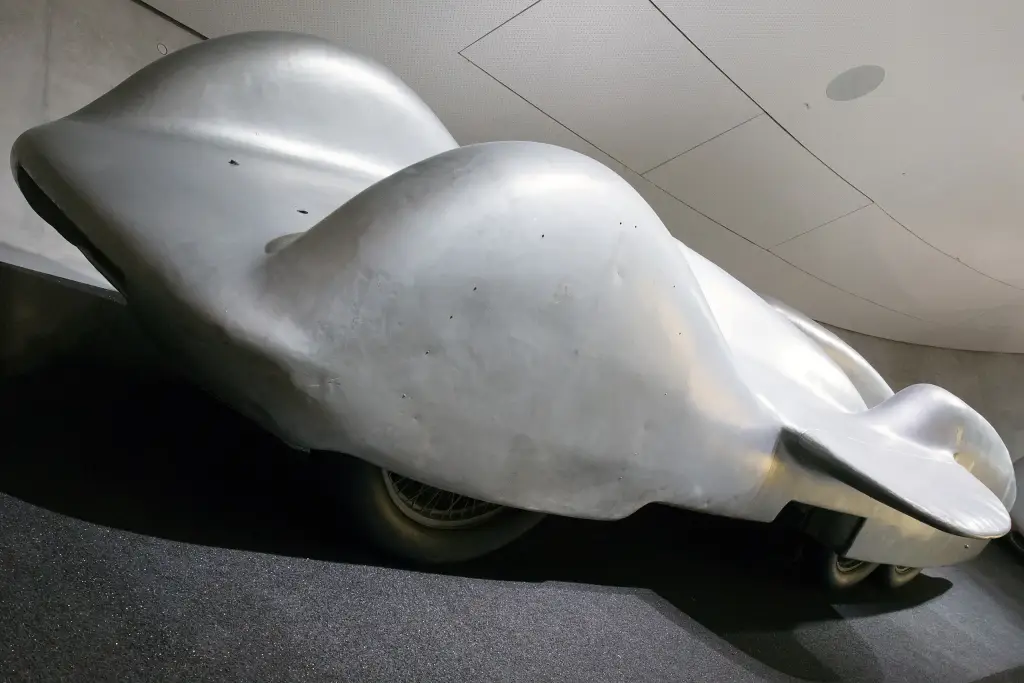
The Mercedes-Benz T80 was a six-wheeled record car designed by Ferdinand Porsche in the late 1930s. It was built to break the world land speed record but never made the attempt, because the Second World War intervened.
Mercedes-Benz T80 at a glance
| Project started | 1937 |
|---|---|
| Designer | Ferdinand Porsche |
| Driver intended | Hans Stuck |
| Target speed | 550 km/h, then 600, finally 750 km/h |
| Engine | 44.5-litre DB 603 inverted V12 |
| Power | 3,452 hp (2,574 kW) |
| Fuel | special methanol, benzene, ethanol, acetone and other blend |
| Length | over 8 m |
| Axles | three, two driven |
| Weight | over 2.7 tonnes |
| Drag coefficient | 0.18 |
| Completed | 1939, at a cost of RM 600,000 |
This article is based on one source, the English Wikipedia article on the Mercedes-Benz T80.
History of the Mercedes-Benz T80
The project began in 1937 on the initiative of the racing driver Hans Stuck, who wanted the world land speed record and persuaded Mercedes-Benz to build a car for the attempt. It was officially supported by Adolf Hitler, a racing enthusiast. Ferdinand Porsche first aimed at 550 km/h, but after George Eyston and John Cobb set records in 1938 and 1939 the target rose to 600 km/h and, by late 1939 when the car was finished, to 750 km/h. It was to be the first attempt at the absolute record on German soil, on a specially prepared stretch of the Reichsautobahn between Berlin and Halle/Leipzig, 25 m wide and almost 10 km long with the median paved over.
The engine was the 44.5-litre Daimler-Benz DB 603 inverted V12, an enlarged derivative of the DB 601 that powered the Messerschmitt Bf 109; the unit fitted was the third prototype of the variant, tuned to 3,452 hp (2,574 kW), about twice the power of a Bf 109 or a Spitfire. It ran on a special mixture of methyl alcohol, benzene, ethanol, acetone, nitrobenzene, aviation fuel and ether, with methanol-water injection for charge cooling and as an anti-detonant.
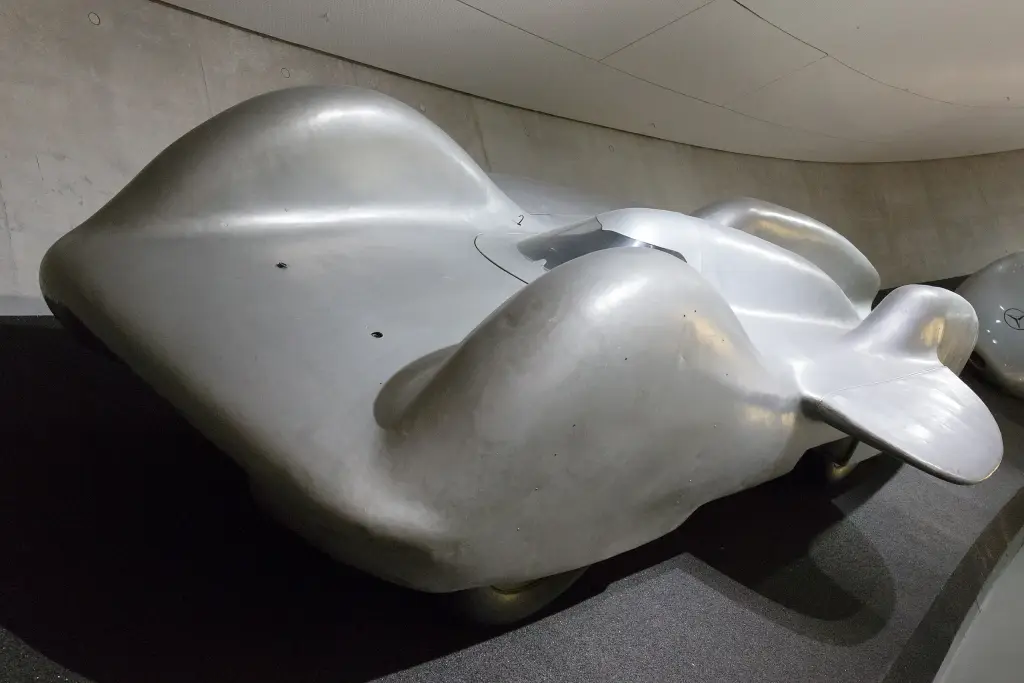
By 1939 the T80 was complete at a cost of 600,000 Reichsmark. It was over 8 m long, had three axles with two of them driven, weighed more than 2.7 tonnes and, with aerodynamics by Josef Mickl, was projected to reach 750 km/h. The body had a Porsche-designed enclosed cockpit, a low sloping bonnet, rounded wings and long tail booms, with two small wings amidships for downforce, inspired by the wings of Fritz von Opel’s Opel-RAK of 1928. The twin-tailed, heavily streamlined body reached a drag coefficient of 0.18. The run was set for the January 1940 Record Week, but the war that began on 1 September 1939 prevented it. The DB 603 engine was removed during the war and the car survived, later going to the Mercedes-Benz museum.
Design and features
- Aircraft engine: a 44.5-litre DB 603 V12 tuned to 3,452 hp.
- Six wheels: three axles, two of them driven.
- Very low drag: a coefficient of 0.18.
- Downforce wings: two small wings amidships for stability.
Mercedes-Benz T80 versions
- T80 (1939): the only car built.
The T80 was a research and record project of the same years as the W154 and W165 racing cars. More in the Mercedes-Benz collection.
Video: 1939 Mercedes-Benz T80 record car
Video by YouTube on YouTube.
Sources
- Mercedes-Benz T80, English Wikipedia: project, engine, construction, record attempt