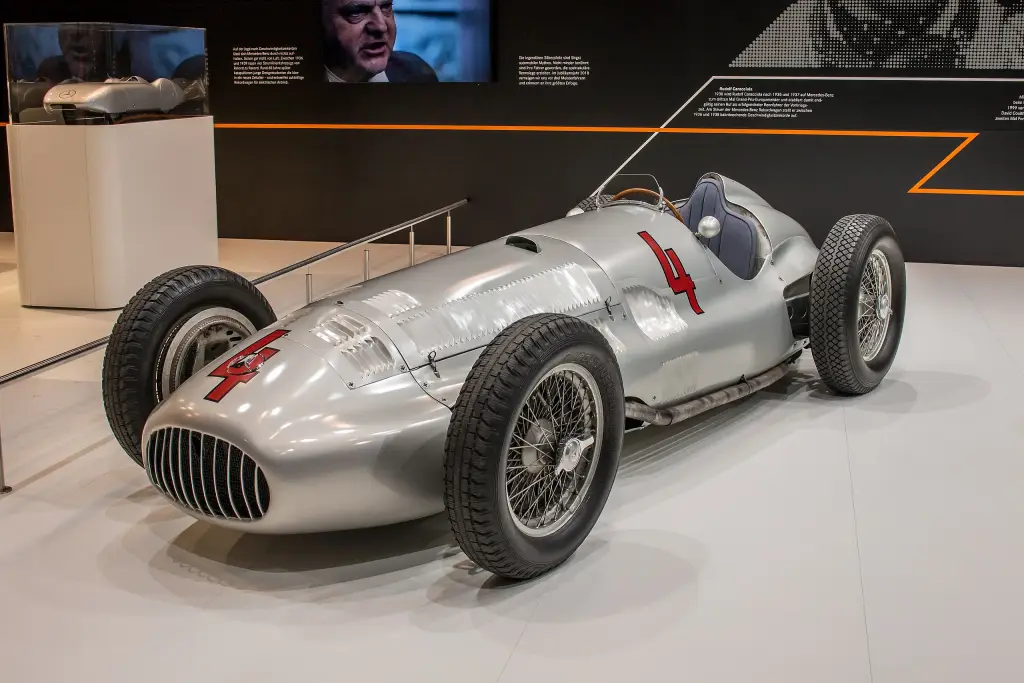
The Mercedes-Benz W154 was a Grand Prix racing car designed by Rudolf Uhlenhaut. It competed in 1938 and 1939 and took Rudolf Caracciola to the 1938 European Championship.
Mercedes-Benz W154 at a glance
| Seasons | 1938 and 1939 |
|---|---|
| Designer | Rudolf Uhlenhaut |
| Regulation | 3,000 cc supercharged or 4,500 cc unsupercharged |
| Engine | 2,961 cc supercharged V12, M154 |
| Power | 425 to 474 hp |
| 1939 engine | M163, two-stage supercharger, 476 bhp at 7,800 rpm |
| Engine cost | 89,700 Reichsmark each in 1938 |
| Gearbox | five-speed manual, first gear latched |
| Chassis | oval-tube nickel-chrome molybdenum frame from the W125 |
| Rear suspension | De Dion tube with cockpit-adjustable dampers |
| Body | unpainted aluminium |
| Starter | external, no starter motor fitted |
This article is based on one source, the English Wikipedia article on the Mercedes-Benz W154.
History of the Mercedes-Benz W154
For 1938 the governing body AIACR moved from a weight-limited formula to one limited by engine capacity: 3,000 cc with a supercharger or 4,500 cc without. Mercedes-Benz’s previous car, the supercharged 5,700 cc W125, was therefore ineligible. The company decided that a new car based on the W125 chassis would be better than modifying the old one, and chose a supercharged 3-litre engine after testing both types.
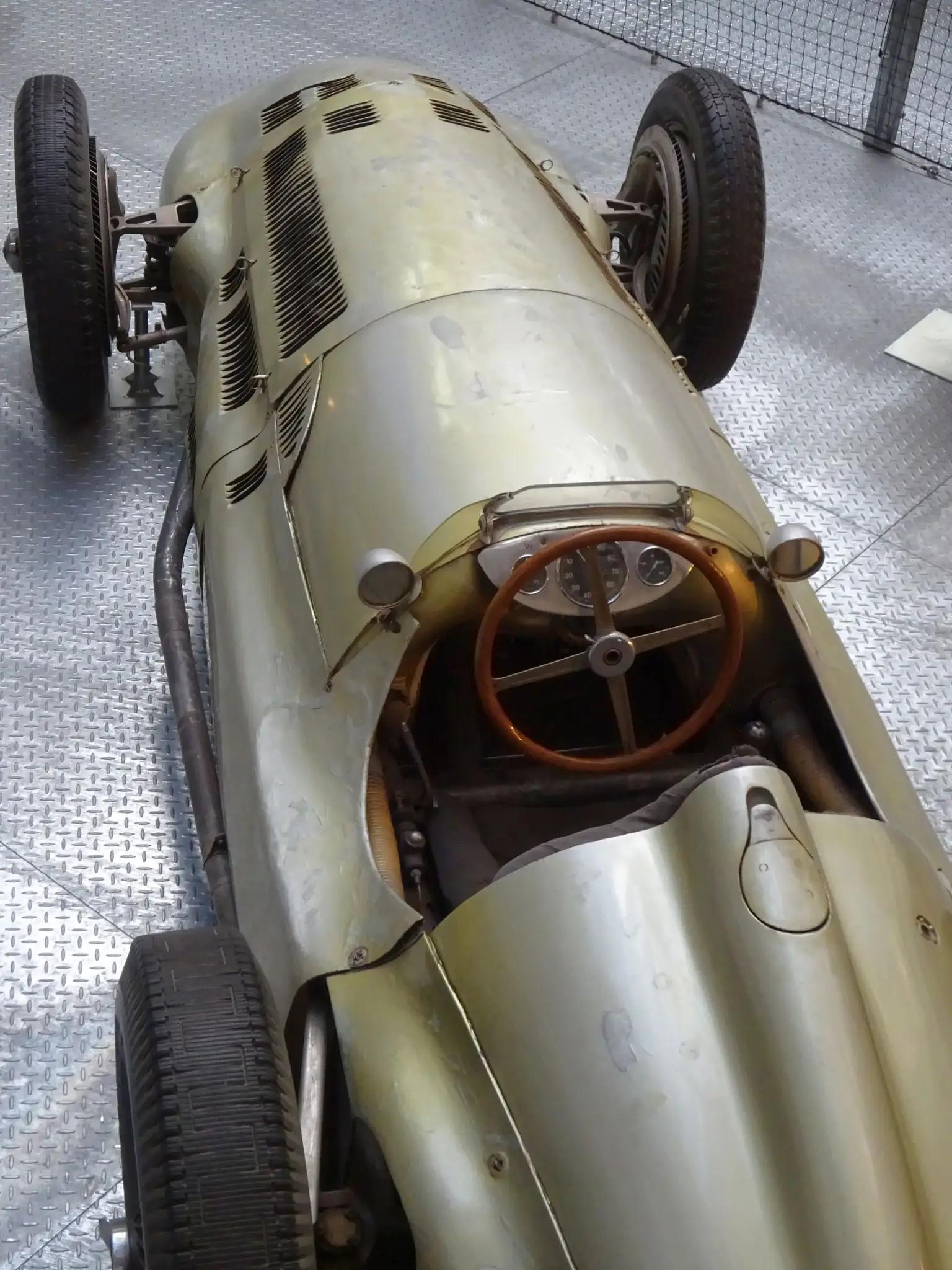
The chassis was largely that of the W125, with a frame of oval tubes in nickel-chrome molybdenum for stiffness. The suspension was nearly identical, with a De Dion tube at the rear to keep the wheels parallel and hydraulic dampers adjustable from the cockpit during a race. The body was aluminium left unpainted, like its predecessors, making another of the Silver Arrows. The M154 engine was a 2,961 cc supercharged V12 of 67 mm by 70 mm, giving between 425 and 474 hp; in 1939 a two-stage supercharged version reached 476 bhp at 7,800 rpm on the test bed, and each engine reputedly cost 89,700 Reichsmark in 1938.
To compensate for the smaller engine the W154 had a five-speed gearbox, with a latch to stop the first gear being engaged by accident. The engine was slightly offset and the transmission tunnel ran beside the seat rather than under it, so the car could be very low, and to save weight there was no starter motor, an external starter being used instead. The W154 made its debut in the opening race of 1938 and won three of the four championship races; although using the same chassis in 1939, it had a different body and the M163 engine, which is why the 1939 car is sometimes wrongly called the W163.
Design and features
- 3-litre V12: supercharged, from 425 to 474 hp.
- W125 chassis: a stiff oval-tube frame carried over.
- De Dion rear: with dampers adjustable from the cockpit.
- Weight saving: no starter motor and off-set engine for a low body.
Mercedes-Benz W154 versions
- 1938 car: M154 engine and the first body.
- 1939 car: M163 two-stage engine and new body.
The W154 replaced the W125 and was joined in the voiturette class by the W165. More in the Mercedes-Benz collection.
Video: VSCC Mercedes W154 demonstration
Video by YouTube on YouTube.
Sources
- Mercedes-Benz W154, English Wikipedia: regulations, engine, chassis, racing history