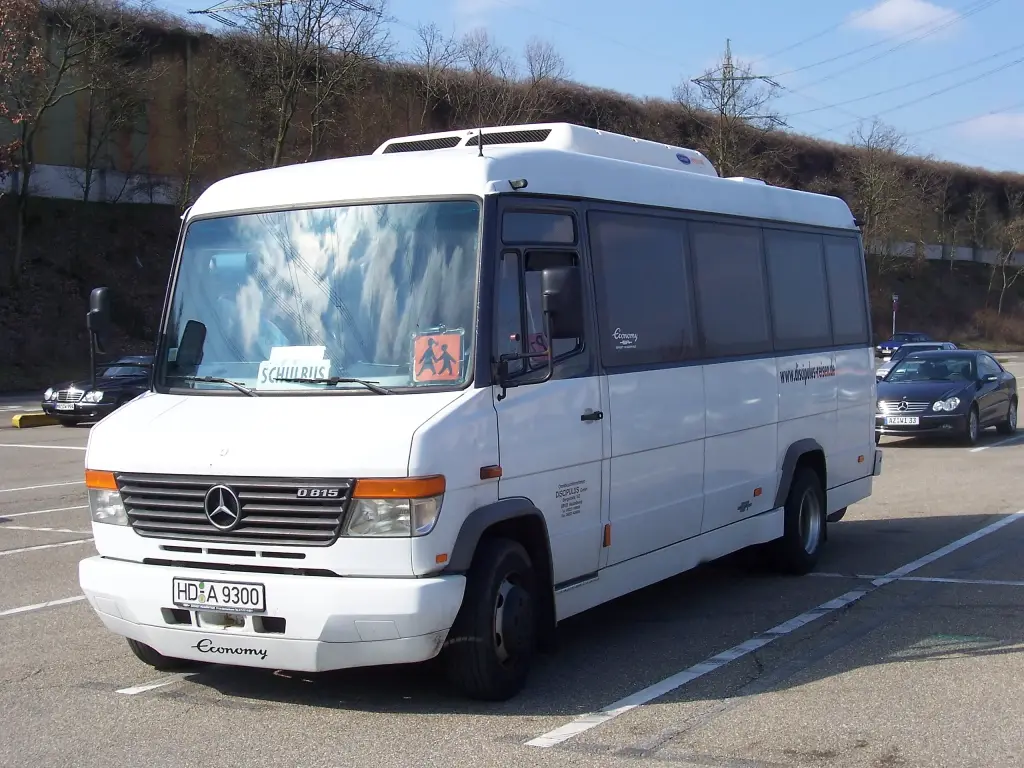
The Mercedes-Benz Vario, model designations BM667, 668 and 670, is a full-size heavy van and medium-duty truck built between 1996 and 2013. It was launched as a facelifted version of the T2.
Mercedes-Benz Vario at a glance
| Production | 1996–2013 |
|---|---|
| Based on | Mercedes-Benz T2 |
| Designations | BM667, BM668 and BM670 |
| Built | 90,743 |
| Last car | 27 September 2013, Ludwigsfelde |
| Early engines | OM602LA 2,874 cc five and OM904LA 4,250 cc four |
| From 2000 | 4.2-litre turbo diesel with 136 or 150 hp |
| Most powerful | 177 hp and 675 Nm |
| Euro 4 | OM904LA BlueTec4 with 129, 156 or 177 hp |
| Gearboxes | five- and six-speed manual, Allison automatic on buses |
| Payload | up to 4.4 tonnes |
| Load volume | 17.4 cubic metres |
This article is based on one source, the English Wikipedia article on the Mercedes-Benz Vario. Free photographs of the Vario were not available, so the record keeps its earlier picture.
History of the Mercedes-Benz Vario
The Vario was launched in 1996 as a facelifted T2, and its bodyshell stayed almost unchanged through 17 years of production. It was a popular base for trucks, minibuses and mini-coaches, and when new rules required access for disabled passengers a version with a wheelchair lift was offered.
Several Mercedes-Benz engines were used. Cars built before 2000 had the five-cylinder OM602LA of 2,874 cc and the four-cylinder OM904LA of 4,250 cc, both turbocharged and intercooled. From September 2000 the Vario 618 D and 818 D used a 4.2-litre turbo diesel with intercooler and direct injection producing 136 or 150 hp and 520 or 580 Nm, and the most powerful version gave 177 hp and 675 Nm. With the Euro 4 standards the Vario received the OM904LA BlueTec4 engine of 4,250 cc in 129, 156 or 177 hp, together with new manual gearboxes, a new automatic and extra equipment.
Two gearbox types were available, a five-speed manual later replaced by a six-speed, and on buses an Allison AT 545 four-speed automatic, later an Allison LCT 1000 five-speed. Maximum payload was 4.4 tonnes with a load volume of 17.4 cubic metres, and a four-wheel-drive model was offered. All versions had parabolic leaf springs, ventilated disc brakes and power steering. The last Vario left the Ludwigsfelde line on 27 September 2013; in the Daimler Trucks range it was succeeded by heavier versions of the Sprinter and lighter versions of the Atego.
Design and features
- T2 facelift: the same body shell with new lights, grille, interior, engines and suspension.
- Great variety: trucks, minibuses, mini-coaches and wheelchair-accessible buses.
- Heavy-duty chassis: parabolic leaf springs and ventilated disc brakes.
- Four-wheel drive: available for rough work.
Mercedes-Benz Vario versions
- Vario 618 D and 818 D (2000): 4.2-litre diesel with 136 or 150 hp.
- 177 hp version: the most powerful, with 675 Nm.
- Euro 4 cars: BlueTec4 engines of 129, 156 or 177 hp.
- Bus chassis: with Allison automatic gearboxes.
The Vario replaced the T2 and was in turn covered by the Sprinter and Atego. More in the Mercedes-Benz collection.
Sources
- Mercedes-Benz Vario, English Wikipedia: production, engines, gearboxes, payload