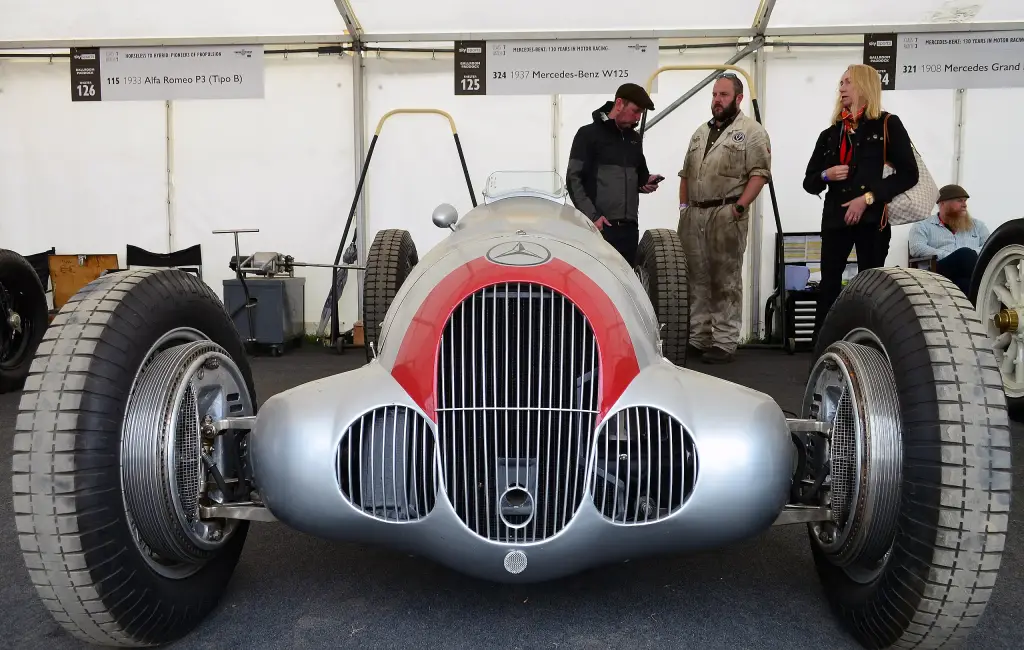
The Mercedes-Benz W125 was a Grand Prix racing car built for the 1937 season. Designed by Rudolf Uhlenhaut, it took Rudolf Caracciola to the 1937 European Championship, with W125 drivers second, third and fourth behind him.
Mercedes-Benz W125 at a glance
| Season | 1937 |
|---|---|
| Designer | Rudolf Uhlenhaut |
| Engine | 5,663 cc supercharged twin-cam straight-eight |
| Bore and stroke | 94 mm × 102 mm |
| Race power | 595 hp (444 kW) |
| Highest test-bed power | 637 bhp at 5,800 rpm |
| Torque | 872 Nm at 2,000 rpm |
| Chassis | oval-tube frame of nickel-chrome molybdenum steel |
| Body | unpainted aluminium |
| Race speeds | well over 300 km/h, especially at Avus |
| Successor | W154 for 1938 |
| Record car | W125 Rekordwagen at 432.7 km/h |
This article is based on one source, the English Wikipedia article on the Mercedes-Benz W125.
History of the Mercedes-Benz W125
After the W25 proved uncompetitive, Mercedes-Benz withdrew from the 1936 Grand Prix season midway through the year to design a car that would put it back on top. A new racing department, the Rennabteilung, was set up and Rudolf Uhlenhaut, previously a production car engineer, was chosen to lead the design team late in 1936. He had not designed a racing car before but had tested road cars extensively on the Nürburgring. Testing the old W25, he found the suspension too stiff, so the wheels could not follow the road; the chassis flexed and the rear axle bent by 7 to 10 cm under braking. The brief for the new car therefore called for a stiffer chassis and more suspension travel.
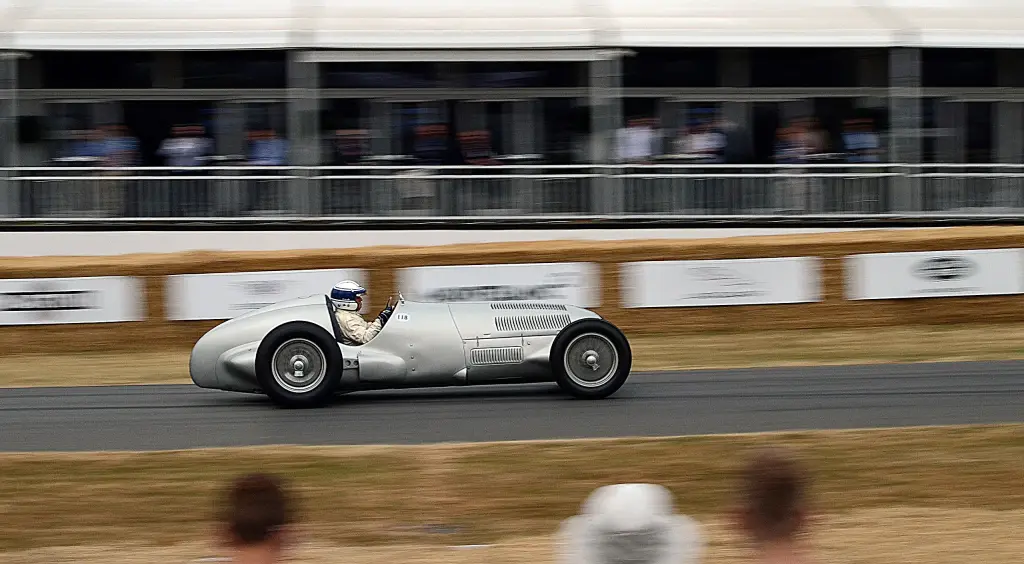
The W125 used a much stiffer tubular frame than the W25, made of oval tubes in nickel-chrome molybdenum steel. Its aluminium bodywork, like that of its predecessor, was left unpainted in bare silver, which gave Mercedes-Benz cars of the period their Silver Arrows nickname. The engine was a supercharged double overhead camshaft 5,663 cc straight eight of 94 mm by 102 mm, producing 595 hp in race trim; the highest power measured on the test bed was 637 bhp at 5,800 rpm, with 872 Nm of torque at 2,000 rpm.
In 1937 the W125 reached race speeds well over 300 km/h, especially at Avus in Berlin with a streamlined body. It was considered the most powerful road racing car for three decades, until large-capacity American V8s in CanAm sports cars reached similar figures in the late 1960s; in Grand Prix racing the figure was not exceeded until the turbocharged engines of the early 1980s. In 1938 supercharged Grand Prix engines were limited to 3 litres and the W125 was replaced by the W154. A separate record car, the W125 Rekordwagen, used a 5.6-litre V12 of 726 hp and was clocked at 432.7 km/h over a mile and a kilometre; it was too heavy for the 750 kg Grand Prix limit and never raced.
Design and features
- 595 hp straight eight: supercharged and twin-cam, with up to 637 bhp on test.
- Stiff oval-tube frame: a response to the flexing W25 chassis.
- Silver bodywork: unpainted aluminium, the racing colour of Germany.
- Over 300 km/h: especially on the Avus circuit.
Mercedes-Benz W125 versions
- W125 Grand Prix car: the 1937 racer.
- Streamlined Avus body: for the high-speed Berlin circuit.
- W125 Rekordwagen: the 432.7 km/h record car with a V12.
The W125 replaced the W25 and was followed by the W154; the record car belongs with the T80 project. More in the Mercedes-Benz collection.
Sources
- Mercedes-Benz W125, English Wikipedia: design, engine, chassis, records, successor