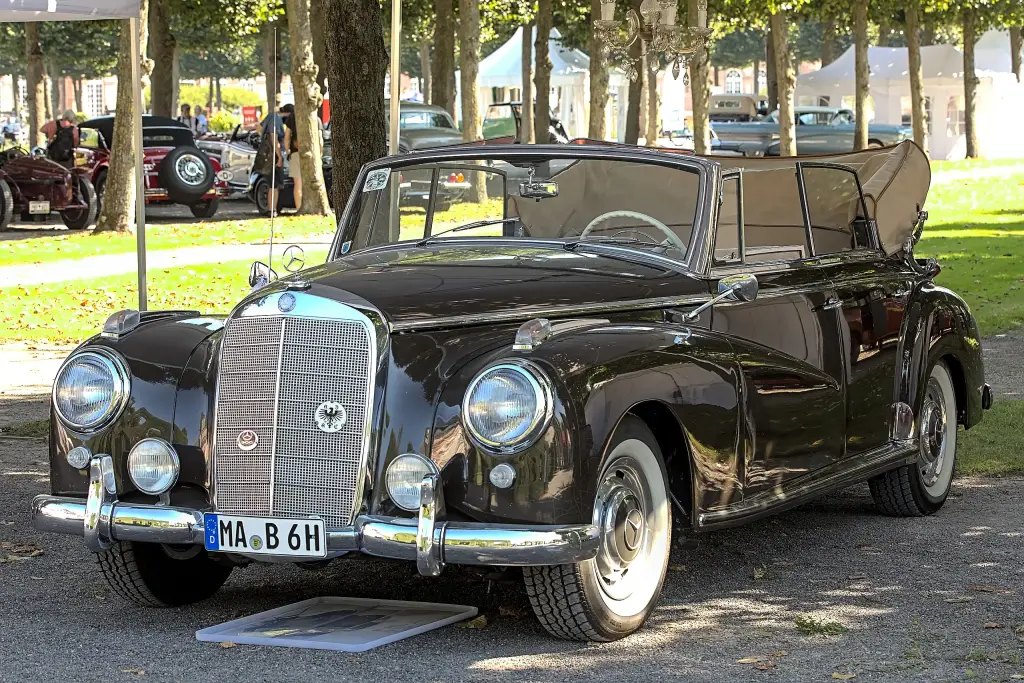
The Mercedes-Benz W186 Model 300 is a four-door luxury saloon produced from 1951 to 1957. It was the company’s flagship, succeeding the wartime W150, and was built in three successive versions known as the 300, 300 b and 300 c.
Mercedes-Benz 300 at a glance
| Production | 1951–1957 |
|---|---|
| First shown | Frankfurt Motor Show, April 1951 |
| Series production | from November 1951 |
| Versions | 300, 300 b and 300 c |
| Engine | 2,996 cc overhead-cam M186 straight six, aluminium head |
| Power | 115 PS at 6.4:1 compression |
| Gearbox | four-speed all-synchromesh manual |
| Chassis | X-shaped ovoid steel tube frame |
| Front suspension | double wishbones, coil springs and stabiliser |
| Rear suspension | double coil spring swing axle with load levelling |
| Brakes | hydraulic drums all round |
| Successor | 300 d on the W189 chassis |
This article is based on one source, the English Wikipedia article on the Mercedes-Benz W186.
History of the Mercedes-Benz 300
The four-door 300 was introduced at the Frankfurt Motor Show in April 1951 and entered series production in November 1951. It had no letter suffix; the a, b and c were added later by enthusiasts to tell the three W186 generations apart. It came as a saloon and cabriolet with modernist bodywork on Mercedes-Benz’s proven X-frame chassis. The new 3.0-litre overhead-cam M186 straight six had an aluminium head and was coupled to a four-speed all-synchromesh gearbox, with twin downdraft Solex carburettors and an innovative diagonal head-to-block joint that allowed oversized intake and exhaust valves, producing 115 PS at a 6.4:1 compression ratio.
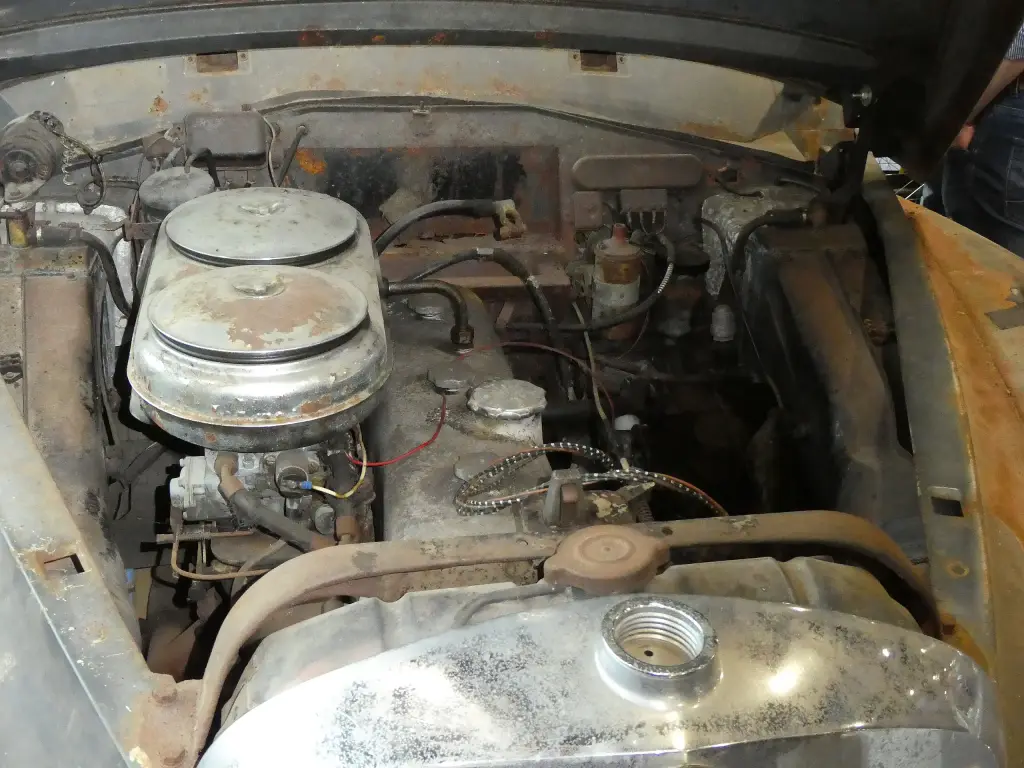
The engine was designed for reliable service under prolonged hard use, with deep water jackets, thermostatically controlled oil cooling, copper-lead bearings and a hardened crankshaft. It had no natural cruising speed: the car could sustain anything up to its maximum all day, road conditions permitting. The rigid X-shaped ovoid steel tube frame and four-wheel independent suspension gave surprisingly nimble handling, with double wishbones, coil springs and a stabiliser bar in front and the company’s double coil spring swing axle at the rear, while a dashboard-operated rear load-levelling system engaged a torsion bar to increase stiffness by a third when needed. A pedal-operated central lubrication system kept the friction points quiet, and the brakes were hydraulic drums all round.
The W186 was equal in features and price but superior in performance to the Rolls-Royce Silver Cloud and Bentley S1, and it was favoured by statesmen and business leaders, offering a glass partition, VHF mobile telephone and dictation machine. It is often called the Adenauer after Konrad Adenauer, the first Chancellor of West Germany, who used six custom cabriolet, hardtop saloon and landaulet versions of the W186 and its successor during his 1949 to 1963 tenure; those parade cars had writing desks, sirens, curtains, dividing partitions and sunroofs. The 300 was regarded as a driver’s car and shared engine, suspension and chassis ideas with the 300 SL Gullwing. It was replaced in late 1957 by the larger 300 d on the W189 chassis.
Design and features
- Flagship saloon: the top of the Mercedes-Benz range in the 1950s.
- M186 six: a 3-litre overhead-cam engine with an aluminium head.
- Load levelling: dashboard-operated, raising stiffness by a third.
- State cars: custom cabriolets and landaulets for Chancellor Adenauer.
Mercedes-Benz 300 versions
- 300 (1951): the first series.
- 300 b: the second series.
- 300 c: the final W186 version.
- Custom state cars: cabriolets, hardtop saloons and landaulets.
The W186 was the four-door relative of the 300 S and shared its engine ideas with the 300 SL; its successor was the 300 SE. More in the Mercedes-Benz collection.
Video: 1954 Mercedes-Benz 300B saloon
Video by YouTube on YouTube.
Sources
- Mercedes-Benz W186, English Wikipedia: models, engine, chassis, equipment, Adenauer use