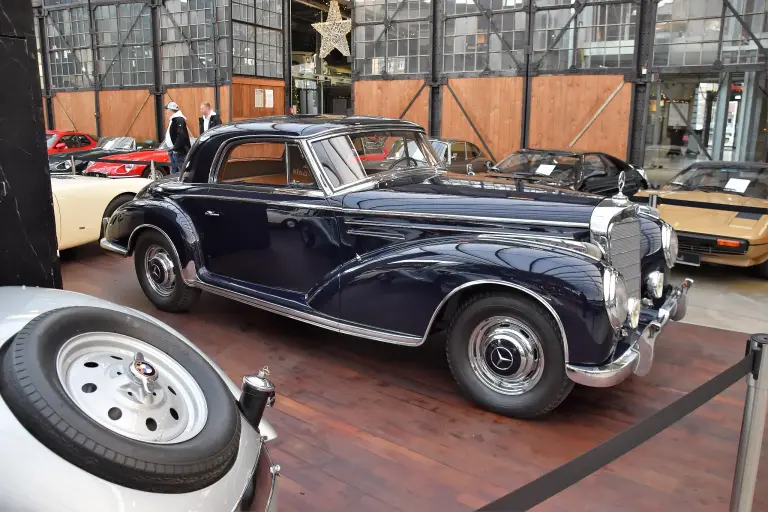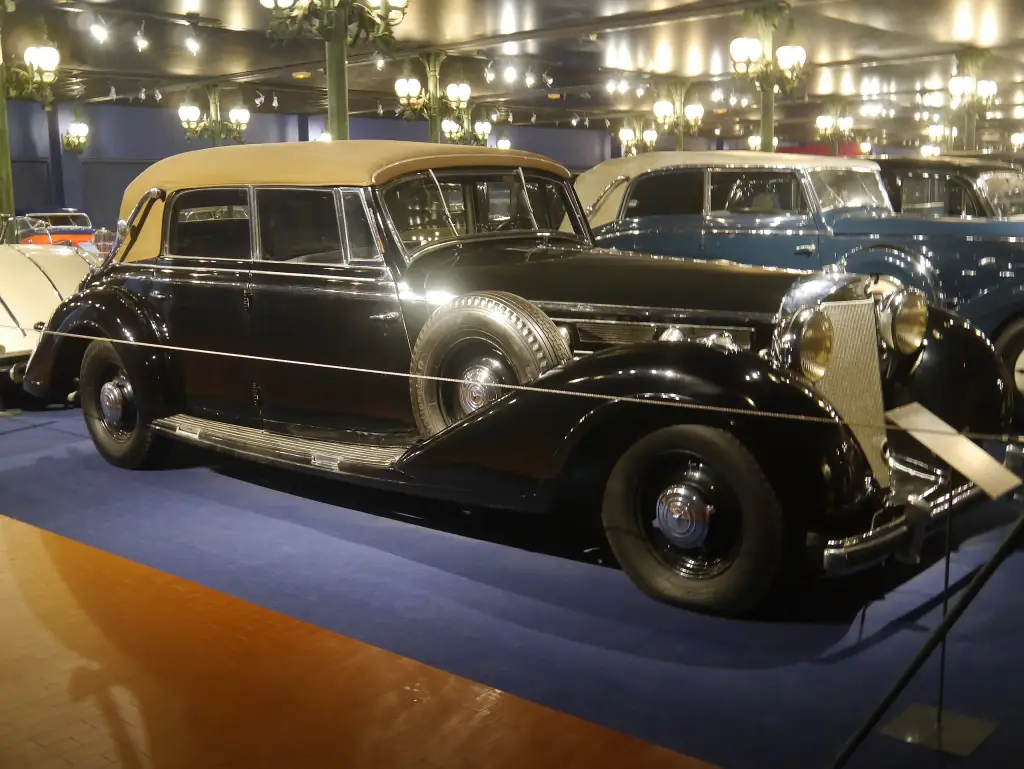
The Mercedes-Benz 770, known as the Großer Mercedes, was an ultra-luxury car built from 1930 to 1944. Two series were made, the W07 from 1930 to 1938 and the W150 from 1938 to 1944, and many cars served as state vehicles.
Mercedes-Benz 770 at a glance
| Production | 1930–1944 |
|---|---|
| Series I | W07, 1930–1938 |
| Series II | W150, 1938–1944 |
| Engine | 7,665 cc overhead-camshaft straight-eight |
| W07 power | 150 bhp, or 200 bhp with the Roots supercharger |
| W150 power | 155 bhp, or 230 bhp supercharged |
| Twin-supercharged version | 400 hp, five built |
| W07 chassis | boxed frame, leaf springs, beam axles |
| W150 chassis | oval-tube frame, coil springs, independent front, De Dion rear |
| W07 wheelbase | 3,750 mm |
| W07 built | 117 |
| W150 built | 88 |
This article is based on one source, the English Wikipedia article on the Mercedes-Benz 770.
History of the Mercedes-Benz 770
The 770 was introduced in 1930 as the successor to the Typ 630, with the internal code W07. These high-priced cars were mainly used by governments as state vehicles; Reich President Paul von Hindenburg, Emperor Hirohito and Pope Pius XI were among the customers, and Adolf Hitler used a 770 from 1931. The 7,665 cc straight-eight with overhead camshaft and aluminium pistons gave 150 bhp, or 200 bhp when the optional Roots supercharger came in at full throttle, for a top speed of 160 km/h. The four-speed transmission had a direct third and an overdrive fourth. The boxed frame ran on semi-elliptic leaf springs with beam axles front and rear, on a wheelbase of 3,750 mm. 117 W07 cars were built up to 1938.
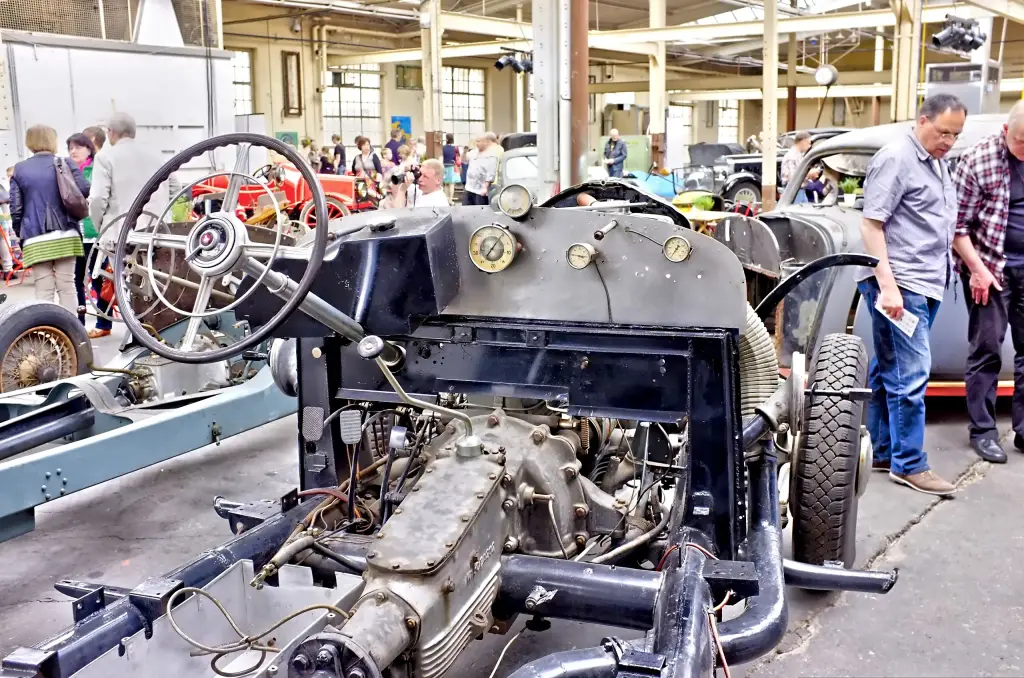
The 770 was revised in 1938 as the W150. The new frame was made of oval-section tubes and ran on coil springs all round, with independent front suspension and a De Dion rear axle. Hydraulic brakes replaced the servo-assisted mechanical brakes of the earlier series. The engine produced 155 bhp without and 230 bhp with the supercharger, for a top speed of about 170 km/h; a twin-supercharged 400 hp model reached about 190 km/h and only five were made. The W150 was the most expensive German passenger car of its time, though no price was published and it was quoted only on request. 88 cars were built before chassis production ended in 1944.
The W150 became the official car of many Axis leaders, and several were given as gifts to allied heads of state, among them Ion Antonescu, Benito Mussolini, Francisco Franco, Carl Gustaf Emil Mannerheim and Emil Hácha. An armoured W 150 II version of 1940–43 weighed 4,100 kg, with 40 mm glass, 18 mm steel armour, armoured steel wheels and bullet-resistant tyres. One of Hitler’s seven cars is preserved in the Canadian War Museum in Ottawa, and the car owned by Mannerheim later appeared in the 1951 film The Desert Fox.
Design and features
- Straight-eight: 7,665 cc with overhead camshaft and aluminium pistons.
- Supercharger: a Roots blower engaged at full throttle.
- Two chassis generations: boxed frame with beam axles, then oval tubes with independent front suspension.
- State cars: standard bodies for governments, plus armoured versions.
Mercedes-Benz 770 versions
- 770 (W07): 150 bhp, 200 bhp supercharged.
- 770 K (W150): 155 bhp, 230 bhp supercharged.
- Twin-supercharged W150: 400 hp, five built.
- W 150 II: armoured state car of 1940–43.
The 770 was the largest Mercedes of its day, above the 540K, and the name Grosser passed to the 600 of 1963. More in the Mercedes-Benz collection.
Video: 1940 Mercedes-Benz 770K
Video by YouTube on YouTube.
Sources
- Mercedes-Benz 770, English Wikipedia: engines, chassis, production, owners