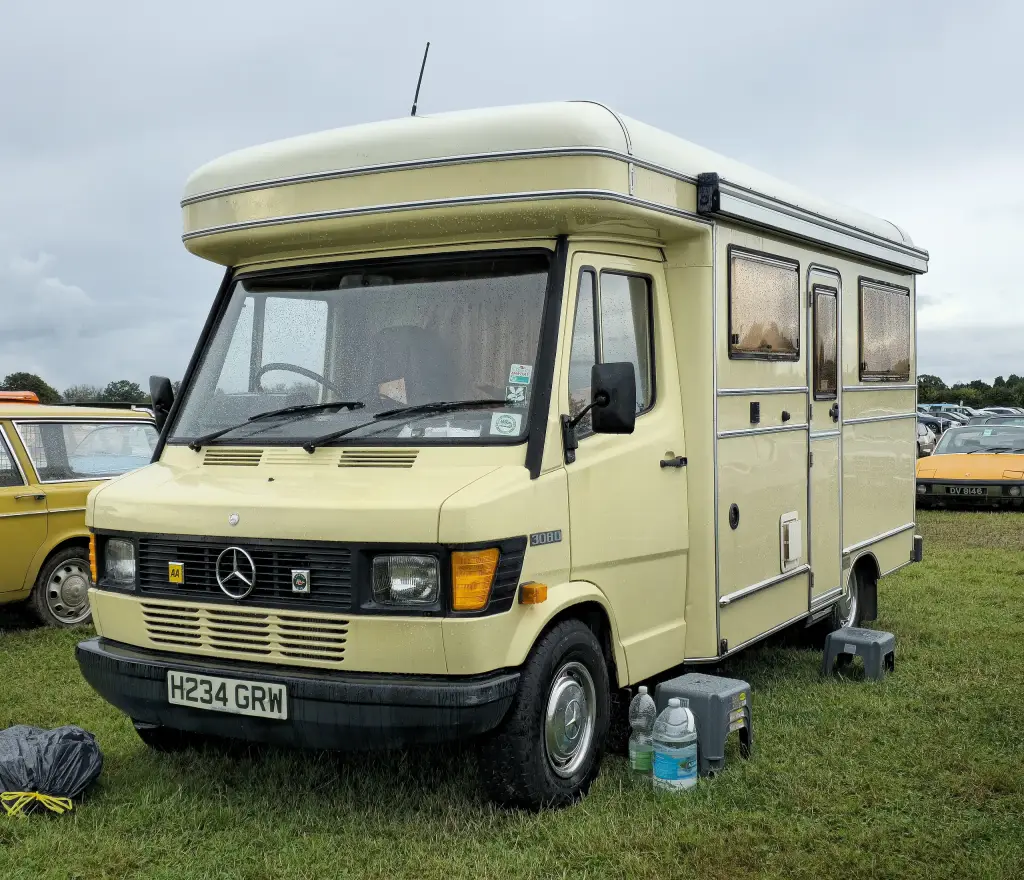
In 1977 Daimler-Benz introduced a new van and light truck, called the T1 internally and also known as series TN, Transporter Neu, or the Bremer Transporter after its first plant in Bremen.
Mercedes-Benz T1 at a glance
| Introduced | April 1977 |
|---|---|
| Production | 1977–1995 |
| Names | T1, TN and Bremer Transporter |
| First plant | Bremen, later Düsseldorf |
| Gross weights | 2.55 to 4.6 tonnes |
| Chassis codes | 601, 602 and 611 |
| Wheelbases | three |
| Diesel engines | OM616 2.4-litre four, 65 PS; later OM617 3.0 five, 88 PS |
| Petrol engine | M115 2.3-litre four, 85 PS |
| First models | 207 D, 208, 307 D and 308 |
| Built | about 970,000 |
| Replaced by | T1N Sprinter in 1995 |
This article is based on one source, the English Wikipedia article on the Mercedes-Benz TN.
History of the Mercedes-Benz T1
The T1 was available as a minibus, a van with a cargo box or a flatbed, the latter two with a double cab option. There were three wheelbases, gross weights from 2.55 to 4.6 tonnes and a choice of Mercedes-Benz petrol and diesel engines driving the rear wheels. The best-known four-wheel-drive versions were converted by Iglhaut using parts of the G-Wagen, and the van was a popular basis for campervans because it was much larger than the Volkswagen Transporter. In 1995, after 18 years, it was replaced by the T1N Sprinter.
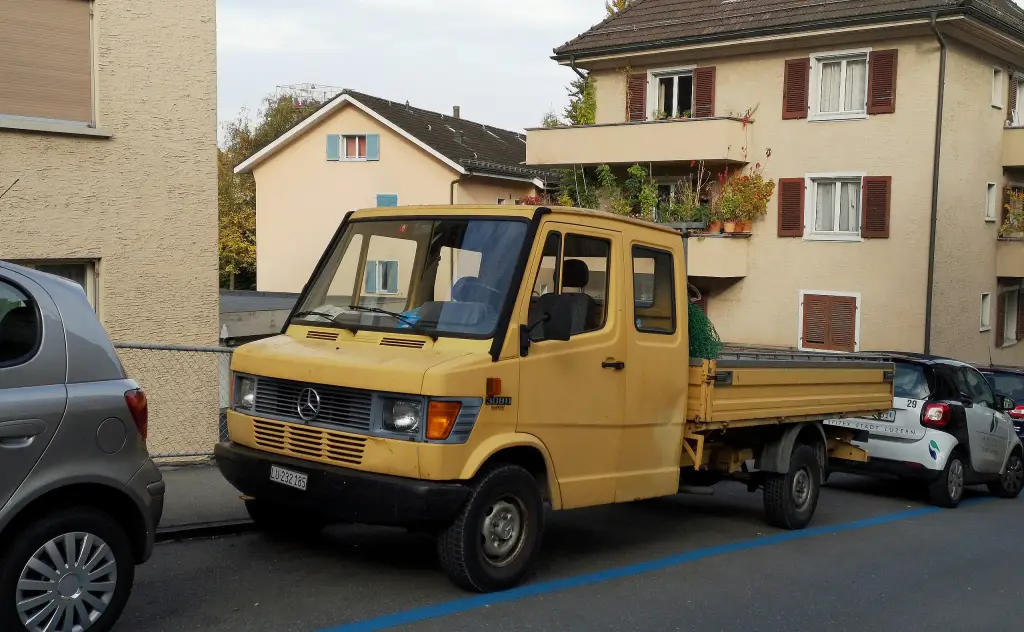
The first models, launched in April 1977, were the 207 D, 208, 307 D and 308. The 207 D and 307 D used the 2.4-litre OM616 four-cylinder diesel of 65 PS, the same engine as in the W123 240 D and W460 240 GD, while the 208 and 308 had the 2.3-litre M115 petrol four of 85 PS. Almost 90 per cent of buyers chose the diesel, which was preferred for its low fuel consumption and reliability; petrol versions were used mainly for ambulances, fire engines and vans for cold regions. In Britain only diesels were offered at first, and sales were poor in a market that was 80 per cent petrol; petrol models were added in 1982 and sales immediately rose by 80 per cent.
In September 1981 the 407 D, 409 D and 410 were added with a gross weight of 4,600 kg. The 409 D had a larger five-cylinder diesel of 2,998 cc and 88 PS, the OM617 also used in the 300 D and the 300 GD. Later the OM616 received a modified cylinder head and a slightly smaller bore, 2,399 cc instead of 2,404, with 72 bhp and a five-speed gearbox instead of four speeds. In autumn 1988 two new diesels, the OM 601/23 and OM 602/29, were introduced and won the Diesel 1989 award. About 970,000 Bremer Transporter were built in 18 years.
Design and features
- Three wheelbases: from 2.55 to 4.6 tonnes gross weight.
- Diesel following: about 90 per cent of buyers chose the diesel.
- Many bodies: minibus, panel van, flatbed and double cab.
- Conversions: campervans and Iglhaut four-wheel-drive versions.
Mercedes-Benz T1 versions
- 207 D, 208, 307 D and 308 (1977): the first models.
- 407 D, 409 D and 410 (1981): the 4.6-tonne versions.
- OM 601 and OM 602 cars (1988): with the newer diesels.
- Iglhaut 4×4: all-wheel drive using G-Wagen parts.
The T1 was replaced by the Sprinter and was followed in size by the T2. More in the Mercedes-Benz collection.
Sources
- Mercedes-Benz TN, English Wikipedia: models, engines, weights, production