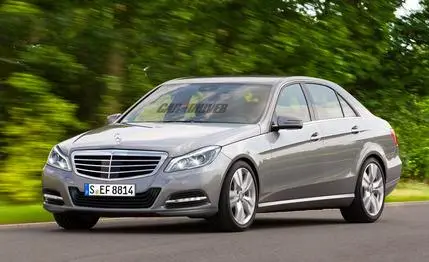
The Mercedes-Benz E-Class is a range of executive cars produced since September 1953. It sits in the middle of the Mercedes-Benz range and has been sold worldwide in five generations under that name, and in many more models before it.
Mercedes-Benz E-Class at a glance
| Produced since | September 1953 |
|---|---|
| Position | middle of the Mercedes-Benz range |
| Generations under the E-Class name | five |
| Sold by 2023 | more than 16 million |
| Earlier name | the E suffix meant Einspritzmotor, fuel injection |
| E-Class name adopted | July 1993, with the facelifted W124 |
| Drive | rear-wheel drive or 4MATIC four-wheel drive |
| Early bodies | saloon, estate, coupé and convertible |
| Coupé and convertible 1997–2009 | sold as the CLK-Class |
| Latest platform | W213, shared by all body styles |
| Award | 2021 Motor Trend Car of the Year for the W213 |
This article is based on one source, the English Wikipedia article on the Mercedes-Benz E-Class. Free photographs of the E-Class were not found, so the record keeps its earlier picture.
History of the Mercedes-Benz E-Class
The E-Class name was adopted in July 1993 for the second facelift of the W124, when Mercedes-Benz began sorting its products into classes. Before that, the letter E had meant Einspritzmotor, fuel injection, as in the 1970s when injection spread beyond the luxury models. Mercedes-Benz traces the line back further, to the pre-war W136 170 V that restarted production after 1946, and further still to the W15 170, the W21 200 and the diesel W138 260D.
The line’s modern history began with the W120 Ponton 180 of 1953, which shared its engineering with the R121 190 SL and ran until 1962. The W110 Fintail of 1961 added tail fins and gained a straight-six in the 1965 230 model. The W114 and W115 of 1968 were known as the Stroke-8; the six-cylinder W114 was the more common, the W115 formed the bottom of the range with four- and five-cylinder engines, and a coupé joined in 1969 as the first mid-range Mercedes with D-Jetronic injection. The W123 of 1975 became a best seller: more than 2.6 million were built until 1986, especially as the 240 D and 300 D diesels, in saloon, coupé and estate form.
The W124 arrived in November 1984 with production from January 1985, bringing 4MATIC four-wheel drive, twin-cam cylinder heads and catalytic converters. From 1997 to 2009 the coupé and convertible versions were sold as the CLK-Class on C-Class underpinnings, a pattern repeated with the C207 E-Class coupé and convertible sold alongside the W212. With the W213 of 2017 all body styles shared one platform. The E-Class has been used as taxis, police cars and ambulances, and in November 2020 the W213 won the 2021 Motor Trend Car of the Year award, the first for Mercedes-Benz.
Design and features
- Long history: from the 180 Ponton of 1953 to the W213.
- Best seller: more than 16 million cars sold by 2023.
- Wide choice: saloons, estates, coupés and convertibles over the years.
- 4MATIC: four-wheel drive offered on every generation.
Mercedes-Benz E-Class versions
- W120 (1953): the Ponton 180.
- W110 (1961): the Fintail.
- W114 and W115 (1968): the Stroke-8.
- W123 (1975): more than 2.6 million built.
- W124 (1984): the first car to carry the E-Class name.
- W213 (2017): one platform for all body styles.
The E-Class sits between the C-Class and the S-Class, and its earlier generations have their own pages, such as the W123. More in the Mercedes-Benz collection.
Video: 2014 Mercedes-Benz E-Class production
Video by YouTube on YouTube.
Sources
- Mercedes-Benz E-Class, English Wikipedia: history, generations, naming, sales