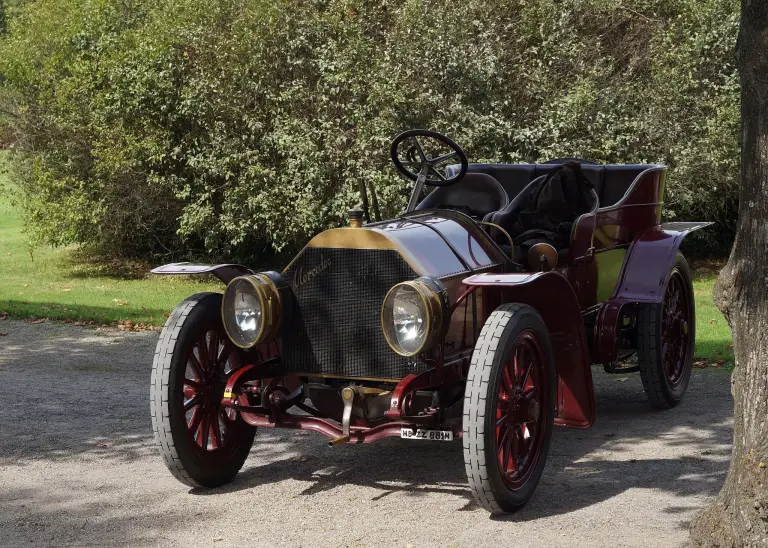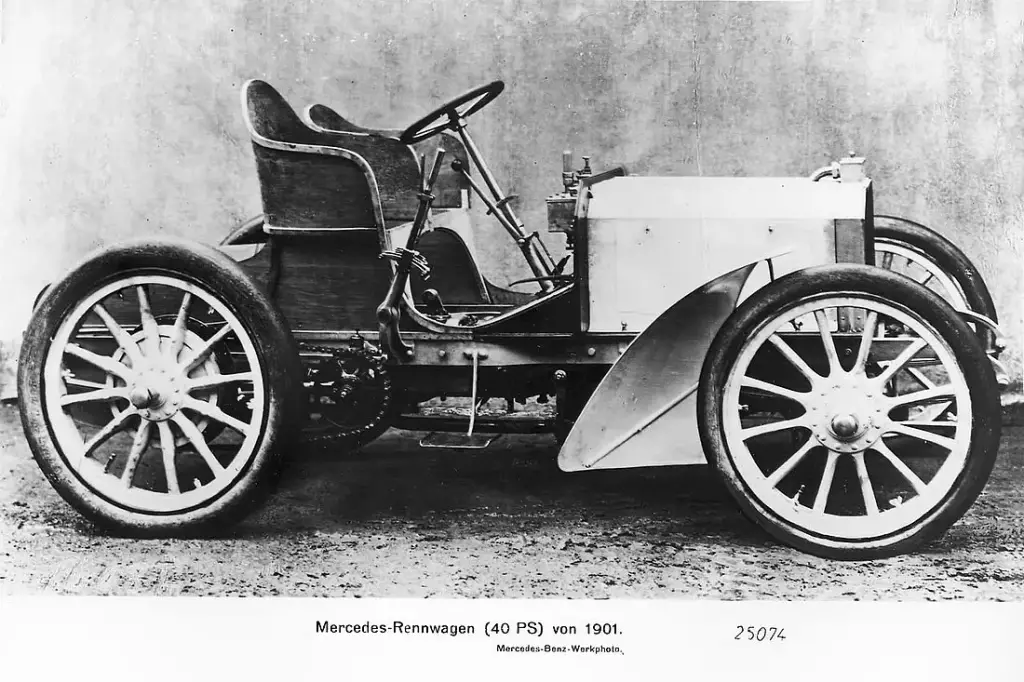
The Mercedes 35 hp, known in German as the Mercedes 35 PS, was a car of 1901 designed by Wilhelm Maybach and Paul Daimler for Emil Jellinek. Built in Stuttgart by Daimler-Motoren-Gesellschaft, it began the Mercedes line of cars, which was renamed Mercedes-Benz in 1926.
Mercedes 35 hp at a glance
| Introduced | 1901 |
|---|---|
| Designers | Wilhelm Maybach and Paul Daimler |
| Built by | Daimler-Motoren-Gesellschaft, Stuttgart |
| Engine | petrol, 35 PS (26 kW) |
| Wheelbase | 2,345 mm |
| Track | 1,400 mm |
| Weight | 1,200 kg |
| Engine weight | 230 kg |
| Road speed | 70–75 km/h |
| Racing top speed | about 86 km/h |
| Wheels | wooden, twelve spokes, pneumatic tyres |
| Order | 36 cars for 500,000 marks |
This article is based on one source, the English Wikipedia article on the Mercedes 35 hp.
History of the Mercedes 35 hp
By 1900 Wilhelm Maybach was chief engineer of Daimler-Motoren-Gesellschaft, the company built on the Cannstatt workshop he had run with Gottlieb Daimler. Gottlieb Daimler died that year and his son Paul took his place beside Maybach. The customer behind the new model was Emil Jellinek, a wealthy Austrian businessman and diplomat living in Nice, who sold DMG cars and raced them under the name of his daughter Mercédès. After a DMG mechanic was killed in the Nice–La Turbie race of March 1900, the company withdrew from motorsport, but Jellinek persuaded it to build a new car and to name it after his daughter.
Jellinek asked for a car unlike the motorised carriages of the day: longer, wider and with a lower centre of gravity. Maybach gave it a frame of pressed steel with a U-shaped section, mounted the engine over the front axle without extra subframes and kept the whole car down to 1,200 kg. Maybach tested the car for the first time on 22 November 1900 and Jellinek received his first example on 22 December. In March 1901 five of the cars started in Nice–La Turbie and dominated the race, averaging 51.4 km/h against the previous 31.3 km/h and reaching 86 km/h.
The result impressed the motoring world; Paul Meyan of the French Automobile Club remarked that motoring had entered the Mercedes era. DMG built two further models, the 12/16 hp and the 8/11 hp, between March and August 1901, and the Mercedes trademark was used on its cars from 23 June 1902 and formally registered on 26 September 1902. In June 1903 Jellinek changed his own name to Jellinek-Mercedes.
Design and features
- Pressed-steel frame: a light chassis of U-shaped section instead of a strengthened carriage.
- Low centre of gravity: the engine sat directly over the front axle, close to the ground.
- Two brake systems: a hand brake on the rear drums and a water-cooled foot brake on the chain-drive shaft.
- Tuned for racing and road: the racing version exceeded 85 km/h while road cars ran at 70–75 km/h.
Mercedes 35 hp versions
- Racing car (1901): the version that won at Nice–La Turbie.
- Road car: with a body for normal use and a top speed of about 75 km/h.
- Family version: DMG added two rear seats in Stuttgart.
- Later models: the 12/16 hp and 8/11 hp of 1901.
The 35 hp was followed by the Mercedes Simplex of 1902, which carried the same ideas further. More early cars are in the Mercedes-Benz collection.
Sources
- Mercedes 35 hp, English Wikipedia: design, dimensions, races, prices