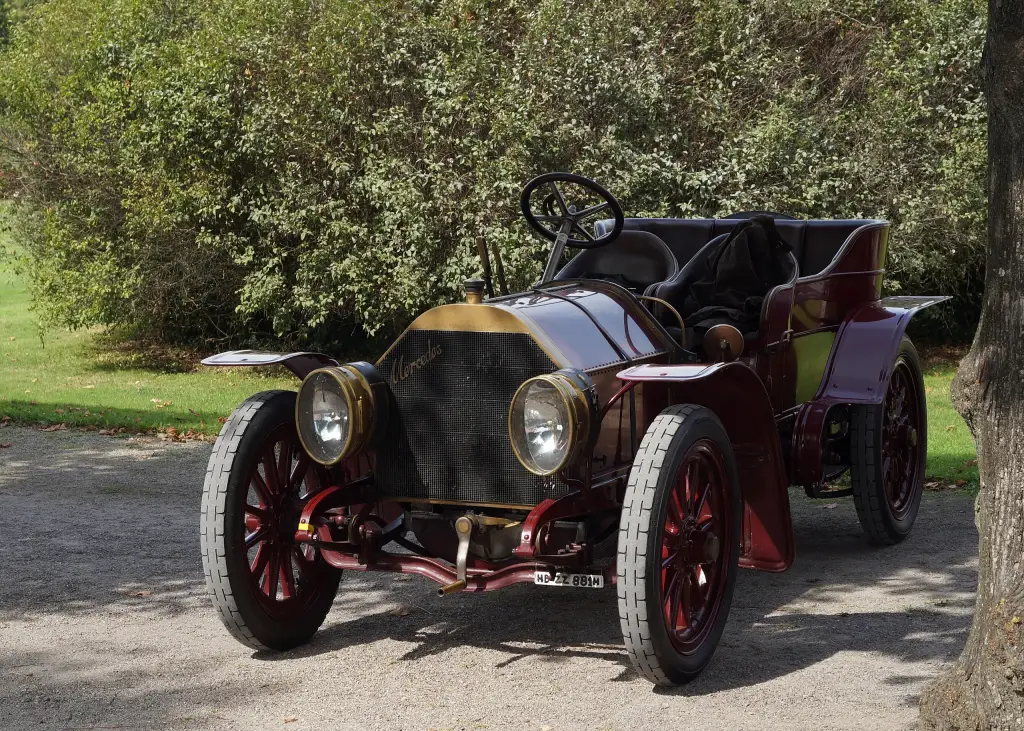
The Mercedes Simplex was an automobile built from 1902 to 1909 by Daimler-Motoren-Gesellschaft, the predecessor of Daimler-Benz. Designed by Wilhelm Maybach, it continued the use of the Mercedes name and offered engines from 40 to 60 hp.
Mercedes Simplex at a glance
| Production | 1902–1909 |
|---|---|
| Maker | Daimler-Motoren-Gesellschaft, Stuttgart |
| Designer | Wilhelm Maybach |
| Engine | four-cylinder, 6,786 cc, 44 hp at 1,300 rpm |
| Power range | 40 to 60 hp |
| Wheelbase | 2.45 m |
| Weight | 942 kg |
| Gearbox | four-speed gate change plus reverse |
| Drive | long roller chain to the rear axle |
| Wheels | wooden with twelve spokes; cast steel from 1905 |
| Notable model | Simplex 60 hp of 1903 |
This article is based on one source, the English Wikipedia article on the Mercedes Simplex.
History of the Mercedes Simplex
The Simplex followed the Mercedes 35 hp of 1901, which had already broken with the motorised-carriage layout. DMG and Maybach wanted to go further and offered what they called comfort by means of simplicity, hence the name. A second explanation is that, by the standards of 1901, the car was very simple to operate. The large, wide body had a low centre of gravity and the frame was made of pressed steel with the engine welded to it directly, which helped to keep the weight down to 942 kg.
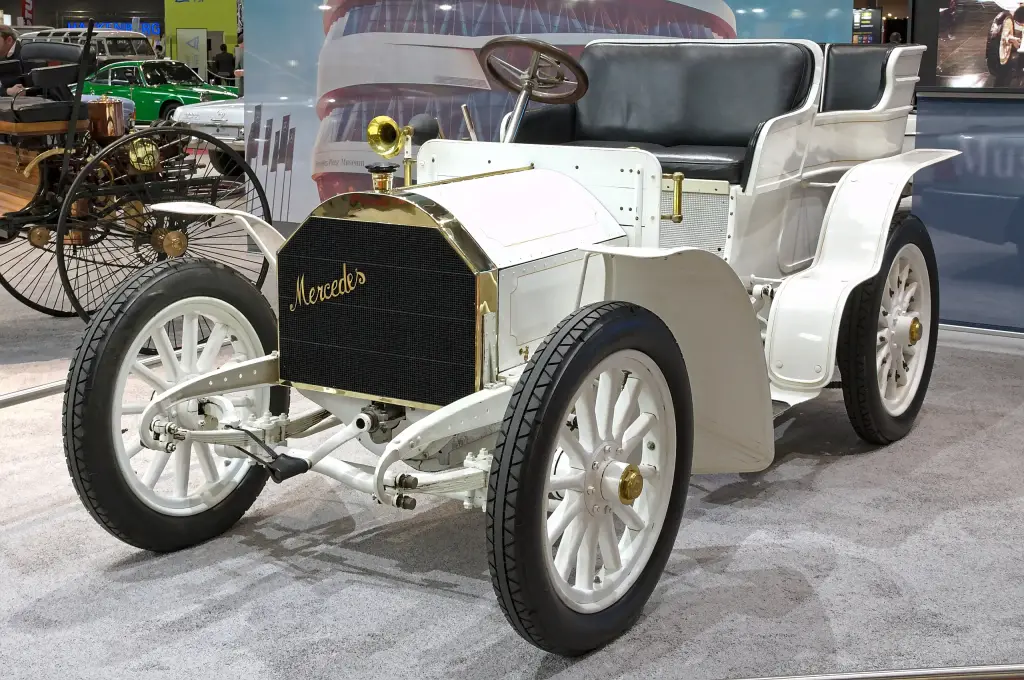
The new car was a success in racing as well as in the showroom. Jellinek received his first Simplex on 1 March 1902 at Nice and entered it in the Nice–La Turbie hillclimb, where it won again. In April 1902 Albert Lemaître finished second in the Nice–La Turbie mountain race, and the same year a Simplex won a five-mile track race at Grosse Pointe near Detroit. The American millionaire William K. Vanderbilt Jr broke records with the car, reaching 111.8 km/h over a flying start between Ablis and Chartres; one of his Simplex cars is the oldest surviving Mercedes.
In 1903 Maybach designed a second version with 60 hp. The model became the foundation of the super-luxury class: a large touring saloon unlike anything else of its time, bought by royalty and aristocrats and the ancestor of later flagship Mercedes models. In 1905 the Simplex pioneered cast-steel wheels, and by about 1909 the front and rear wheel sizes had been made equal. Kaiser Wilhelm II admired the car at the Berlin automobile exhibition of 1903, remarking that the engine was beautiful but that the car was not as simple as its name suggested.
Design and features
- Pressed-steel frame: long, wide and low, with the engine mounted directly on it.
- Chain drive: power left the engine through a 60 cm sprocket flywheel and a long roller chain.
- Four-speed gate gearbox: with reverse and a coil-spring clutch worked together with the brake lever.
- Two water-cooled brakes: a hand brake on the rear drums and a foot brake on the intermediate shaft.
Mercedes Simplex versions
- Simplex 40 hp (1902): the original model with the 6,786 cc four-cylinder engine.
- Simplex 60 hp (1903): the second, larger version designed by Maybach.
- Racing cars: lightened cars with a small screen used by Jellinek’s team.
- Cast-steel wheel cars: from 1905.
The Simplex came directly from the Mercedes 35 hp of 1901 and was followed by the rear-engined 130 three decades later. More in the Mercedes-Benz collection.
Video: Mercedes-Benz Simplex and Friends
Video by YouTube on YouTube.
Sources
- Mercedes Simplex, English Wikipedia: history, races, dimensions, engine